The practical answer
- Short answer
- Learn why 'innovation theater' kills deal value and how to present a product roadmap that drives premium multiples. 2026 M&A benchmarks and 3-slide framework.
- Best fit
- Industry: B2B SaaS & Services. Function: Product Management
- Operating path
- Exit Readiness → Operational Excellence → Transaction Advisory Services
- Key metric
- 34% Median R&D spend as % of revenue for high-growth private SaaS companies (Benchmarkit 2025).
The 'Innovation Theater' Trap: Why Your Visionary Roadmap Scares Buyers
When founders stand before a Private Equity investment committee, they naturally default to 'Visionary Mode.' They present a roadmap packed with Generative AI agents, blockchain integrations, and market-shifting features intended to justify a premium valuation multiple. They believe they are selling potential.
The buyer, however, is buying predictability. While you are presenting a feature wish list, the PE Operating Partner is mentally calculating the 'Liability Score' of your roadmap. They aren't asking 'How cool is this?' They are asking: 'How much technical debt is hiding behind these promises? How many of these features are contractually committed to close the Q4 pipeline? And why is R&D spend at 12% of revenue when the benchmark for high-growth private SaaS is 34%?'
Significant research from 2025 due diligence cycles reveals that unrealistic product roadmaps are a primary driver of the 15-20% valuation re-trade that occurs between LOI and close. When a buyer discovers that your 'AI Roadmap' is actually 'Vaporware'—unsupported by engineering capacity or technical architecture—they don't just cut the roadmap; they cut the deal price. To protect your exit, you must pivot your presentation from 'Innovation Theater' to 'Capital Deployment Reality.'
A roadmap in due diligence isn't a marketing brochure; it's a capital allocation request. If you can't prove the ROI of every feature, you're just handing the buyer a reason to lower the price.
The 3-Slide Framework: How to Present a Defensible Roadmap
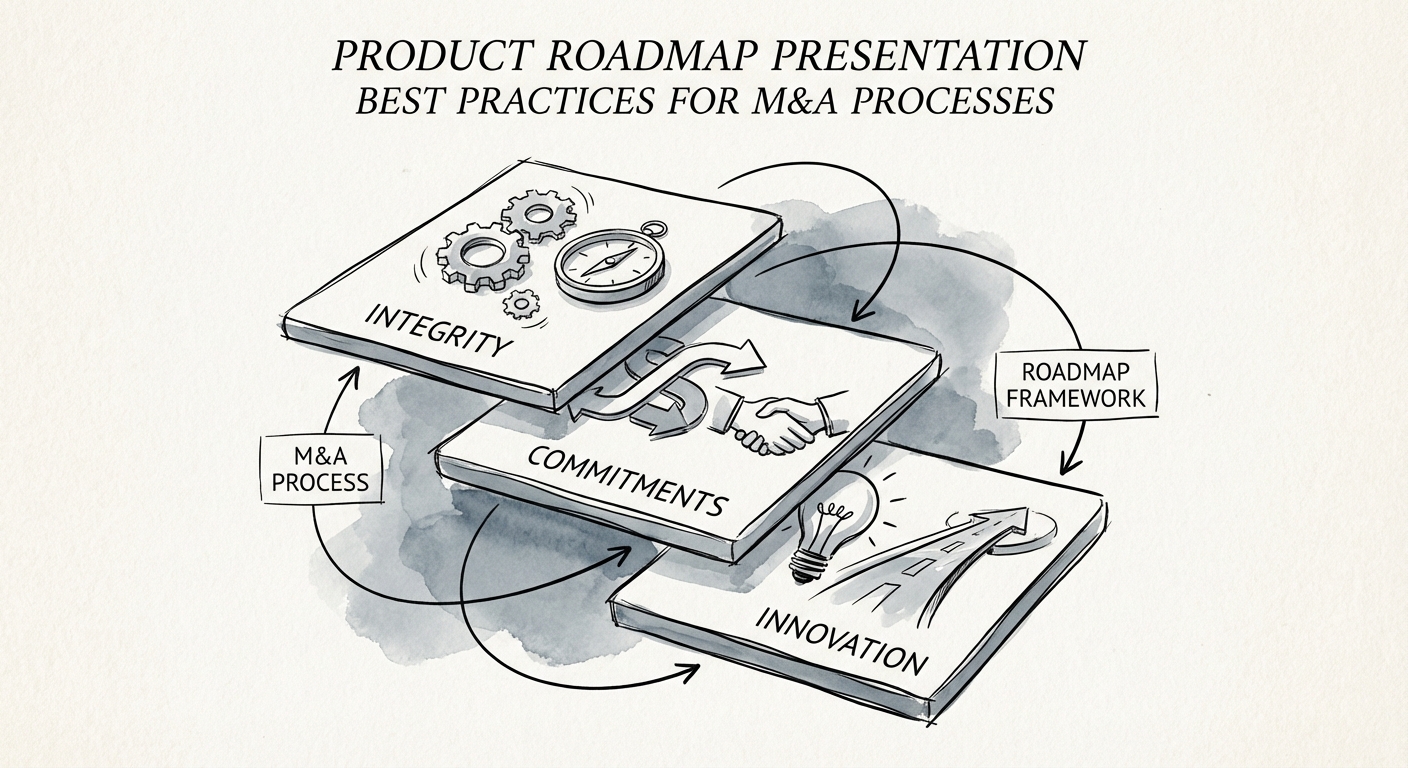
Stop presenting a 12-month Gantt chart that you know is a lie. Instead, structure your product presentation into three distinct layers that align with the buyer's risk/reward calculus. This 'Defensible Roadmap' structure proves you have command over your technical reality.
Slide 1: The Integrity Roadmap (Keep the Lights On)
This is the slide most founders hide, but it is the one buyers respect most. Explicitly show the 20-30% of engineering capacity allocated to paying down technical debt, security patching, and infrastructure upgrades. This signals operational maturity. It tells the buyer, 'I know my house needs maintenance, and I have budgeted for it.' If you claim 100% of capacity is for new features, the buyer assumes your code is rotting.
Slide 2: The Commitments Roadmap (Protect Revenue)
Map specific roadmap items to specific revenue outcomes. 'We are building Feature X because Customer Y (contract value $1.2M) requires it for renewal in Q3.' This transforms your roadmap from a 'nice-to-have' list into a revenue-protection mechanism. Buyers love this because it de-risks the existing ARR base. It demonstrates that your product strategy is tethered to commercial reality, not just engineering curiosity.
Slide 3: The Innovation Roadmap (The Upside Case)
Only after you have secured the base do you present the growth levers. But here is the key: Tie every innovation bet to a specific Technical Feasibility Score. Don't just say 'AI Analytics.' Say 'AI Analytics: Prototype complete, architecture validated, data pipeline ready, requires $500k incremental investment.' This shifts the conversation from 'Is this real?' to 'Do we want to fund this?'—which is exactly where you want the negotiation to be.
Validating R&D Efficiency: The 'Code vs. Claims' Audit
In 2026, diligence is algorithmic. Buyers are no longer taking your word for it; they are connecting their code scanning tools (like Black Duck or SonarQube) to your repositories to validate your roadmap claims. They are looking for the 'gap' between your presentation and your commit history.
If your presentation claims a heavy focus on 'Enterprise Security,' but your commit logs show 80% of effort going toward 'UI/UX Refresh,' you have a credibility problem. This mismatch suggests a lack of strategic alignment between the boardroom and the engine room. To prepare, conduct your own 'R&D Efficiency' audit before the buyer does. Ensure your technical debt ratios align with your stage, and verify that your engineering allocation actually mirrors the strategic priorities you are presenting. A boring, predictable roadmap that executes on time is worth 2x more than a visionary roadmap that misses every deadline.