The practical answer
- Short answer
- Generalist Salesforce partners trade at 8x EBITDA. CPQ and Revenue Cloud specialists command 14x. Here is the diagnostic on why niche expertise drives exit value.
- Best fit
- Industry: Tech Services / Private Equity. Function: M&A / Corporate Strategy
- Operating path
- Exit Readiness → Operational Excellence → Transaction Advisory Services
- Key metric
- 14x Average EBITDA multiple for high-performing CPQ/Revenue Cloud specialist firms in 2025, compared to 8x for generalists.
The "Generalist Trap" vs. The Revenue Architecture Moat
In the Salesforce partner ecosystem, there are two distinct economies. The first is the commoditized world of "Sales Cloud Generalists." These firms, often stuck between $5M and $15M in revenue, sell capacity. They augment staffing, clear ticket backlogs, and trade at 6x to 8x EBITDA. They are valuable, but they are not strategic assets. They are easily replaced.
The second economy belongs to the Revenue Cloud Specialists. These firms do not sell hours; they sell the ability to transact. They handle the "quote-to-cash" infrastructure—CPQ (Configure, Price, Quote), Billing, and Subscription Management. In 2025 and moving into 2026, we are seeing these specialist firms trade at 12x to 15x EBITDA. Why the massive delta? Because while a broken Sales Cloud implementation is an annoyance, a broken CPQ implementation is an existential threat.
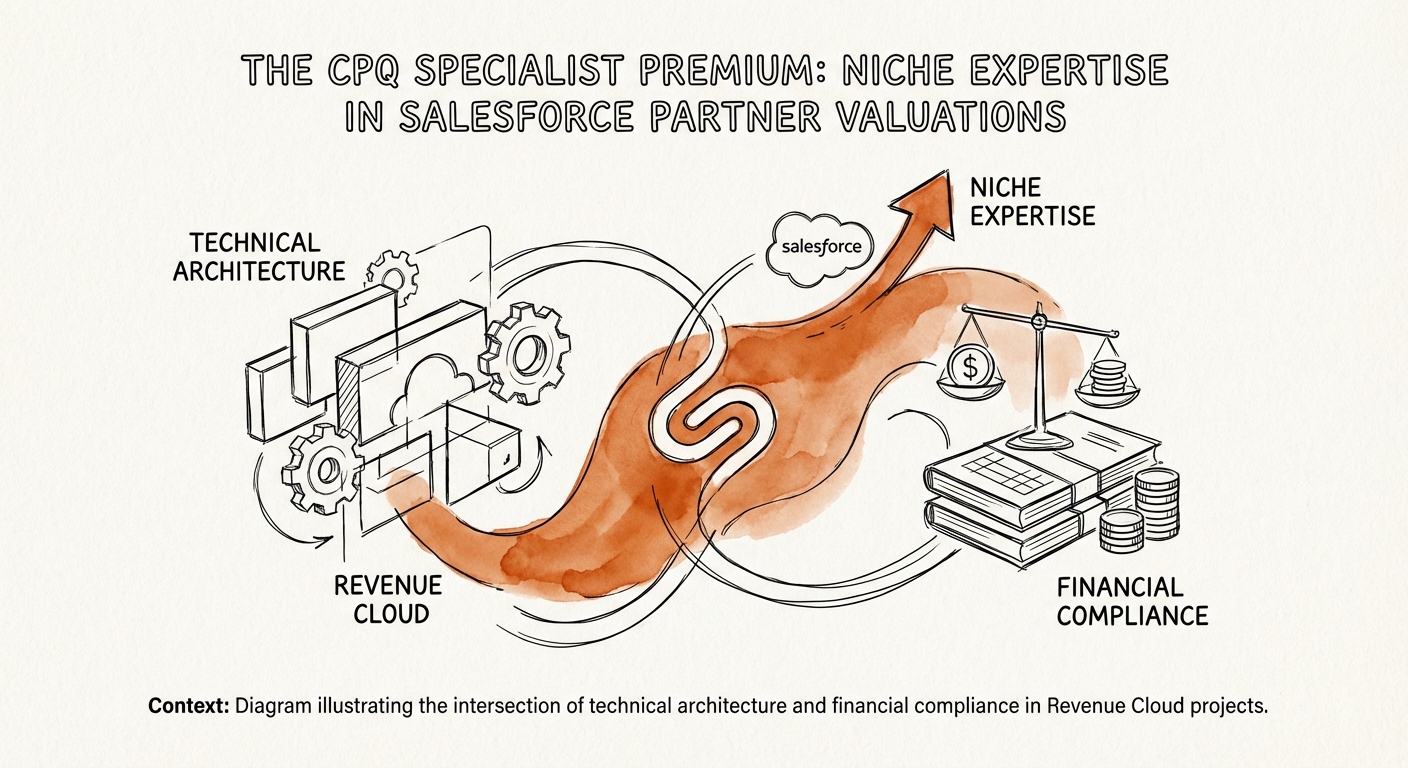
For founders, the path to a premium exit isn't adding more headcount to service more tickets. It is narrowing the focus to where the risk—and therefore the value—is highest. Private Equity buyers are currently paying a premium for firms that understand the intersection of technical architecture and financial compliance (ASC 606). If your firm speaks fluent EBITDA and fluent CPQ object models, you are no longer a service provider. You are a risk mitigation asset.
A broken Sales Cloud implementation is an annoyance. A broken CPQ implementation is an existential threat. That risk profile is why specialists command a 14x multiple.
The "Heart Surgery" of the Enterprise: Why Complexity Drives Value
Why do acquirers pay nearly double the multiple for CPQ expertise? Because CPQ is the heart surgery of the enterprise tech stack. A generalist firm can fumble a generic CRM field update with minimal consequence. But if a CPQ partner misconfigures a price rule or a revenue recognition schedule, the client cannot send invoices. Cash flow stops. The stakes are absolute.
The market data reflects this risk premium. Industry benchmarks indicate that 70% of digital transformation projects fail to meet their original objectives, but the failure rate for CPQ implementations specifically is often driven by data quality and process misalignment rather than software bugs. Generalists fail at CPQ because they treat it as a technical installation problem. Specialists succeed because they treat it as a Revenue Architecture problem.
This specialization creates a defensive moat around your valuation. A generalist billing $175/hour is competing with thousands of other firms and offshore resources. A CPQ specialist billing $275/hour (or fixed-fee equivalents) faces far fewer credible substitutes because the cost of failure is too high for the client to choose the low bidder. When we audit Salesforce consultancies for PE due diligence, we look for this specific "Revenue Intelligence." We ask: Do you understand consumption modeling? Can you architect for multi-year ramp deals? If the answer is yes, your EBITDA is worth significantly more because it is defensible.
The Pivot: From "Admin for Hire" to "Revenue Architect"
For the founder stuck at $15M revenue, the pivot to a specialist model requires a fundamental shift in how you package your services. You cannot simply "add CPQ" to your line card. You must build a methodology that bridges the gap between the CIO and the CFO.
1. Stop Selling "Implementation"
Start selling "Revenue Compliance" and "Transaction Velocity." Your value proposition isn't that you know how to install the package; it's that you ensure the client's ARR reporting is audit-ready on Day 1. This re-positioning allows you to move upstream to the Office of the CFO.
2. Productize Your IP
The highest multiples go to firms that bring accelerators—pre-built product bundles, pricing rule libraries, or documented integration frameworks for ERPs like NetSuite or SAP. This proves to a buyer that your revenue isn't solely dependent on the genius of your lead architect (who might leave post-close).
3. Audit Your Revenue Mix
If 80% of your revenue comes from "Staff Augmentation" and only 20% from "Strategic Projects," your valuation will be dragged down to the lowest common denominator. Actively fire low-margin, high-churn generic work. Re-deploy those resources into training for Revenue Cloud certifications. A smaller, specialized firm with $12M revenue and 25% EBITDA margins is worth significantly more than a $20M generalist firm with 10% margins.
The window to claim this "Specialist Premium" is open, but as AI agents begin to commoditize basic configuration tasks, only the firms handling the complex logic of revenue will remain defensible. Choose your lane now.