
The practical answer
- Short answer
- Why generalist AWS partners trade at 6x EBITDA while DevOps specialists command 12x. A diagnostic guide for founders on unlocking the specialization premium.
- Best fit
- Industry: Technology Services. Function: Corporate Strategy / M&A
- Operating path
- Exit Readiness → Operational Excellence → Transaction Advisory Services
- Key metric
- 12x Target EBITDA multiple for DevOps specialists with proprietary IP and >30% recurring revenue.
The Great Bifurcation: 6x vs. 12x
In 2021, you could put "AWS Partner" on your website and command a 10x EBITDA multiple. Demand for cloud migration was insatiable, and capacity was the only constraint. If you had available engineers with "Associate Solutions Architect" certificates, you were a hot asset.
That market is dead.
As we entered 2026, the AWS partner ecosystem has undergone a brutal bifurcation. On one side, we have the Generalist Implementers: firms doing "lift and shift" migrations, general staff augmentation, and responding to every RFP that mentions "cloud." These firms are currently trading at 5x to 7x EBITDA. They are viewed as commodities—basically IT staffing agencies with better branding.
On the other side, we have the DevOps Specialists: firms that don't just "move" workloads but modernize delivery pipelines. They focus on Platform Engineering, GitOps, and Internal Developer Platforms (IDPs). These firms are trading at 10x to 14x EBITDA.
Why the massive gap? It comes down to Embeddedness and Leverage. A generalist migrates a workload and leaves. A DevOps specialist builds the factory that the client uses to build software every day. Once you own the deployment pipeline, you are impossible to rip out. That stickiness translates directly to valuation.
The Math of the Premium
Run the unit economics. Generalist firms are suffering from a "Body Shop Discount." With billable utilization rates across the industry dropping to a dangerous 68.9% in 2025, generalists are seeing their margins erode as they carry expensive benches waiting for the next migration project. Their revenue is lumpy, project-based, and restarts at zero every January 1st.
Specialists, conversely, are seeing referral conversion rates 3.4x higher than generalists. Why? Because they solve expensive, specific problems (e.g., "Fix our failed Kubernetes rollout") rather than generic ones ("Help us with cloud"). This efficiency lowers CAC (Customer Acquisition Cost) and drives EBITDA margins toward the 25%+ "Elite" benchmark, justifying the double-digit multiple.
The generalist DevOps consultant no longer commands a premium. The specialist is doing fine. If you are just renting out engineers by the hour, you are a staffing firm valued at 5x. If you own the platform, you're a strategic asset valued at 12x.
The "Fake" Specialist vs. The Real Deal
Private Equity buyers have become sophisticated. They know that every IT services firm lists "DevOps" on their capabilities slide. In due diligence, we use a specific set of diagnostics to separate the "Fake Specialists" (generalists in disguise) from the high-value targets. If you are a founder looking to exit, you need to know what we look for.
1. The Certification Ratio
A generalist shop boasts about having "50 AWS Certified Engineers." We dig deeper. If 45 of those are Associate level and only 5 are Professional or Specialty (e.g., DevOps Engineer Professional, Security Specialty), you are a body shop. You are hiring juniors and billing them out. A Specialist firm typically maintains a 1:3 ratio of Professional/Specialty to Associate certs. This signals deep technical competency, not just exam-cramming.
2. The IP Litmus Test
Ask a generalist, "How do you set up a landing zone?" and they will show you a resume of a Senior Architect. Ask a Specialist, and they will show you a Repo. Real value lies in "Productized Service Delivery"—pre-built Terraform modules, proprietary control plane configurations, or an "Accelerator" framework that cuts setup time by 40%.
If your "IP" walks out the door every evening at 5 PM, you don't have a DevOps practice; you have a staffing agency. Buyers pay for the code that stays in the building.
3. The Revenue Mix: Managed vs. Project
The biggest valuation killer for DevOps shops is the "Project Trap." You build the CI/CD pipeline, hand over the keys, and the revenue stops. The top-quartile firms (trading at 12x+) have pivoted to Managed DevOps or Platform-as-a-Service (PaaS) models. They charge a monthly subscription to maintain, patch, and optimize the toolchain. If your recurring revenue is less than 30% of total revenue, you will struggle to break the 8x multiple ceiling.
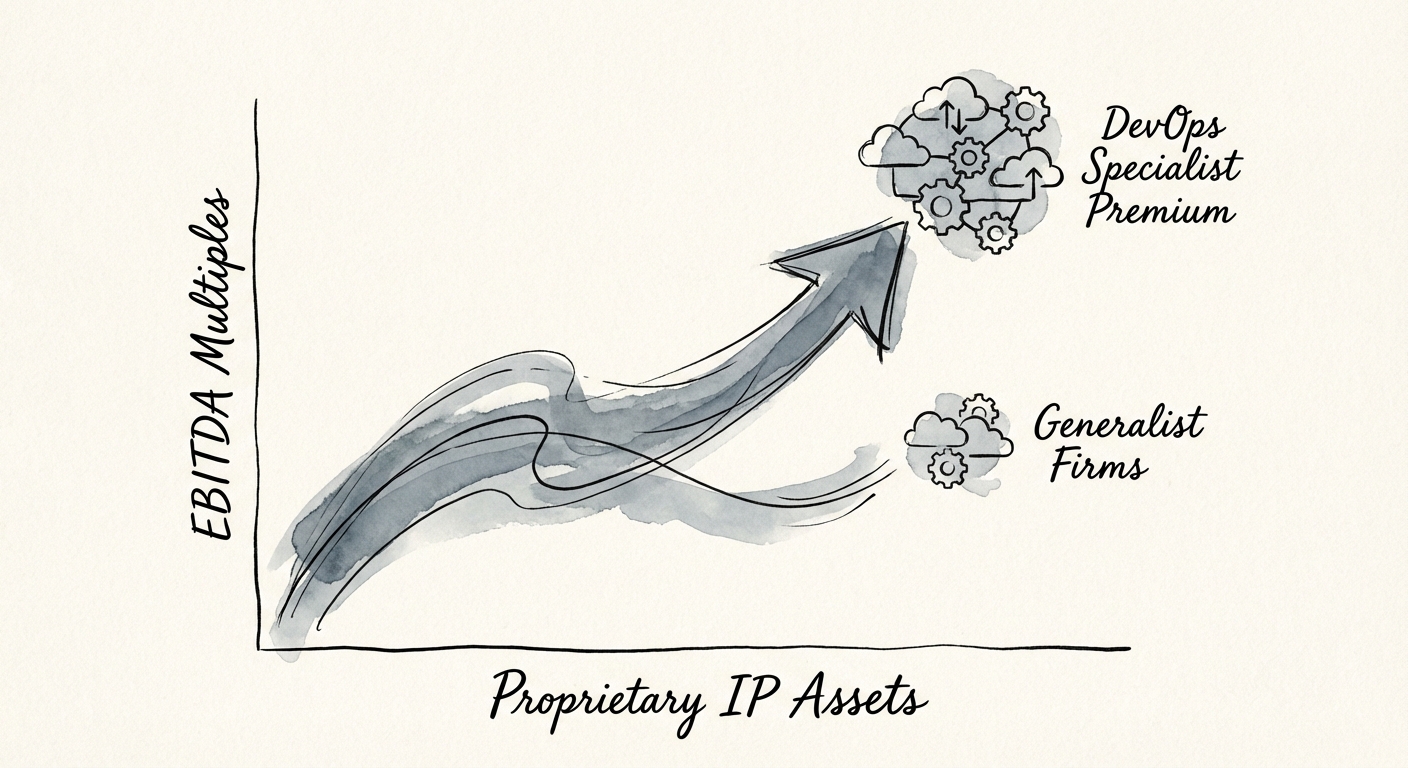
The Transition: From Generalist to Premium
If you are currently a generalist AWS partner, you are leaving 50% of your exit value on the table. The good news is that the pivot is possible, but it requires breaking the "Yes to Everything" habit.
Step 1: Pick a Lane (and Kill the Rest). You cannot be the best at AWS Migration, Data Lakes, and DevOps. The data shows that Data Infrastructure and DevOps are the two highest-value niches in 2025/2026. Stop responding to RFPs for generic web app hosting. Rebrand your case studies around modernization and velocity, not just "cost savings."
Step 2: Productize Your Knowledge. Take your last five successful projects and extract the common code. Package it. Name it. (e.g., "The FinTech Compliance Landing Zone"). This shifts the sales conversation from "We have smart people" (commodity) to "We have a proven platform" (asset).
Step 3: Fix Your Utilization. You cannot scale a specialist firm with generalist utilization metrics. If your team is billing 68%, you are wasting cash. But in a specialist model, "bench time" isn't idle time—it's R&D time for your IP. Reclassify that non-billable time as "Product Development" (CAPEX) to defend your EBITDA adjustments in due diligence.
The window to exit as a generic "Cloud Consultant" has closed. The market is shouting that it wants engineering, not administration. Listen to it.