
The practical answer
- Short answer
- Why Microsoft Dynamics 365 CE practices trade at 10-12x EBITDA while F&O generalists lag at 6-8x. A valuation diagnostic for scaling founders.
- Best fit
- Industry: Technology Services. Function: M&A Strategy
- Operating path
- Exit Readiness → Operational Excellence → Transaction Advisory Services
- Key metric
- 12x Target EBITDA multiple for specialized Dynamics CE practices with >40% managed services revenue.
The Valuation Gap: Revenue Engines vs. Cost Centers
In the 2025 M&A landscape, not all Microsoft Dynamics revenue is created equal. While a dollar of EBITDA looks the same on a P&L, private equity buyers are assigning vastly different risk profiles—and therefore multiples—to Customer Engagement (CE) practices versus Finance & Operations (F&O) shops. The data is stark: Specialized CE practices are trading at 10x-12x EBITDA, while generalist or ERP-heavy firms are stuck in the 6x-8x range.
Why the discrepancy? It comes down to what you actually sell. F&O practices sell efficiency—long, waterfall-style implementations that replace back-office plumbing. These projects are high-risk, high-complexity, and often suffer from the "18-month cliff" where integration failures surface. They are cost centers for the client, meaning budget scrutiny is intense.
CE practices, conversely, sell revenue. When you implement Dynamics Sales or Marketing, you are directly tying your services to the client's top-line growth. In the eyes of a PE sponsor, a CE practice isn't just an IT services firm; it's a Revenue Operations (RevOps) enabler. This distinction shifts the valuation methodology from "staff augmentation" (low multiple) to "digital growth platform" (high multiple).
Furthermore, the delivery model for CE has evolved into high-velocity, low-code deployments leveraging the Power Platform. This allows for faster time-to-value, higher recurring revenue attachment (through managed services), and a lower risk of catastrophic project failure compared to multi-year ERP migrations. If you are a "Dynamics Generalist" mixing these two revenue streams, you are likely suffering from the "Conglomerate Discount"—where buyers apply the lower F&O multiple to your entire business.
You are selling a Ferrari engine inside a dump truck chassis. If you market high-velocity CE services as just another part of a heavy ERP portfolio, you will get the 'heavy' multiple every time.
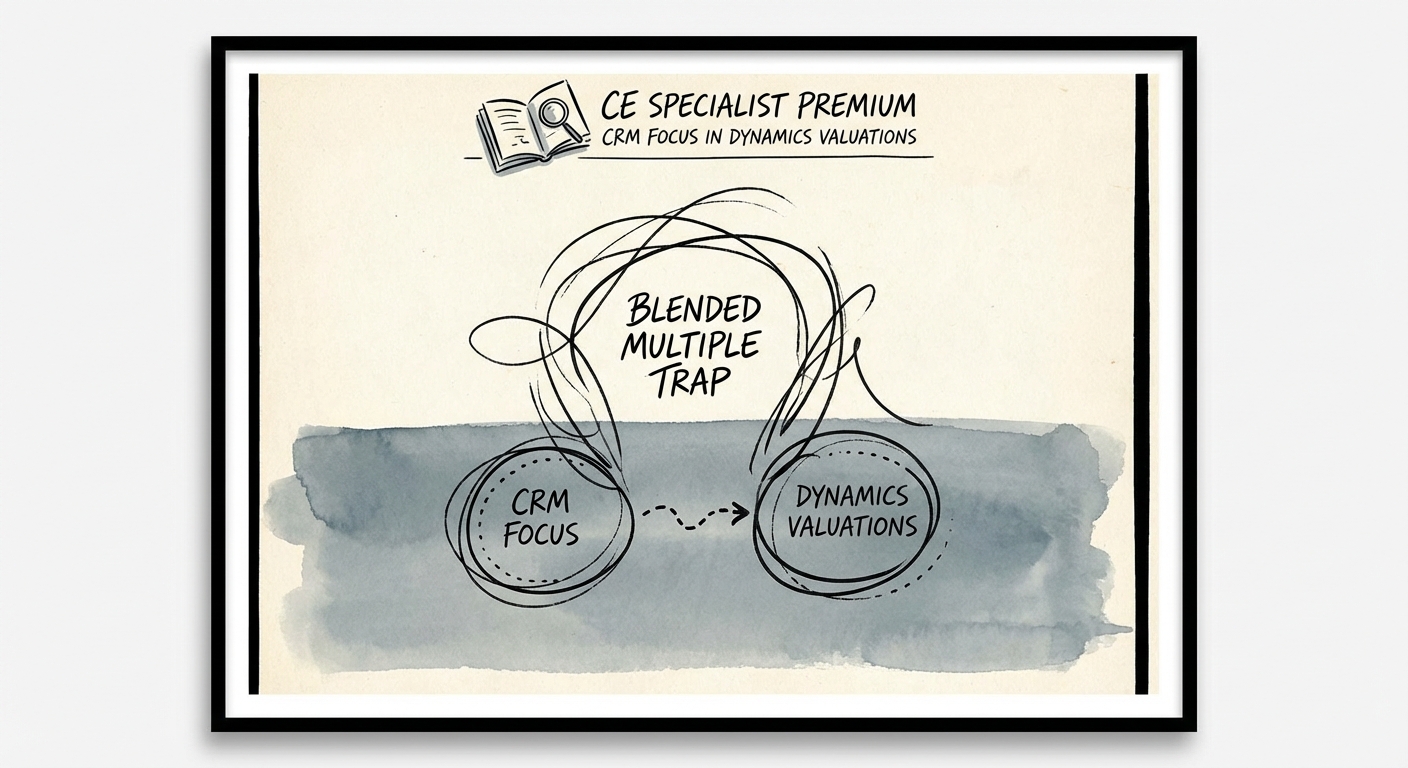
The 'Blended Multiple' Trap: Are You Diluting Your Own Exit?
The most common mistake I see among founders is the belief that a broader service portfolio equals a safer business. You built a $20M Dynamics practice by saying "yes" to everything—CRM, ERP, Business Central, Power BI. While this maximized revenue in the early days, it is now actively capping your enterprise value.
When a PE firm looks at a mixed practice, they don't value the CE revenue at 12x and the F&O revenue at 8x to give you a weighted average. They value the entire entity at the risk profile of the lowest common denominator. Because F&O projects carry higher implementation risk and longer cash flow cycles, your agile, high-margin CE practice gets dragged down by the heavy lift of your ERP division.
The Specialist Diagnostic
To determine if you are positioned for a "Specialist Premium" or a "Generalist Discount," evaluating your operational metrics is critical. Specialized CE firms typically exhibit:
- Sales Cycles < 4 Months: vs. 9-12 months for ERP.
- Managed Services Attach Rates > 40%: Because CRM requires constant optimization, whereas ERP is often "set and forget" until it breaks.
- Gross Margins > 55%: Driven by reusable IP and lighter change management overhead.
If your metrics look like the above, but you are marketing yourself as an "End-to-End Digital Transformation Partner," you are leaving 4 turns of EBITDA on the table. You are selling a Ferrari engine inside a dump truck chassis.
How to Capture the Premium (Even if You Do Both)
You don't necessarily need to divest your F&O practice to fix your valuation, but you must operationally decouple it. The most successful exits in 2024 and 2025 involved firms that created distinct "Practice P&Ls" with separate delivery organizations.
Step 1: Segment Your Narrative. Stop pitching "Microsoft Solutions." Pitch "Revenue Architecture" (CE) and "Operational Backbone" (ERP) as separate value propositions. This allows you to present a "Sum of the Parts" valuation model in the CIM (Confidential Information Memorandum).
Step 2: IP Attachment. The highest multiples go to firms that wrap services in intellectual property. For CE, this means industry-specific accelerators (e.g., "Dynamics for MedTech Sales"). If you can demonstrate that 20% of your revenue comes from proprietary IP or high-margin managed services, you break the linear relationship between headcount and revenue—a key trigger for multiple expansion.
Step 3: The Power Platform Bridge. Use Power Platform as the glue that elevates your valuation. A generic ERP practice is a commodity. An ERP practice that uses Power Apps to build custom mobile front-ends for field workers is a digital product company. Shift your billable hours from "configuration" to "innovation."
The market is telling us clearly: Specialization wins. You can be a generalist in delivery, but you must be a specialist in valuation. Don't let your back-office plumbing devalue your front-office gold.