
The practical answer
- Short answer
- Two Snowflake partners can show identical revenue and EBITDA, yet one is worth 14x and the other 7x. The difference is consumption influence. Here's how to spot it.
- Best fit
- Industry: Technology Services. Function: M&A Strategy
- Operating path
- Exit Readiness → Operational Excellence → Transaction Advisory Services
- Key metric
- 48% Larger initial deal size for Specialist Partners vs. Generalists (Source: Software Oasis)
Picture two Snowflake implementation shops on your desk at the same time. Both did roughly $14M in revenue last year. Both run mid-20s EBITDA margins. Both have a wall of partner badges and a deck full of logos. One seller wants 7x. The other won't entertain a conversation below 13x — and a strategic acquirer is circling at 14x.
If your model treats them as comparable, you're about to overpay for one or walk away from the other for the wrong reason. The income statements are nearly twins. The difference lives in a number neither firm prints: how much Snowflake credit their installed base burns this quarter versus last.
This is the part of the data-services market that breaks the old rollup math. The generalist "digital transformation" shop that moves on-prem SQL Server to the cloud and bills the hours is a commodity — useful, profitable for a quarter, and gone the day the migration closes. Snowflake itself has stopped being a warehouse vendor; its consumption model ties revenue to credits actually used, which means the partners that matter are the ones who make a client's data get used more over time. That's a structurally different asset than a body of billable engineers, and the multiple gap reflects it.
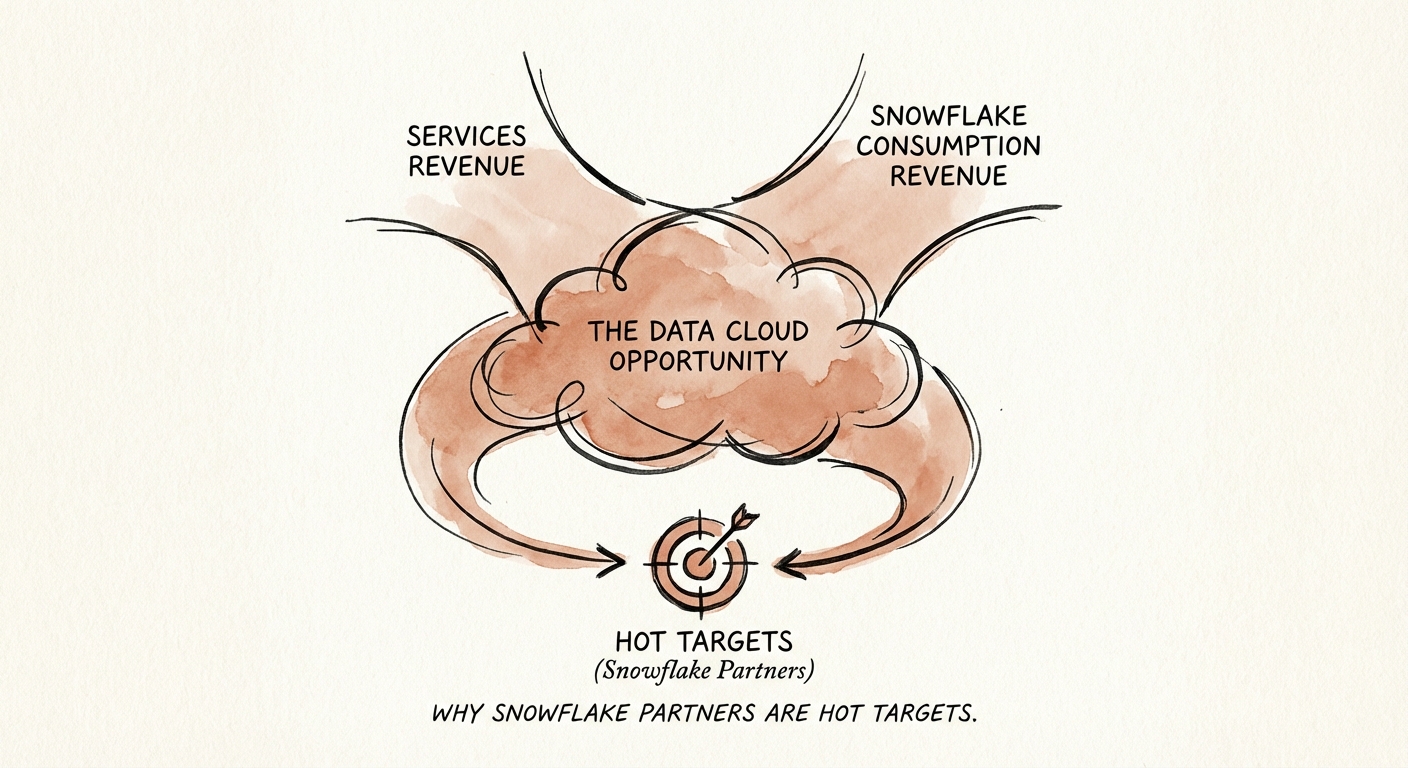
The premium isn't paid for Snowflake expertise. Ten thousand partners claim that. It's paid for what I'd call consumption influence — the demonstrable ability to architect an estate so that AI workloads, data sharing, and downstream analytics drive recurring credit burn the partner helps manage. Specialist partners pull in 48% larger initial deals than generalists not because they charge more per hour, but because buyers route the sticky, consumption-heavy work to the firm that has clearly done it before in their exact vertical.
]]>When I diligence a Snowflake partner, I don't start with their P&L — I start with their clients' credit-burn curves. A firm whose accounts consume more every quarter owns a recurring annuity the income statement never shows. A firm whose accounts flatline after go-live is a staffing agency wearing a consultancy's logo.
Most operating partners diligence a services firm on bookings, backlog, and utilization. Run that lens over a Snowflake partner and you'll misprice it every time, because those metrics measure the migration — the one-time event — and miss the annuity that follows it.
The number I build the model around is the services-to-consumption ratio: for every dollar of services a firm bills into an account, how many dollars of Snowflake credit does that account burn over the following twelve months, and is that line going up or flat? You can reconstruct it during diligence by pulling a sample of the firm's largest accounts and tracing credit usage from go-live forward. It's the closest thing in this market to a net revenue retention curve, and it sorts the field cleanly.
The flatline
Say a 60-person partner did a clean $1.2M lift-and-shift for a mid-market retailer. Great margin on the project. But twelve months later the client's credit burn is exactly where it landed at go-live — the data sits in Snowflake the way it used to sit on-prem, queried by the same three analysts running the same dashboards. The partner made its money on the move and got evicted the day the statement of work ended. There's no annuity here. Price it as project revenue, because that's all it is.
The compounding curve
Now the firm whose accounts show credit burn climbing 30-40% year over year after go-live. They didn't just relocate the data — they stood up the sharing architecture, the feature pipelines for the client's models, the governed access that let three more departments build on the estate. That growth is recurring, the firm is the one managing and optimizing it, and switching them out would mean re-architecting a live revenue system. That stickiness is why these firms trade closer to SaaS comps than services comps. When you ask for the data room, ask for the consumption trend across the top ten accounts — not just the P&L. The shape of those ten curves is the valuation.
]]>
With data and analytics deal value rising across sectors, the noise has gotten loud — and a crowded field of partners has learned to dress like specialists. Four checks separate the real asset from the paper one, and none of them are in the CIM.
- Read the cert mix, not the cert count. Fifty SnowPro Core certifications tells you the firm can pass an entry-level exam with junior staff. It says nothing about whether anyone there can design a Snowpark pipeline. Count the SnowPro Advanced credentials — Architect, Data Engineer, Data Scientist. A firm with 50 Core and zero Advanced is a staffing desk, and you should price the headcount accordingly, not the expertise.
- Strip the resold credits out of EBITDA on day one. Some partners pad the top line by reselling Snowflake credits at a thin margin — a pass-through dressed as services revenue. That dollar is not engineering capability and it does not deserve a services multiple. Pull it out before you do anything else with the numbers; see how to normalize adjusted EBITDA for an acquisition properly.
- Distrust the firm that's an expert in everything. If the deck claims equal mastery of Snowflake, Databricks, Redshift, and BigQuery, you're looking at a generalist. The 14x belongs to the firm that says "we are the premier Snowflake partner for retail supply chain" and can prove it with the credit curves above. Specialization is what drives the margin and the exit multiple.
- Inspect the code, not just the badges. Pull a sample of delivered work. Native Apps, Snowpark, and Unistore are assets — modern features that compound consumption. Walls of legacy SQL bolted onto Snowflake are technical debt that will churn the moment the client hires someone who knows better.
Do these four before the LOI, not after. The CIM will tell you what the firm bills. The credit curves, the cert mix, and a sample of the actual code tell you whether you're buying an annuity or renting a crew until the next migration ends.
]]>