
The practical answer
- Short answer
- A $14M-revenue generalist D365 shop sells at 6x. The vertical specialist next door sells at 14x. The difference isn't size. It's IP attach and co-sell.
- Best fit
- Industry: Private Equity / Technology Services. Function: M&A / Corporate Strategy
- Operating path
- Exit Readiness → Operational Excellence → Transaction Advisory Services
- Key metric
- 14x EBITDA multiple for Vertical Dynamics partners with >30% IP attach rates.
Same P&L, half the price
Put two Dynamics 365 partners on a table in front of a buyer. Both do roughly $14M in revenue. Both have the Gold logo, both run a bench of certified consultants, both have a respectable book of D365 Business Central and Finance & Operations implementations. On paper, twins.
One closes at 6x EBITDA. The other closes at 14x. The seller of the cheap one usually finds this out in the second management meeting, when the buyer's diligence team stops asking about headcount and starts asking a different question entirely: "What do you sell that Microsoft doesn't already give the client for free?"
For the generalist, the honest answer is "our time." That answer is what costs them eight turns of EBITDA. A value-added reseller that bills hours against the standard D365 stack is, to an acquirer, a staffing agency with a Microsoft partner badge — and staffing agencies do not trade at 14x. The vertical specialist has a different answer: a proprietary accelerator, a published industry solution, and a co-sell relationship that hands them qualified pipeline. They sell an outcome that arrives 60% pre-built. Buyers pay for that, and the spread between the two has only widened as the Microsoft channel has matured (Equiteq, Software Equity Group).
Why Microsoft's own program writes the price
The premium is not about "stickiness" as a feeling — it's a CAC story written by Microsoft's incentive structure. A generalist bids on generic intent: "ERP implementation," "D365 partner near me," competing on rate card against every other VAR who bought the same keyword. A vertical partner with a published solution earns a Specialist designation, which turns on Microsoft's co-sell motion. Now the leads come over the wall instead of being fought for — Microsoft field sellers route the deal because the solution shortens their own sales cycle (Microsoft Industry Cloud benchmarks). When the vendor is your top-of-funnel, your acquisition cost collapses, and that shows up directly in the margin line a buyer underwrites.
A buyer can clone your dev team off LinkedIn in a weekend. What they can't clone is the AppSource listing that makes Microsoft's field sellers route deals to you instead of the four other Gold partners in the room.
The four numbers a D365 diligence team will actually pull
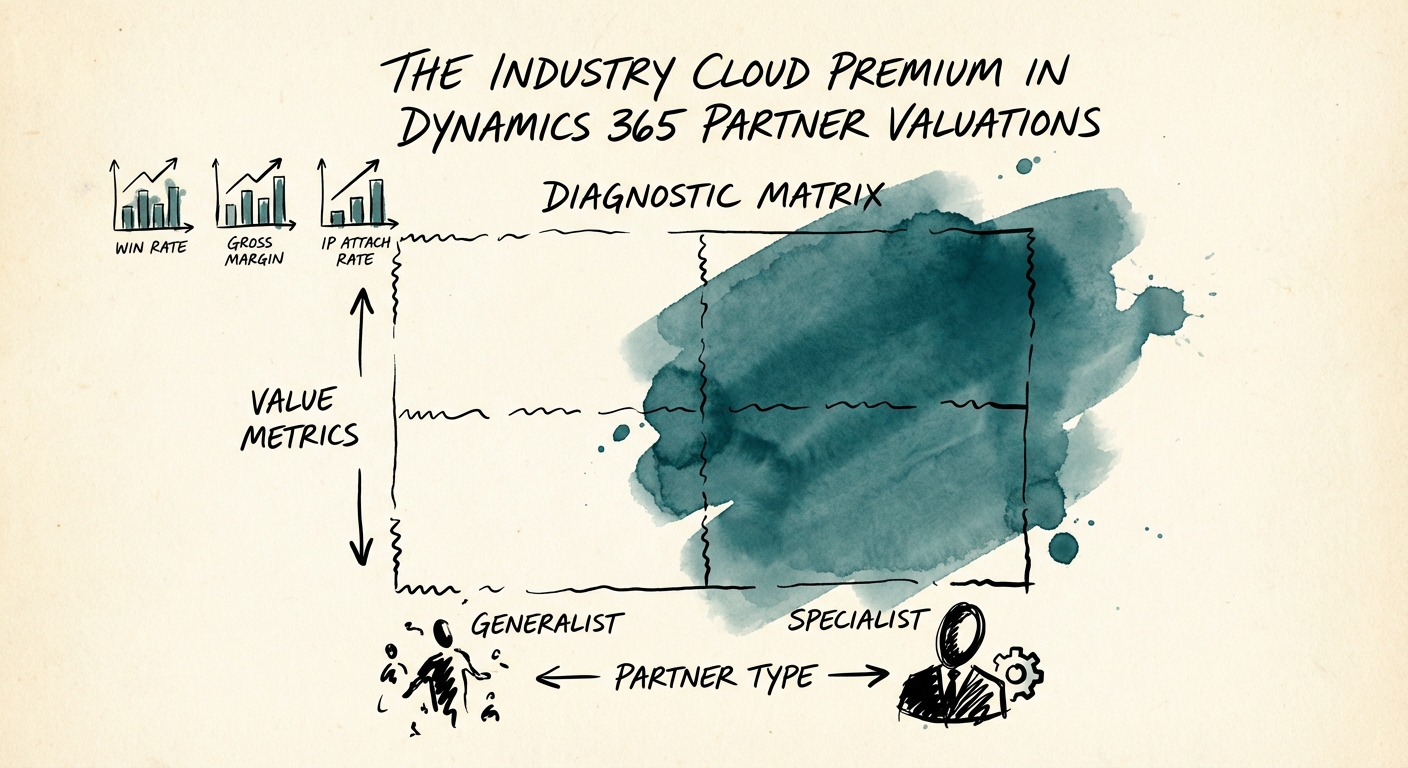
Every partner claims to be a "healthcare specialist" or a "manufacturing specialist" because they happen to have three logos in that vertical. That's a slide, not an asset. When a buyer's analyst opens your accounting system and your CRM, four numbers decide which valuation bucket you land in — and you can pull every one of them yourself before anyone else does.
1. IP attach rate — does your own SKU ride along?
Look at your last 30 statements of work. How many of them include a line item that is your intellectual property — a named accelerator, an industry data model, a packaged integration — and not just billable Microsoft configuration? If the answer is "we mostly resell licenses and bill the build," you are a reseller wearing a platform's clothes. The partners commanding the premium are attaching proprietary IP to roughly a third of new bookings. That attach line is the first thing a quality-of-earnings review isolates, because recurring IP revenue underwrites a higher multiple than project services ever will.
2. Co-sell conversion — does Microsoft trust you with its pipeline?
Filter your CRM to deals sourced through Microsoft referral or co-sell. A generalist limps in around a 1-in-5 close rate on those — they got handed the lead and still lost to three peers on price. A genuine Specialist closes the majority of co-sell deals, because the referral came specifically because of the published solution. If your win rate on vendor-sourced opportunities is sitting under 40%, you don't have domain authority. You have a logo and a hope.
3. The blank-sheet ratio — how much do you rebuild every time?
Pull your last five projects in the same vertical and ask delivery what percentage of each one started from existing assets versus a blank Visual Studio project. If your team rebuilt the same field-service portal or the same revenue-recognition workflow for the fifth time, you are paying senior consultants to re-solve a solved problem — and burning the exact margin a buyer is trying to find. Vertical leaders start north of 60% complete on day one.
4. Revenue per billable head — is revenue still chained to hours?
Generalist D365 shops plateau around $200K–$220K of revenue per billable consultant, because revenue is literally a function of utilization. Once IP carries the delivery, that ceiling lifts past $300K — not because the consultants work harder, but because the firm finally charges for the value of the accelerator instead of the hours to install it (Channel Futures). That single ratio is the cleanest proxy a buyer has for "is this a platform or a body shop."
The 18-month pivot — from VAR to vertical platform
You cannot pitch-deck your way from 6x to 14x. If you're holding a generalist D365 partner, the multiple gets engineered into the asset over about six quarters, and the work is more product management than marketing.
Months 1–6: harvest the IP you've already built
Freeze net-new custom development that isn't billable and run an inventory of your last 20 projects instead. The same three or four code blocks show up everywhere — a payment-gateway integration, a compliance report, an onboarding workflow you've rebuilt a dozen times. Package those into a formal, versioned delivery asset. It does not need to be a standalone SaaS product on day one; it needs to be a repeatable component your delivery org reuses by default. The margin lift is immediate, because you stop paying to rebuild what you already own.
Months 7–12: get listed and get designated
Map that asset to a specific Microsoft Industry Cloud and publish it on AppSource. The listing is the price of admission to the Specialist designation, and the designation is what flips on co-sell. Be honest that this is half technical and half relationship: your real objective is to become the partner that Microsoft's field sellers think of first for that vertical, so the pipeline starts arriving instead of being chased (Microsoft Industry Cloud).
Months 13–18: reprice so you keep the efficiency
Kill the "estimated hours" quote. Replace it with a fixed-fee package that bundles your IP and the implementation around it. This is the step generalists skip — they build the accelerator, then pass all the time savings straight to the client and wonder why margin didn't move. Fixed-fee packaging captures the efficiency for the firm, which is exactly the math that breaks the linear link between headcount and revenue.
When you take that to market, you are no longer selling a Dynamics services firm. You are selling a vertical platform that happens to run on Dynamics. The first gets a polite nod and 6x. The second gets the kind of exit you can actually return a fund on. If you want a candid read on which side of that line your asset sits today, start with an honest diagnostic of your IP attach and co-sell numbers before you ever talk to a banker.