
The practical answer
- Short answer
- Dynamics partners trade between 6x and 14x EBITDA. Learn the 3 revenue quality metrics that determine the multiple and why generic implementation shops are a value trap.
- Best fit
- Industry: Private Equity / Technology Services. Function: M&A Due Diligence
- Operating path
- Exit Readiness → Operational Excellence → Transaction Advisory Services
- Key metric
- 14x EBITDA multiple for IP-led Dynamics partners (vs. 6x for pure services)
The 'Reseller' Trap: Why Top-Line Revenue Lies
If you are looking at a CIM for a Microsoft Dynamics partner showing $50M in revenue and $8M EBITDA, you might think you’ve found a stable platform investment. You haven't. You’ve likely found a latent risk of margin compression.
In 2026, the Microsoft ecosystem is bifurcating. On one side are the Business Transformation Partners who own intellectual property (IP), vertical-specific operational templates, and high-margin managed services. These firms trade at 12x to 14x EBITDA. On the other side are the Implementation Shops—firms that essentially act as staffing agencies for Microsoft licenses. They trade at 5x to 7x, and frankly, even that is generous.
The License Margin Mirage
Historically, partners relied on license resell margins (CSP) to pad their P&L. Microsoft has systematically compressed these margins and increased the operational burden of the New Commerce Experience (NCE). If the target’s profitability relies on the 15-20% margin from license resale, you are buying a melting ice cube. In the 2025 IT Services M&A landscape, smart money values pure resale revenue at 1x or less.
The real trap, however, is Service Mix. Generic 'Body Shop' implementation work—swapping hours for dollars to install Business Central or Finance & Operations (F&O)—carries a 35% gross margin ceiling. Once you load up a PE cost structure (Operating Partners, compliance, reporting), that EBITDA evaporates. You must look for the IP Attach Rate.
We see a 5x valuation spread between partners who sell 'hours' and partners who sell 'IP'. If you don't own the code, you're just renting the customer.
The Diagnostic: 3 Metrics That Reveal True Asset Quality
When conducting due diligence on a Dynamics partner, ignore the 'Gold' or 'Solutions Partner' badges. They are pay-to-play hurdles, not indicators of value. Instead, demand these three data points to triage the asset.
1. The IP Attach Rate (Target: >20% of Revenue)
Does the partner sell naked Dynamics, or do they wrap it in proprietary IP? The highest-value targets have built vertical accelerators—pre-configured codebases for 'Food & Beverage Manufacturing' or 'Non-Profit Grant Management.' This IP does two things:
- Increases Gross Margin: IP revenue carries 80%+ margins compared to 40% for services.
- Creates Vendor Lock-in: A customer can fire a generic implementation partner. They cannot fire the partner who owns the code running their core billing engine.
If IP revenue is under 5%, you are buying a consultancy, not a platform.
2. The Managed Services Conversion Ratio (Target: >40%)
Project revenue is lumpy and unpredictable. High-value partners convert at least 40% of their implementation clients into long-term Managed Services contracts (Application Management Services or AMS). This isn't just 'break/fix' support; it's continuous optimization, often billed as a subscription.
Check the Project-to-Managed conversion rate. If the firm implements 50 projects a year but only adds 5 managed services contracts, they have a delivery quality problem or a sales incentive misalignment. This is a classic sign of the valuation gap between MSPs and consultancies.
3. The F&O vs. Business Central Moat
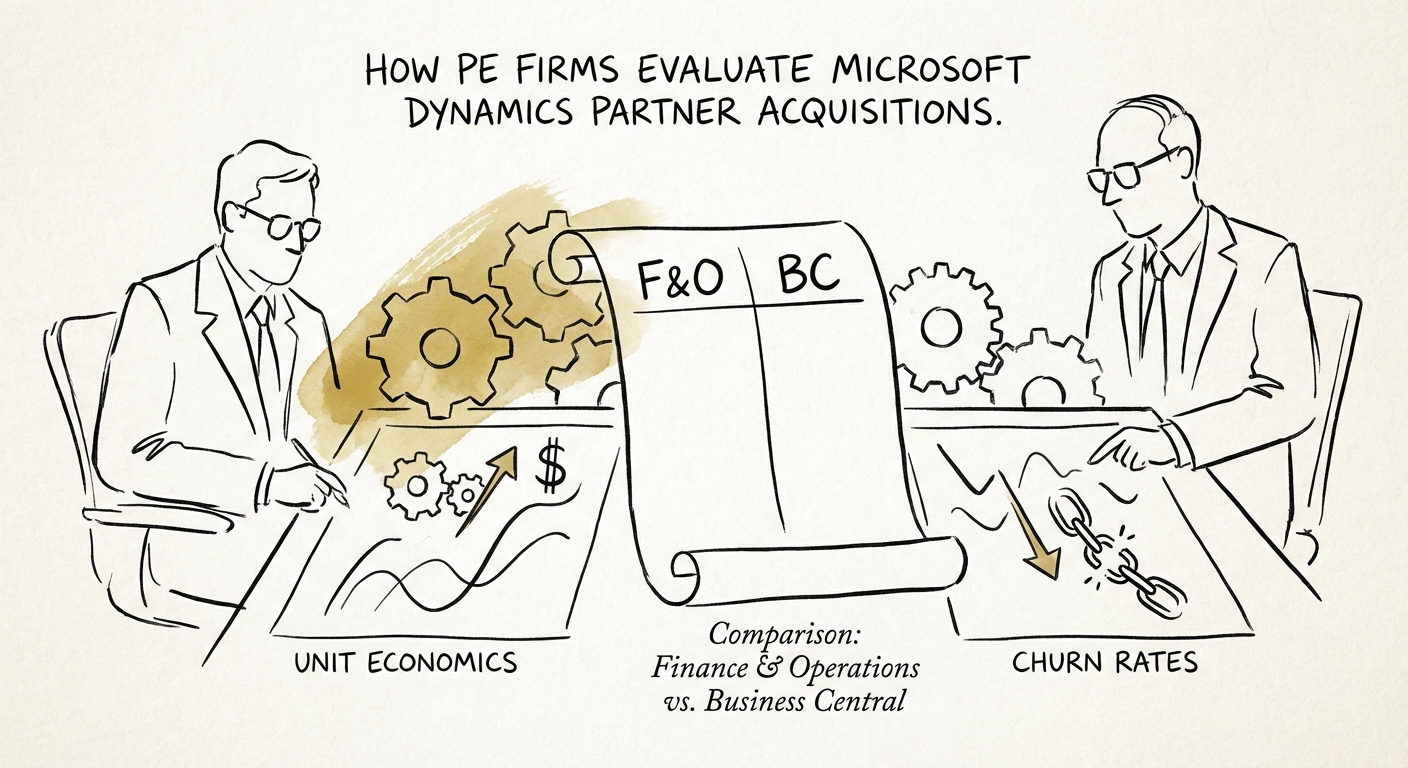
Not all Dynamics is created equal. Dynamics 365 Finance & Operations (F&O) targets the enterprise. Implementation cycles are 12-24 months, and churn is virtually non-existent (<3%). Business Central (BC) is the SMB play. It’s a volume game with higher churn (>10-15%) and lower barriers to entry.
An F&O-heavy partner has a deeper competitive moat but higher concentration risk. A BC-heavy partner needs a massive marketing engine to feed the funnel. Know which game you are buying into.
The Fix: Value Creation Post-Close
You’ve acquired the partner. Now, how do you expand the multiple from 7x to 12x? The answer lies in shifting the revenue mix from 'Hours' to 'Outcomes'.
1. Productize the Service Delivery
Stop bidding on custom development work that requires 'heroic' engineering. Force the delivery team to document their most common customizations and package them as 'Accelerators.' This moves revenue from one-off low-margin projects to repeatable high-margin IP. As we’ve seen in other sectors, acquirers pay a premium for documented, transferable processes.
2. The 'Copilot' Pivot
The market is obsessed with AI, but few partners know how to monetize it. The immediate opportunity isn't building custom AI models; it's deploying Microsoft Copilot for existing Dynamics bases. This is high-margin advisory work that drags through security and data governance projects (high stickiness). Position the firm not as an 'ERP implementer' but as an 'AI Readiness Partner.'
3. Fix the Technical Debt
Many founder-led partners grew by saying 'yes' to every client customization. This leaves you with a spaghetti code mess that is impossible to upgrade. Conduct a technical code audit immediately. If you find high technical debt, you must pivot to a 'Clean Core' strategy—migrating clients back to standard Dynamics to enable easier updates and higher margins. Hidden technical debt is the silent killer of services margins.