
The practical answer
- Short answer
- Dynamics partners with high Azure attach rates trade at 11-12x EBITDA vs. 6.5x for pure services. Here is the diagnostic framework for PE sponsors to unlock platform synergy.
- Best fit
- Industry: Private Equity / Technology Services. Function: M&A Strategy
- Operating path
- Exit Readiness → Operational Excellence → Transaction Advisory Services
- Key metric
- 9x-12x EBITDA multiple for Microsoft Partners with >70% recurring revenue & high Azure attach.
The Valuation Gap: Services vs. Platform Synergy
If you are holding a pure-play Dynamics 365 implementation firm, you are sitting on a depreciating asset. In 2025, the valuation chasm between a "traditional" Microsoft partner and a "Cloud-Native" partner has widened to a breaking point. Market data indicates that traditional project-based partners—those living project-to-project with <50% recurring revenue—are trading at 6.25x to 7.75x EBITDA. They are viewed as staffing agencies with a Microsoft badge.
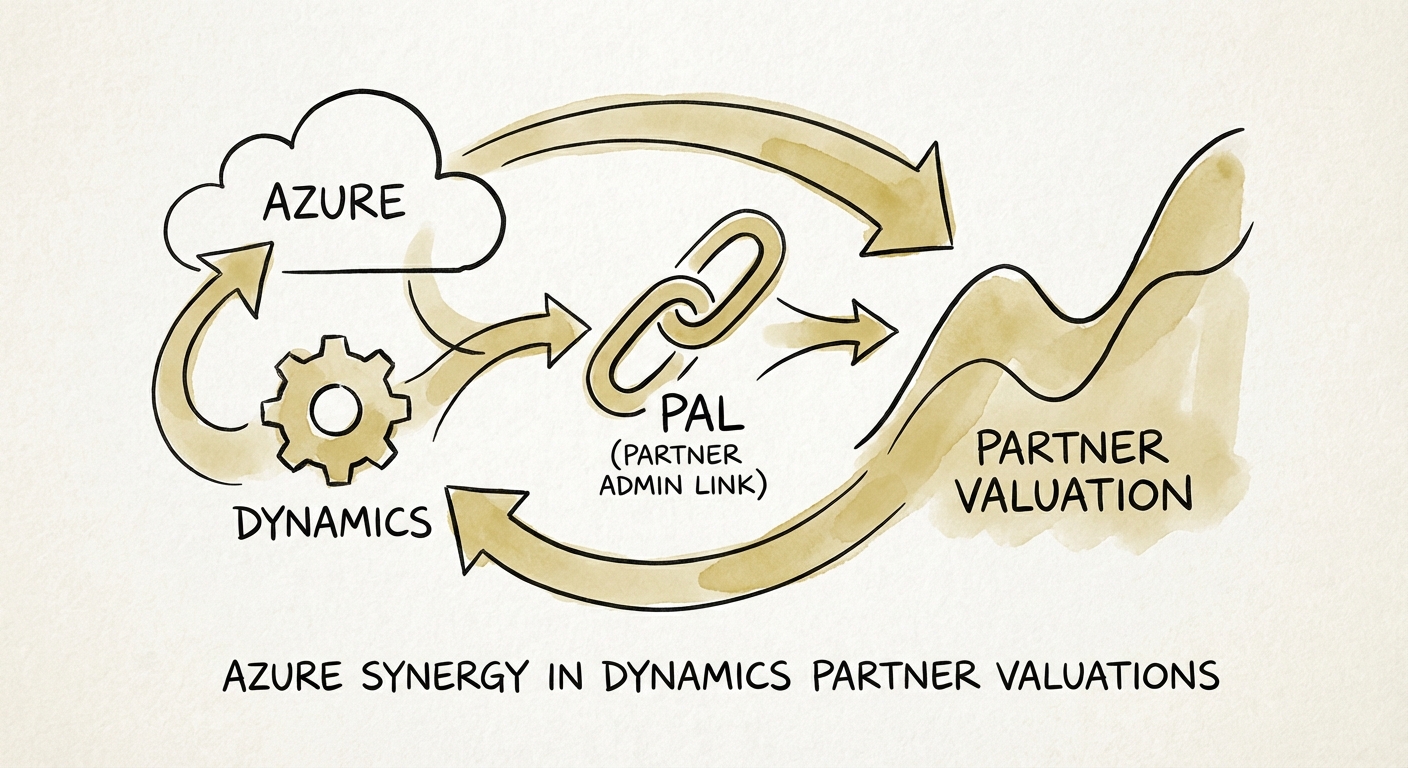
Contrast that with partners who have successfully attached deep Azure consumption (Data, AI, Infrastructure) to their Dynamics deployments. These firms are trading at 9x to 12x EBITDA. Why the 40%+ premium? Because the acquirer isn't buying the implementation hours; they are buying the Azure Consumed Revenue (ACR) tail. ACR is sticky, high-margin, and grows naturally as the client's data estate expands. If your portfolio company is implementing Finance & Operations (F&O) or Business Central without owning the underlying Azure data estate, you are literally giving away the most valuable part of the customer lifetime value.
For a PE sponsor, the play is obvious but operationally difficult: You must pivot the firm from "selling licenses and hours" to "selling business outcomes on Azure." This is not a marketing slogan; it is a fundamental shift in technical delivery and revenue architecture. As detailed in our 2025 IT Services M&A Trends, buyers are aggressively filtering for "platform synergy"—the ability of a partner to drag Azure consumption alongside SaaS licensing.
Services revenue walks out the door every evening. ACR (Azure Consumed Revenue) stays, grows, and compounds. That is what buyers pay for.
The Currency of the Kingdom: ACR and PAL
The single biggest mistake I see in Dynamics partner due diligence is a lack of attribution. You might effectively control the client's cloud environment, but if Microsoft doesn't see it, you don't get the credit, and your valuation suffers. The metric that matters is ACR (Azure Consumed Revenue). This is the revenue Microsoft recognizes as "influenced" or "consumed" through your services.
To capture this value, your portfolio company must rigorously implement the Partner Admin Link (PAL) across every single client environment. PAL is the telemetry mechanism that links your partner ID to the client's Azure resources. Without PAL, your engineers are doing the work, but the "consumption credit" evaporates into the ether. I have seen firms with $5M in theoretical Azure influence showing $0 on their Microsoft scorecard because they failed to implement PAL governance.
The "Rule of 78" in the Ecosystem
Valuation premiums heavily correlate with the quality of revenue. In the Microsoft ecosystem, the magic number is often referred to as the "Rule of 78" (growth rate + profit margin), but specifically for valuation multiples, the threshold is 70-75% recurring revenue. A Dynamics partner that wraps Managed Services and Azure management around the ERP core hits this recurring benchmark. A partner that just does "go-lives" rarely cracks 40%. The former gets the 12x multiple; the latter gets the 6x.
The Strategic Pivot: Achieving "IP Co-Sell" Status
To maximize exit value, you cannot just be a reseller; you must be a creator. The highest valuations are reserved for partners with Azure IP Co-sell Eligible status. This is not just a badge; it is a commercial key that unlocks enterprise budgets. When a solution is IP Co-sell Eligible, it counts toward a large enterprise customer's MACC (Microsoft Azure Consumption Commitment).
Think about the leverage this provides. A Fortune 500 CIO has a $10M Azure commit they must spend or lose. If your portfolio company's Dynamics solution is "MACC Eligible," that CIO can pay for your software using pre-committed budget dollars. It dramatically shortens sales cycles and increases win rates. Achieving this status requires a specific architectural rigor—transactable marketplace offers, validated technical architecture, and proven trailing-12-month revenue.
For a PE Operating Partner, the roadmap for the next 12 months is clear:
- Audit Attribution: Enforce PAL across 100% of the customer base immediately.
- Architecture Review: assess technical debt preventing Azure scalability (see our concentration risk frameworks for parallels).
- IP Packaging: Repackage custom code into a transactable Marketplace offer to gain MACC eligibility.
You are not just fixing a services firm; you are engineering a platform asset.