The practical answer
- Short answer
- Why AWS Data & Analytics specialists trade at 14x EBITDA while generalists stall at 8x. A diagnostic guide for PE Operating Partners on unlocking exit value.
- Best fit
- Industry: Private Equity / IT Services. Function: M&A / Strategy
- Operating path
- Exit Readiness → Operational Excellence → Transaction Advisory Services
- Key metric
- 14x EBITDA multiple for AWS Data & Analytics specialists in 2025, vs 8x for generalists.
The Generalist Trap: Why 'Lift and Shift' is a Commodity
I recently sat down with a PE sponsor who was baffled. He had a $50M revenue AWS Premier Partner in his portfolio. They had the badges, the headcount, and the 'Gold' status. He was expecting a 12x exit. The LOIs came in at 7.5x.
His mistake? He confused capacity with capability.
For the last decade, the 'Generalist' AWS shop—the firm that helps enterprises migrate on-prem servers to EC2—was a growth darling. But in 2026, basic infrastructure migration is a race to the bottom. It’s a commodity game won by Global Systems Integrators (GSIs) with massive offshore armies. If your portfolio company's primary revenue stream is 'lift and shift' or generic managed services (MSP), you aren't building a technology asset; you're running a staffing agency with a cloud badge.
The Valuation Compression
The market data is disciplined. According to 2025 M&A benchmarks, generalist Managed Services Providers (MSPs) are trading in the 8.2x – 10.8x EBITDA range. Why? Because infrastructure churn is real, margin pressure is high, and 'keeping the lights on' doesn't command a premium anymore. Buyers treat this revenue as lower quality because it lacks the 'sticky' nature of intellectual property or deep business integration.
You think you have a 'Cloud Practice.' You actually have a staffing agency with an AWS badge. The market doesn't pay for 'access to talent' anymore. It pays for 'access to answers'.
The Data Premium: The 6-Turn Delta
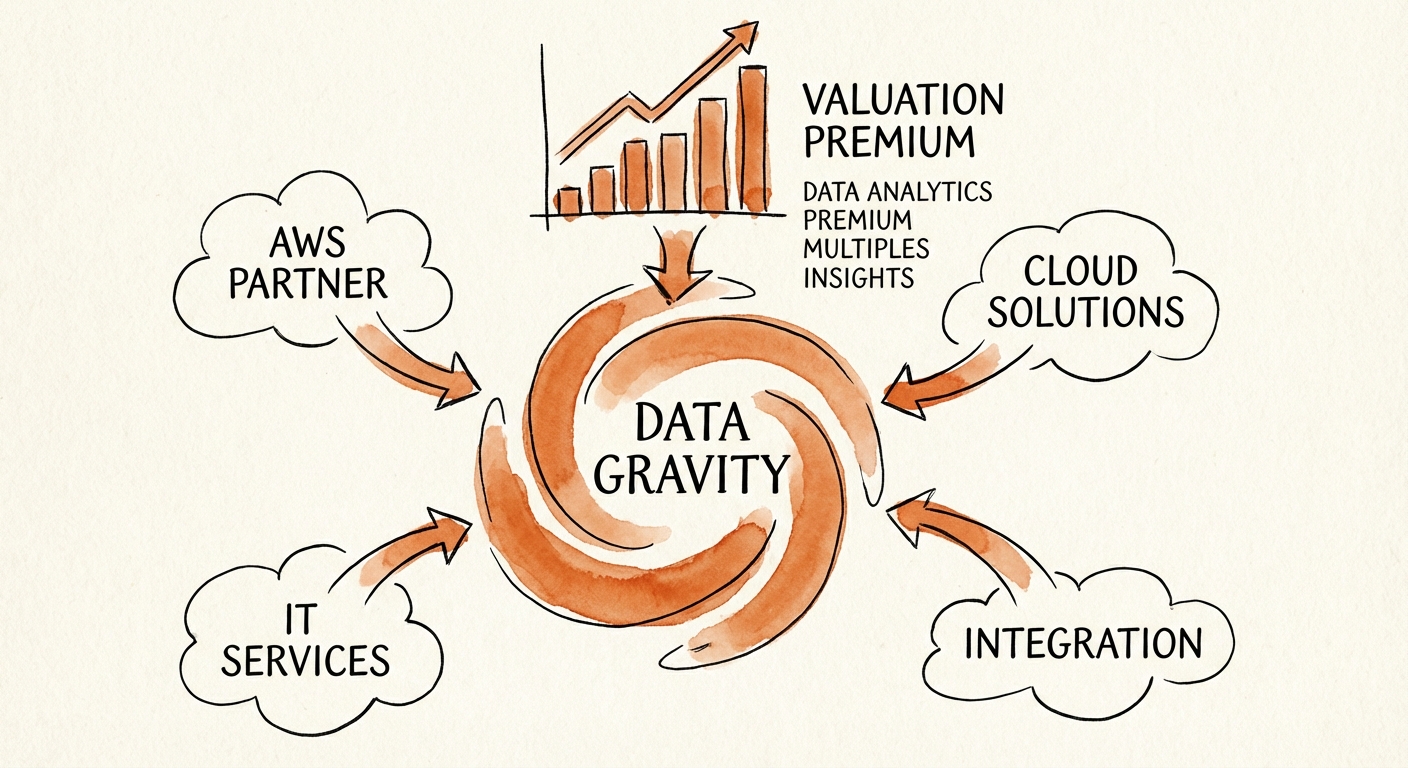
While generalists fight for 8x, specialized AWS partners focused on Data, Analytics, and AI are commanding 10x – 14x EBITDA. I call this the 'Data Premium,' and it's the single most important arbitrage opportunity in the IT services ecosystem right now.
Why the massive delta? Data Gravity.
An infrastructure partner is easily replaced; a data partner is wired into the decision-making cortex of the client. When you own the data pipeline (Redshift, Glue, Snowflake) and the consumption layer (Quicksight, SageMaker), you aren't just a vendor; you're a strategic necessity.
The Metrics Behind the Multiple
The economics of a Data Specialist are fundamentally different:
- Higher Bill Rates: Data Engineers and AI Architects command 40-60% higher bill rates than Cloud Ops engineers.
- Consumption Multipliers: Omdia's 2026 forecast indicates that partners can achieve up to a $7.13 multiplier for every dollar of AWS spend when delivering high-value services like AI and Analytics.
- Sales Efficiency: Referrals for specialized Data & AI partners convert at 67%, compared to just 20% for generalist partners. You spend less to win more.
PE buyers know that 2026 is the year of 'AI execution.' You cannot execute AI strategies without a modernized data estate. Therefore, the firms that build the data foundations are the 'pick and shovel' plays for the AI gold rush, guaranteeing their relevance (and revenue) for the next 5-7 years.
The Exit-Ready Pivot: From 'Body Shop' to Data Powerhouse
If you are holding a generalist AWS partner, you have a choice: accept the 'staffing discount' or engineer a pivot. You cannot simply hire two data scientists and claim you have a practice. The 'Data Premium' requires structural changes to your revenue quality.
1. Stop Selling 'Hours', Start Selling 'Outcomes'
Generalists sell hours of migration support. Specialists sell 'Data Estate Modernization' or 'Predictive Maintenance Frameworks.' You need packaged IP—accelerators, code libraries, and frameworks—that reduces delivery time and increases margins. If every project starts from a blank sheet of paper, you are a generalist.
2. Target NRR, Not Just ARR
In the data world, Net Revenue Retention (NRR) is the kingmaker. Valuations spike when NRR exceeds 110%. This proves that you aren't just landing projects; you are expanding usage. Data projects naturally lead to 'Day 2' operations (DataOps, MLOps), which creates high-margin, recurring revenue that buyers love.
3. The M&A Tuck-In Strategy
If organic growth is too slow, use the balance sheet. Don't buy another $10M generalist to 'add scale.' Buy a $3M boutique data consultancy with deep expertise in Redshift or Databricks. Inject their capabilities into your broader customer base. This is the fastest way to re-rate your multiple from 8x to 12x before you go to market.
The era of the 'Cloud Generalist' is over. The market has spoken: Specialization is the new scale.