
The practical answer
- Short answer
- Why NetSuite partners with Advanced Manufacturing expertise trade at 10-12x EBITDA while generalists stall at 6x. A diagnostic guide for founders on valuation premiums.
- Best fit
- Industry: Enterprise Software / Professional Services. Function: M&A / Strategy
- Operating path
- Exit Readiness → Operational Excellence → Transaction Advisory Services
- Key metric
- 12x EBITDA multiple for NetSuite partners with documented Advanced Manufacturing IP (vs. 6-8x for generalists).
The 6x vs. 12x Reality Check
If you are running a generic NetSuite Alliance Partner firm doing $20M in revenue, you are likely trading at 6x to 8x EBITDA. You implement core financials, CRM, and maybe SuiteCommerce. You are competing with hundreds of other firms on rate, often grinding typically around $175-$200 per hour. Your differentiation is likely relationship-based, which disappears the moment you leave the building.
However, if you pivot that same $20M revenue base into Advanced Manufacturing (AM), the valuation calculus changes materially. In 2025, we are seeing specialized manufacturing partners trade at 10x to 12x EBITDA. Why the gap?
The Complexity Moat
Generalist partners solve accounting problems. Manufacturing partners solve physics problems. Configuring NetSuite to handle Work in Process (WIP), Finite Capacity Scheduling, and Standard Costing for a complex aerospace facility creates a natural moat. A generalist consultant cannot fake their way through a conversation about shop floor control or backflushing. This scarcity of talent allows specialized firms to command bill rates of $275-$350+ per hour, driving gross margins from the standard 45% to upwards of 60%.
Private Equity buyers aren't just buying your cash flow; they are buying your ability to execute IT Services M&A for their portfolio. When a PE firm acquires a $200M manufacturing platform, they need an ERP partner who can integrate that asset in 90 days, not 12 months. If you own that capability, you command a premium.
Generalists solve accounting problems. Specialists solve physics problems. The market pays 6x for the former and 12x for the latter.
The 'Carve-Out' Catalyst
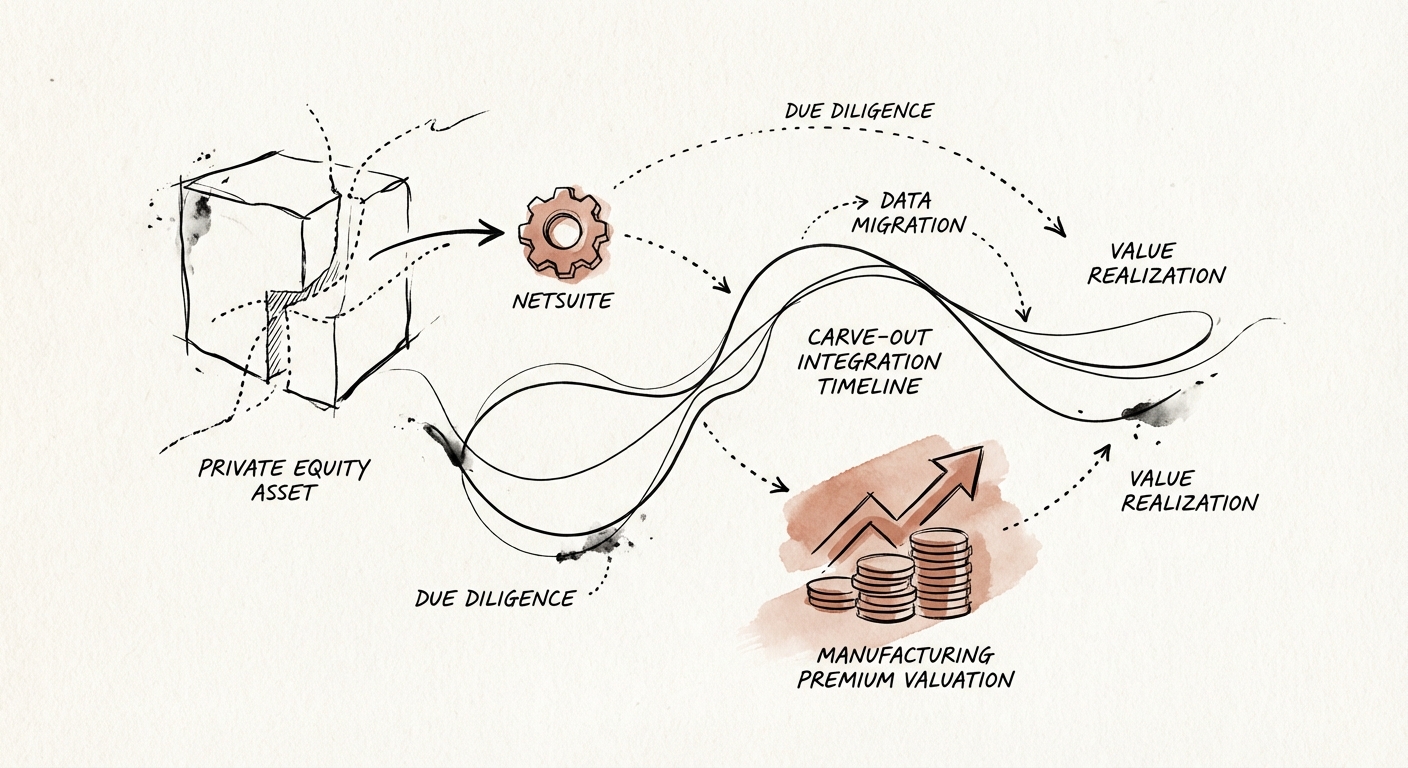
The macro environment in 2025-2026 is defined by reshoring and supply chain densification. Private Equity firms are aggressively buying manufacturing assets, often as "carve-outs" from larger conglomerates. These new standalone entities have 12 months to get off the parent company's legacy SAP or Oracle instance and onto a modern cloud ERP.
This is where the valuation premium crystallizes. A generalist partner sees a migration project. A specialized partner sees a Risk-Adjusted Value Creation Event. If you have a documented playbook for migrating a CNC machine shop from AS/400 to NetSuite Advanced Manufacturing in 4 months, you are no longer a service provider; you are an insurance policy against a failed investment thesis.
The Metric That Matters: 'Time to First Part'
In manufacturing implementations, the critical metric isn't Go-Live; it's "Time to First Part"—the speed at which the shop floor resumes production after the cutover. Generalists often crash production for weeks due to misconfigured routing steps or BOM errors. Specialists maintain continuity. Acquirers pay for this reliability. As noted in The Transferability Premium, buyers will pay up to 2x more for a firm that has turned this "tribal knowledge" into documented IP and accelerators.
Escaping the 'Hour-Selling' Trap
To capture this 12x multiple, you must stop positioning yourself as a consulting firm and start positioning as a verticalized solution provider. The firms commanding the highest multiples in 2025 aren't just selling hours; they are selling proprietary "accelerators"—pre-packaged configurations for specific sub-verticals like Medical Device manufacturing or Automotive Tier 1 suppliers.
From Services to 'Tech-Enabled'
Your goal is to shift your revenue mix. If 100% of your revenue is time-and-materials implementation, you are capped at 8x. If you can demonstrate that 20-30% of your revenue comes from recurring managed services (AMS) specific to manufacturing optimization, or IP-based licensing of your proprietary connectors, you enter the "Tech-Enabled Services" valuation band.
The Strategic Pivot:
- Audit your customer base: If 40% of your revenue is manufacturing, but the rest is non-profit and retail, you are diluting your multiple. Divest or de-emphasize the generalist work.
- Productize your knowledge: Take your top 3 manufacturing implementations and extract the common code/scripts/workflows. Package this as "The [Your Company] Manufacturing Core."
- Hire for 'Shop Floor' DNA: Stop hiring fresh accounting grads. Hire former plant managers and teach them NetSuite. Their credibility in the sales cycle is what closes $500k implementation deals at 70% margins.