
The practical answer
- Short answer
- Two HubSpot partners booking $10M can be worth wildly different sums. Why Content Hub technical depth — HubDB, serverless, partitioning — drives a 12x EBITDA exit.
- Best fit
- Industry: Marketing Technology / IT Services. Function: M&A / Strategy
- Operating path
- Exit Readiness → Operational Excellence → Transaction Advisory Services
- Key metric
- 13.6x Average EBITDA multiple for specialized technical digital transformation firms vs. 5.2x for generalist agencies (2025 benchmarks).
Two partners, same booking, a buyer who only wants one
Picture two HubSpot Diamond partners on the same diligence shortlist. Both book around $10M. Partner A runs the classic full-service shop: social, paid media, email workflows, a steady drip of theme-based website builds. Partner B looks smaller and duller from the outside — fewer logos, no awards reel — but every engagement runs through HubDB-backed data models, serverless functions calling client APIs, and a migration practice that pulls enterprises off Adobe Experience Manager and Sitecore.
The buyer puts a term sheet in front of Partner B and politely passes on Partner A. And the gap in what they'd pay is not 20%. Generalist agencies are clearing roughly 4x to 6x EBITDA right now; technical Content Hub specialists are pricing at 10x to 14x. The 2025 agency multiple data from First Page Sage tells the same story from the generalist side — discretionary marketing revenue gets the discretionary multiple.
Why "full-service" reads as a red flag in the data room
If you're telling yourself that "we do everything" is a differentiator, here's the expensive translation: to a private-equity buyer, full-service reads as unfocused, undifferentiated, and easy to churn. Marketing campaigns are the first line item a CFO cuts when the quarter goes sideways. A company's primary content platform and its structured data layer are the last — because they ARE the digital business, not a promotion of it.
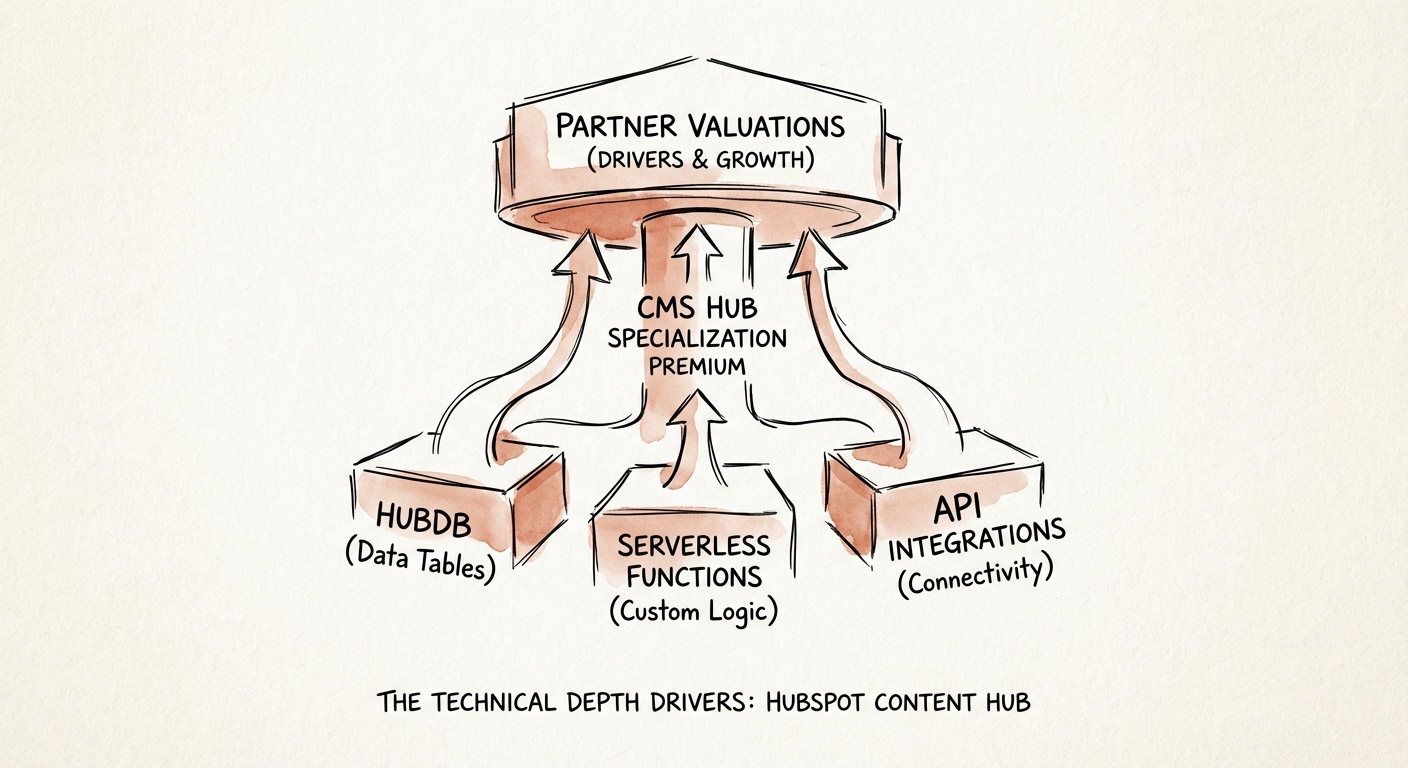
That's the whole thesis. When you've built a client's portal logic on content partitioning, their product catalog on HubDB, and their integrations on serverless functions, you stopped being a vendor and became a utility. A creative retainer dies on 30 days' notice. Ripping out a wired-in Content Hub implementation is a 12-month project with a budget attached — and that friction is exactly what a buyer is paying the extra turns for.
A diligence team can read a 30-day cancellation clause on a creative retainer in about four seconds. They take their time with a HubDB schema wired to a client's ERP — because that one takes twelve months and a real budget to unwind. The clock on the unwind is your moat.
The rebrand was a tell — and most partners missed it
When HubSpot renamed CMS Hub to Content Hub, it wasn't a logo refresh. It was a public statement that the product had graduated from "where we host the blog" to "where the enterprise runs its content operations." For partners, that quietly redrew the line between a creative shop and an engineering one — and the buyers noticed before most agencies did.
The capital chasing this ecosystem since 2024 is not hunting for creatives. It is hunting for teams who can run complex migrations off legacy monoliths and who can write Liquid, React, and GraphQL against a real content model. There's a clean way to test which side of the line you're on: count the engagements where, if your team vanished tomorrow, the client's site would keep running but no one could safely change the data structure. That's the revenue a buyer underwrites at a premium.
AI agents can't read a flat HTML site — and that's your leverage
An AI agent cannot govern, query, or act on a flat HTML page. It needs structured content it can address. Partners who model content properly inside Content Hub are quietly building the addressable layer their clients' future AI agents will run on top of — which reframes the partner from "web designer" to the architect of the client's machine-readable foundation. HubSpot's own State of Marketing report tracks how fast that expectation is becoming table stakes, and the DXP market sizing from Fortune Business Insights shows where the platform spend is consolidating.
Run the numbers on yourself. If your mix is 80% creative retainer and 20% technical execution, your multiple is capped no matter how good the work is — the buyer prices the 80%. Flip that ratio and you change asset classes. As the revenue-versus-EBITDA math makes brutally clear: a $10M shop where $9M is low-margin churny creative is worth less than a $5M specialist where $2M is high-margin recurring technical managed services. The buyer isn't pricing your top line. They're pricing how hard you are to fire.
The pivot: stop selling projects, start selling things that stay
So how does a founder move her firm from the 5x bucket to the 12x one? Not by being more creative. By making the technical dependency undeniable and repeatable. Three concrete moves, the kind you can start on Monday.
1. Productize the migration. "Website redesign" is a project; projects don't carry multiple. A "Legacy CMS to Content Hub Migration Accelerator" — a documented method, your own scripts for moving content trees and redirect maps off AEM or Sitecore, priced on outcome — is an asset. That's documented, transferable IP, and it adds turns precisely because it survives the departure of any one engineer.
2. Own the middleware, not the theme. Installing themes is a commodity; a buyer assumes anyone can do it. Writing the custom middleware that syncs NetSuite inventory into HubDB to power a live catalog, or wiring serverless functions into a client's Snowflake instance, is strategic infrastructure that doesn't get re-bid every year. The further you sit from the CMS template and the closer you sit to the enterprise stack, the higher the multiple climbs.
3. Fix utilization before a buyer finds it broken. Most agencies run technical teams either below 60% (you're carrying dead payroll) or above 90% (you're burning the people who hold the institutional knowledge — and a buyer will price that flight risk down hard). The valuation-ready target is roughly 75–80% billable with a deliberate 20% reserved for building the accelerators above. That utilization discipline is both a margin story and a retention story in the same number.
The full-service era is over for anyone who wants a real exit. The market is paying for technical competence that stays in the building after the founder leaves — and the partners modeling content properly in Content Hub are the ones cashing the premium.