
The practical answer
- Short answer
- Why the 2025 drop in billable utilization to 68.9% is killing NetSuite partner margins. A diagnostic guide to fixing bench management and restoring 25%+ EBITDA.
- Best fit
- Industry: B2B Tech Services. Function: Operations
- Operating path
- Unit Economics → Commercial Performance → Transaction Advisory Services
- Key metric
- 68.9% Average billable utilization in 2025 (down from 73% in 2021), signaling a market-wide efficiency crisis.
The "New Normal" Is a Profitability Death Spiral
If you are running a NetSuite consultancy and hitting the 2025 industry average for utilization, you are likely wasting cash. According to the 2025 Professional Services Maturity Benchmark by SPI Research, average billable utilization has plummeted to 68.9%. For many founders, this number feels "safe" because it matches the market.
It is not safe. It is a disaster.
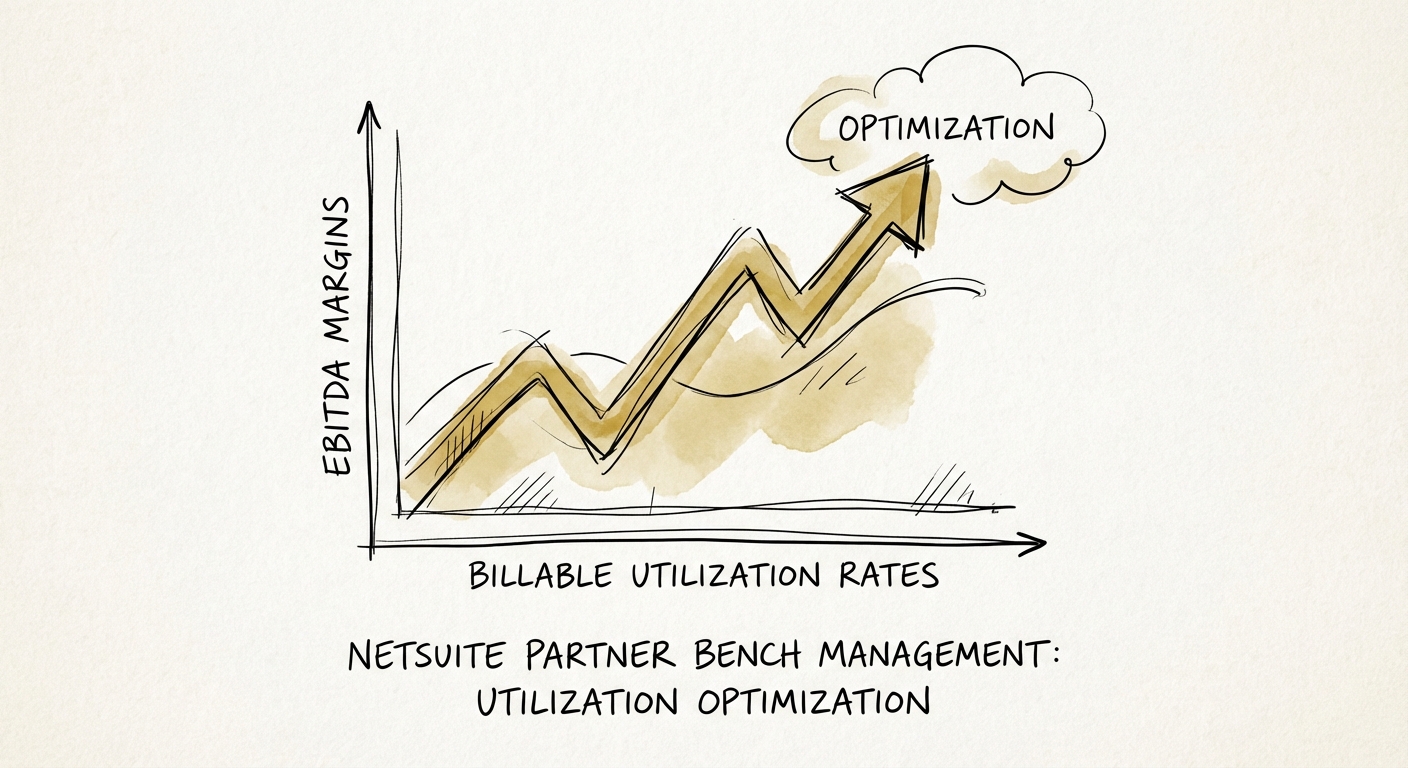
That same dataset reveals that alongside this drop in utilization, EBITDA margins have cratered to 9.8%—the lowest in five years. For a specialized NetSuite partner, where demand is growing at 18% YoY, single-digit EBITDA is a sign of operational negligence, not market conditions.
The math is unforgiving. A Senior Solution Architect with a $160,000 base salary and a $225/hr bill rate sitting at 68% utilization isn't just generating "less" profit; they are actively eroding the margin created by your juniors. When you factor in the load—benefits, software, overhead—that "bench" time isn't free. It’s expensive inventory that expires every single hour.
The Diagnostic: Look at your bench report from last week. Do not count "internal initiatives" as utilized. If your true billable utilization for senior delivery staff is under 75%, you aren't managing a bench; you're funding underused capacity.
A NetSuite Solution Architect billing $225/hr costs you $18,000/month just to sit there. You think your 15% bench is a safety net. I see $2M of EBITDA evaporating.
The "Shadow Bench" and The IP Factory
The most dangerous leak in a NetSuite practice isn't the consultant with zero hours assigned; it's the consultant assigned to "Shadow Bench" projects. These are internal codes like "Knowledge Management," "Accelerator Development," or "Mentoring" that have no budget cap and no ROI tracking.
I see this in due diligence constantly. A firm claims 85% utilization, but when we audit the timesheets, 15% of that is tagged to an internal "NetSuite AI Research" code that hasn't produced a single billable asset in six months. This is hidden margin leakage that distorts your forecasts and inflates your valuation artificially.
Turn the Bench into an IP Factory
You cannot eliminate the bench—you need buffer for new deals. But you must monetize it. In 2026, the best NetSuite partners have converted their bench into an IP Factory. If a consultant is not billable:
- They are building a specific, scoped SuiteApp or accelerator.
- That asset has a release date and a projected revenue attachment.
- If the asset doesn't ship, the time is reclassified as "Idle," impacting their personal utilization score.
This psychological shift changes everything. Suddenly, your Functional Consultants aren't just "waiting for the next ERP implementation"; they are racing to finish a billable asset so they can get back to client work. It turns Revenue Per Employee from a lagging metric into a daily operational target.
Dynamic Resource Allocation: Moving Beyond "Who is Free?"
The traditional staffing model—"Who has availability starting Monday?"—is the enemy of utilization optimization. It treats all hours as equal, which they are not. A Junior Associate billing at $175/hr has a vastly different margin profile than a Principal Architect billing at $350/hr, yet lazy resource management often assigns the Principal to low-leverage work simply because they are on the bench.
The Fix: The Margin-Based Staffing Matrix
Effective utilization requires a staffing logic that prioritizes margin contribution over mere schedule filling. Before assigning a bench resource, ask:
- Is this role billable at the resource's standard rate? If you have to discount a Senior resource to fit a Junior role budget, you are setting a dangerous precedent for utilization rate benchmarks.
- Can we split the role? Instead of putting one Senior on the bench for 5 days, can a Junior do 4 days of execution with 1 day of Senior oversight? This keeps the Senior available for high-value "swat team" interventions on other accounts.
- Is there a "Paid Bench" option? Leading firms are now selling "retainer-lite" packages to existing clients—guaranteed access to a specific consultant for 10 hours a month. It creates a floor for utilization and smooths out the peaks and valleys of project-based revenue.
Your bench isn't a waiting room. It's a strategic reserve. Manage it with the same rigor you apply to your cash flow, or it will consume your EBITDA from the inside out.