The practical answer
- Short answer
- Stop treating ServiceNow certifications like trophies. A diagnostic guide to calculating the true ROI of your partner bench, from CMA costs to billable rate multipliers.
- Best fit
- Industry: Professional Services. Function: Operations
- Operating path
- Unit Economics → Commercial Performance → Transaction Advisory Services
- Key metric
- $17k Direct program cost for a single Certified Master Architect (CMA) credential
The $17,000 Vanity Metric
In the ServiceNow ecosystem, there is a dangerous conflation between capability and credentialing. As a founder, you are likely writing checks for the Certified Master Architect (CMA) program—a $17,000 direct line-item expense per head, before you even account for travel, lost billable hours during the 6-month cohort, and the inevitable "post-certification wage bump" demand.
Here is the brutal reality: A CMA badge on a slide deck does not close deals. A CMA delivering strategic value closes deals. Too many partners (specifically those stuck in the $10M–$20M revenue valley) treat certifications like trophies. They end up with a "Paper Tiger" bench: highly certified, technically brilliant, and commercially illiterate.
Data from the 2025 ecosystem shifts shows that while ServiceNow has quadrupled investments in partner incentives, the bar for monetizing those incentives has risen. The market no longer pays a premium just because your architect passed an exam. They pay for the outcome that the architect drives. If your CMA is doing ticket-smashing work that a CSA (Certified System Administrator) could handle, you aren't just misallocating resources; you are actively compressing your own gross margins.
A CMA badge on a slide deck does not close deals. A CMA delivering strategic value closes deals. If you cannot bill your CMA at 3x your junior rate, do not pay for the certification.
The Hidden "Rot Rate" of Your Bench
Your bench assets depreciate faster than a new car. ServiceNow's six-month release cycle (e.g., Xanadu, Yokohama) creates a forced obsolescence curve that most financial models ignore. It is not just the $200 annual maintenance fee—that is a rounding error. It is the Delta Exam Tax.
Calculating the True Carry Cost
Every time a new release drops, your billable capacity takes a hit. If you have 50 certified consultants, and each spends 4 hours on delta prep and exams twice a year, that is 400 hours of lost inventory annually. At a blended billable rate of $225/hr, that is $90,000 of revenue evaporation—hidden in "G&A" or "Training" rather than being allocated to Cost of Goods Sold (COGS) where it belongs.
Furthermore, the 2025 Partner Program changes prioritize specializations over generic capacity. The demand is shifting aggressively toward AI-driven workflows (ServiceOps GenAI, Customer Experience GenAI). A bench heavy on legacy ITSM certs but light on GenAI capability is a stranded asset. You are paying carrying costs for inventory that the market is rapidly losing interest in buying.
The 3x Multiplier Framework
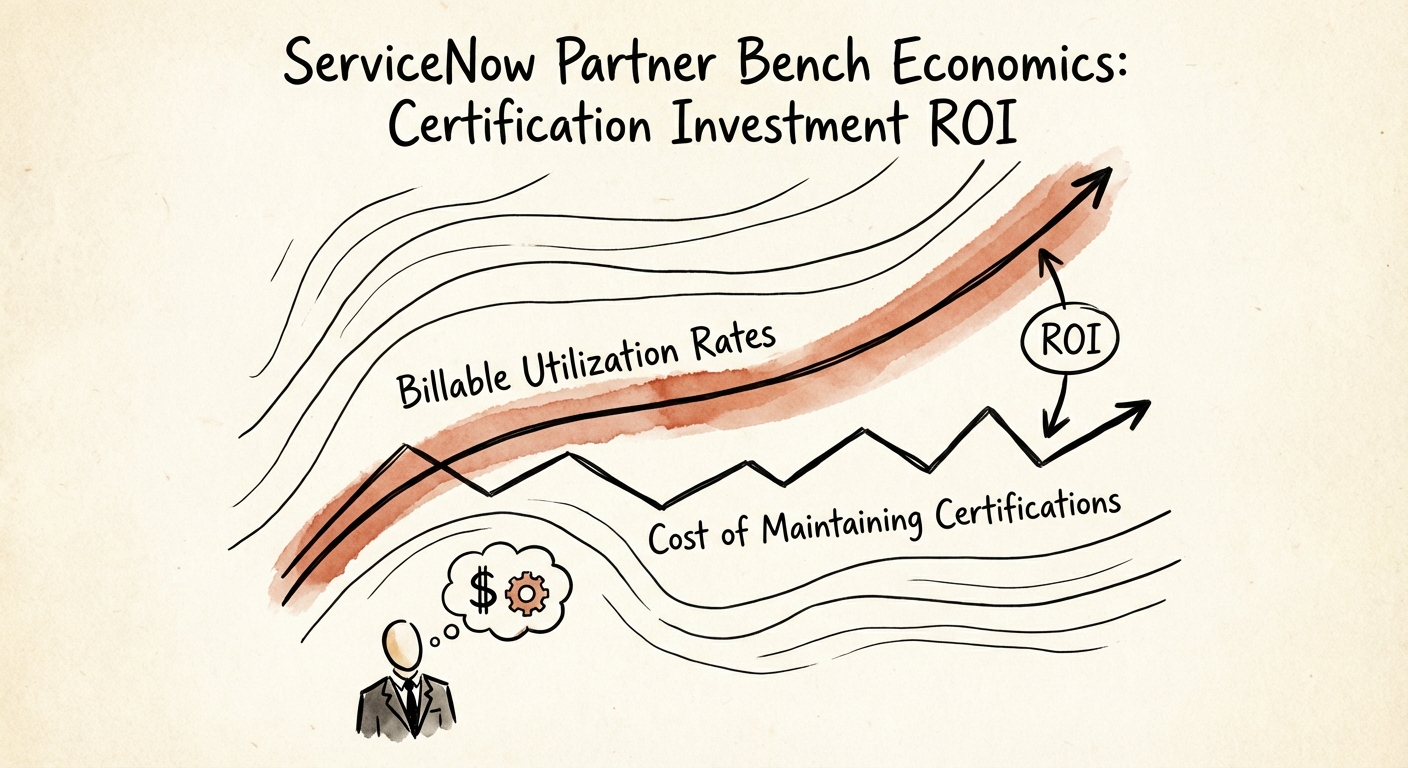
So, how do you fix it? You stop measuring "Number of Certs" and start measuring Return on Certification Investment (ROCI). You need a strict tiered pricing architecture that reflects the credential's scarcity and value.
- Tier 1 (Commodity): CSA/CIS. These are table stakes. Billable target: $150-$185/hr. If they aren't utilized 75%+, they are a drag.
- Tier 2 (Specialized): GenAI, SecOps, GRC. High demand, lower supply. Billable target: $225-$275/hr.
- Tier 3 (Strategic): CMA/CTA. These are your "Tip of the Spear." They should not be billing by the hour for configuration; they should be billing for architecture and strategy. Billable target: $350+/hr or fixed-fee strategic retainers.
If you cannot bill your CMA at 3x your junior rate, do not pay for the certification. It is that simple. Your goal is to build a pyramid, not a cylinder. If you have too many senior architects (CMAs) and not enough certified implementers (CSAs) to execute the work, your blended margin will collapse under the weight of your own payroll.