
The practical answer
- Short answer
- A diagnostic guide for Atlassian partners on program tier economics. Analyze Silver vs. Platinum ROI, resale margin compression, and the valuation impact of pivoting from license resale to specialized services.
- Best fit
- Industry: Professional Services. Function: Operations
- Operating path
- Unit Economics → Commercial Performance → Transaction Advisory Services
- Key metric
- 12.5M Revenue required to net $1M Gross Profit via Resale (vs. $2.2M via Services)
The Badge vs. The Bank Account: Analyzing Tier ROI
For many Atlassian partners, the climb from Silver to Gold to Platinum is viewed as a linear path to enterprise value. The assumption is simple: Higher status equals higher visibility, better leads, and premium valuation. However, our analysis of 2025 partner economics reveals a divergence between tier status and unit economics.
The "Platinum Premium" is real, but it is no longer driven by license resale volume. In FY26, the cost of maintaining Platinum status—measured in certified headcount, marketing spend, and cloud sales quotas—has risen by approximately 22% year-over-year. Meanwhile, the gross margin on pure license resale has compressed. Partners who chase Platinum status primarily through resale volume often find themselves in a "margin trap," where the overhead required to maintain the badge consumes the incremental rebates it provides.
The Certification Tax
Atlassian’s rigorous certification requirements (e.g., maintaining a specific number of Atlassian Certified Professionals) are not just an operational hurdle; they are a fixed cost that scales with your tier. For a Platinum partner, the "Certification Tax"—the direct cost of exams ($100-$250 per seat) plus the indirect cost of non-billable study time—can equate to $12,000–$15,000 per year per consultant in lost utilization. If your primary revenue stream is low-margin resale, this fixed cost structure destroys your bottom line.
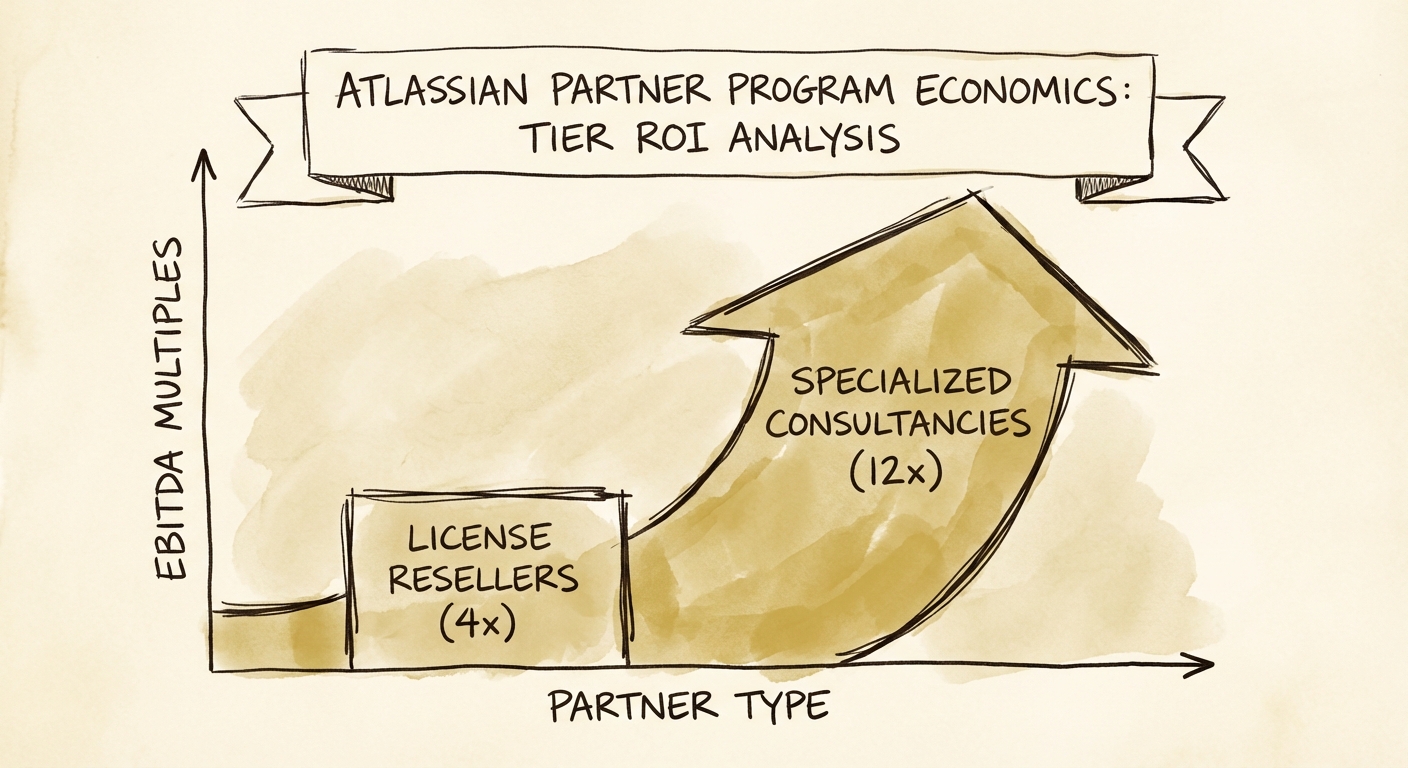
The partners trading at 12x aren't the ones with the most licenses. They're the ones who realized that 'Resale' is a customer acquisition channel, not a business model.
The Resale Trap: Why 20% Margins Are a Myth
Historically, Atlassian partners could build healthy businesses on the back of license renewals, enjoying margins of 20%+ with minimal delivery effort. Those days are effectively over. In 2026, the "Resale Trap" is characterized by three converging pressures:
- Direct-to-Customer Shifts: Enterprise procurement teams are increasingly bypassing partners for standard renewals or demanding "cost-plus" pricing that strips partner margin down to 3-5%.
- Cloud Incentives vs. Maintenance Decay: While Atlassian offers incentives for Cloud migrations, the recurring margin on established Cloud seats is often lower than the legacy Server/Data Center maintenance streams. As the Data Center sunset approaches (2029), partners relying on that passive income face a revenue cliff.
- The "Cost-Plus" Commoditization: When you compete solely on price for licensing, you are in a race to the bottom. We are seeing "Paper Platinum" partners—firms with high license volume but low service depth—trading at 4x-5x EBITDA, essentially valued as low-margin distributors rather than strategic consultancies.
The math is unforgiving: To generate $1M in gross profit via resale at a blended 8% margin, you need $12.5M in top-line revenue. To generate that same $1M via specialized services at a 45% margin, you need only $2.2M in revenue. The former requires a massive sales engine; the latter requires a focused delivery team.
The Pivot: From Reseller to Transformation Partner
The partners commanding 10x-12x EBITDA multiples in 2026 are not the ones moving the most licenses; they are the ones owning the transformation. The economic sweet spot has shifted from "License Management" to three high-margin pillars:
1. Complex Cloud Migrations
With the Data Center end-of-life timeline shrinking, enterprise migrations are no longer "lift and shift" exercises; they are complex re-architecting projects. Partners specializing in "un-customizing" legacy Jira instances and mapping them to standardized Cloud workflows are commanding bill rates 40% higher than generalist implementers.
2. ITSM & ESM Governance
Moving beyond IT, the "Enterprise Service Management" (ESM) play targets HR, Legal, and Finance. This expands the Total Addressable Market (TAM) within existing accounts without requiring new license procurement battles. Services revenue here sticks because it is embedded in business process, not just software configuration.
3. The IP Multiplier
Developing niche Marketplace Apps or standardized "Solution Packs" (e.g., pre-configured Jira Service Management for Biotech compliance) breaks the linear link between revenue and headcount. "Hybrid" partners—those with 30% of revenue coming from proprietary IP or high-margin managed services—see a valuation premium of 2-3 turns over pure services firms.
Strategic Advice: Stop optimizing for the next tier badge if it requires diluting your margins with empty resale calories. Optimize for Gross Margin per Certified Consultant. If that metric isn't growing, your "Platinum" status is a vanity metric that will hurt you at exit.