
The practical answer
- Short answer
- SuiteSuccess accelerates go-lives but compresses service margins. Learn how to fix your unit economics and survive the shift to 'productized' services.
- Best fit
- Industry: Professional Services. Function: Operations
- Operating path
- Unit Economics → Commercial Performance → Transaction Advisory Services
- Key metric
- 1.5:1 The new target Services-to-License ratio for SuiteSuccess deals (down from 3:1)
The Math of Compression: When Speed Kills Revenue
For a decade, the NetSuite partner playbook was simple: sell a license, then sell a "blank sheet" implementation that took 9 to 12 months. You billed Time & Materials (T&M), your senior architects racked up hours in discovery, and your Services-to-License ratio sat comfortably at 3:1 or even 4:1. A $50,000 ARR license meant $150,000 in services revenue.
SuiteSuccess broke that math.
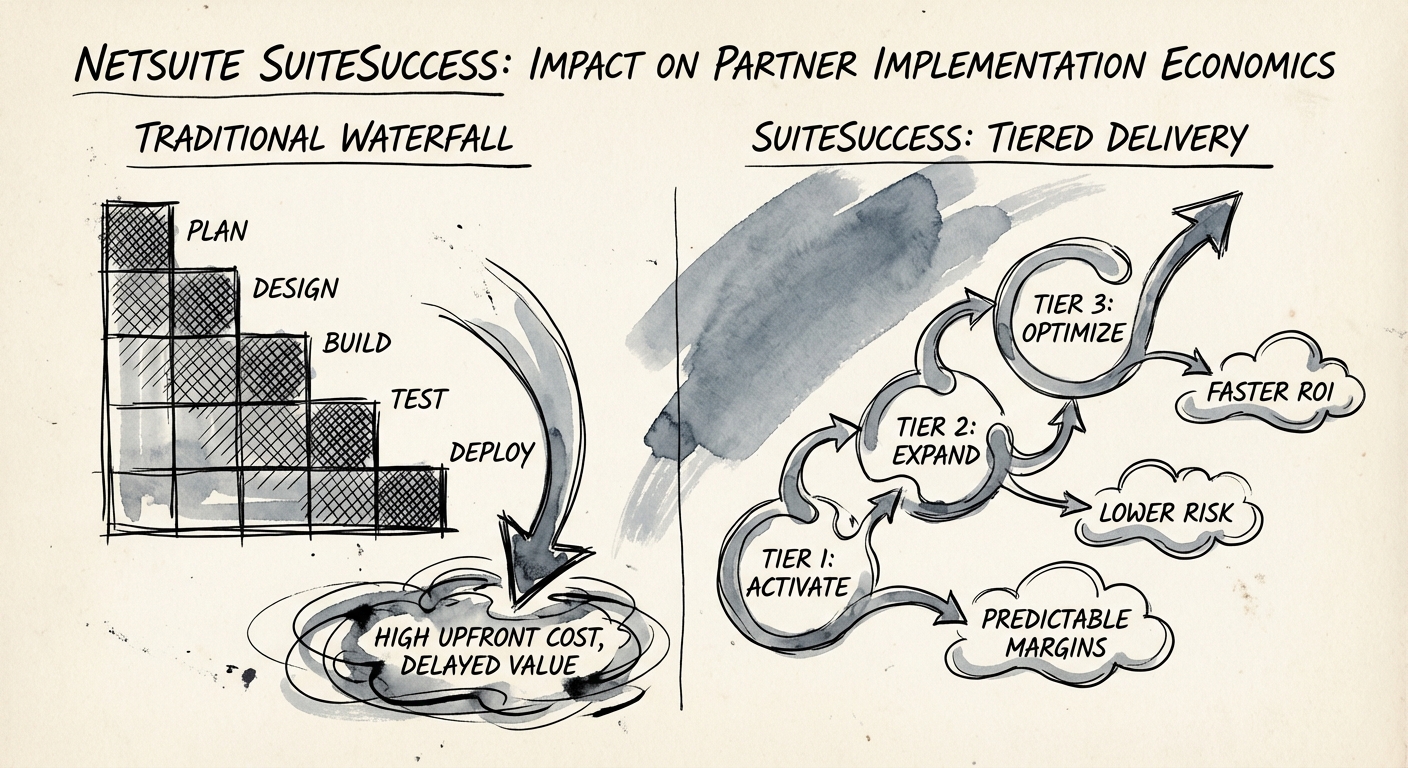
By pre-configuring dashboards, roles, and KPIs for specific industries, Oracle NetSuite effectively "productized" the first 60% of an implementation. For the customer, this is a victory: time-to-value drops from 10 months to 100 days. For you, the partner, it is an economic crisis if you haven't adapted.
The New Unit Economics
When you deploy SuiteSuccess, you are no longer building a house; you are assembling a prefab home. The "discovery" phase—traditionally a high-margin billable period for your best talent—is replaced by "alignment" sessions that take a fraction of the time. The impact on your P&L is immediate:
- Lower Total Contract Value (TCV): That $150,000 services project is now a $60,000 fixed-scope sprint.
- Volume Dependency: To maintain the same top-line revenue, you now need to close and deliver 2.5x the volume of projects.
- The Seniority Trap: If you are still putting your $180k/year Senior Solution Architects on these $60k projects, your gross margins aren't just slipping—they are underwater.
The 2025 SPI Research benchmark shows billable utilization across the sector has dropped to 68.9%, a clear signal that firms are struggling to balance capacity against this new, faster-churning project flow. If you are running a "boutique" shop with a high-cost delivery bench, SuiteSuccess is not an enablement tool; it is a margin compressor.
If you are still staffing SuiteSuccess projects with the same team structure you used in 2019, your margin model is upside down. The margin has moved to the post-live optimization.
The "Stairway" Trap: Commoditization of the Partner
Oracle NetSuite's "Stairway to Heaven" methodology is brilliant marketing, but for a partner, it creates a dangerous equivalency. If every partner is delivering the exact same pre-configured "Software" edition or "Manufacturing" edition, where is your differentiation? You become a commodity implementation factory.
I talk to founders who are proud of their "Gold" or "Platinum" status, yet they are wasting cash because they treat SuiteSuccess as a methodology rather than a pricing signal.
The Resource Mismatch
The biggest mistake I see in sub-$20M partners is failing to tier their delivery teams. You cannot afford to have your A-players executing a standard SuiteSuccess deploy. It's like using a neurosurgeon to apply a band-aid.
To fix your unit economics, you must restructure your delivery model:
- Level 1 (The Factory): Use Junior Consultants (Associates) and off-shore resources to execute the pre-configured SuiteSuccess setup. This is low-margin work if done domestically, but high-margin if executed by a lower-cost resource pool following a strict SOP.
- Level 2 (The Value): Save your Senior Architects for the "Optimization" phase—the complex integrations, the unique business logic, and the "Day 2" improvements. This is where you bill $250+/hour.
If you don't separate these streams, your blended rate will never recover. You will burn out your senior staff on low-leverage data migration while your junior staff sit unbillable because they aren't trusted to lead.
The Pivot: From "Go-Live" to "Stay Live"
The winners in the 2026 partner ecosystem have realized that the money isn't in the implementation anymore; it's in the optimization. Because SuiteSuccess gets a customer live with "standard" processes, that customer will inevitably hit a wall six months later. They will realize the out-of-the-box dunning process doesn't match their reality, or the standard inventory count doesn't fit their warehouse flow.
The "Day 2" Goldmine
Instead of fighting for the shrinking implementation pie, structure your contracts to capture the backend. Shift your business model from "Project-Based" to "Subscription-Based" managed services.
- Stop selling: "We will implement NetSuite for $80k."
- Start selling: "We will get you live in 90 days for $60k, followed by a 12-month 'Business Transformation' retainer at $5k/month to customize the system as you scale."
This restores your Services-to-License ratio by extending the lifetime value (LTV) of the client. It also smooths your cash flow, protecting you from the feast-or-famine cycle of the implementation factory model. The partners trading at 10x EBITDA multiples today are the ones with 40%+ recurring revenue, not the ones with the most one-time implementation logos.