
The practical answer
- Short answer
- Your 'growth bench' is costing you a 15% EBITDA haircut. Learn the unit economics of bench management, optimal utilization targets for Salesforce partners, and how to build a Just-in-Time talent supply chain.
- Best fit
- Industry: Professional Services. Function: Operations
- Operating path
- Unit Economics → Commercial Performance → Transaction Advisory Services
- Key metric
- $3.2M Valuation impact of holding a single senior Salesforce Architect on the bench (at 12x EBITDA).
The $300,000 Parking Lot: The Real Cost of 'Readiness'
Most Salesforce partner CEOs I meet, specifically those in the $10M-$50M range ('founders'), view their bench as a badge of honor. They tell me, "Justin, we keep 15% of our engineering capacity unallocated so we can start new deals on Day 1." They think this is a competitive advantage. The P&L tells a different story: it is an EBITDA anchor that is dragging their valuation underwater.
Let’s look at the unit economics of a Senior Salesforce Technical Architect (TA). In 2025/2026, a high-quality TA commands a base salary of $180k-$200k. When you add benefits, payroll taxes, equipment, and software licenses, their fully burdened cost approaches $270,000 annually. If that Architect sits on the bench for just one month, you aren't just burning $22,500 in cash. You are also incinerating the $50,000 in revenue they should have generated (at a standard $300/hr bill rate).
The math gets uglier when you apply it to your valuation. Private Equity firms value Salesforce consultancies on EBITDA multiples (typically 10x-15x for high-performing firms). That single unallocated Architect reduces your EBITDA by ~$270k/year (assuming they never bill). At a 12x multiple, holding that one "safety net" employee reduces your exit value by $3.24 million. If you have a bench of five, you are proactively deleting $16 million from your company's value under the guise of "readiness."
In professional services, 'capacity' is perishable inventory. An hour of Architect time not billed today cannot be sold tomorrow. It is gone forever.
The Utilization 'Goldilocks Zone': Why 85% is a Trap
If a large bench is expensive, the natural reaction is to run hot. Founders often push for 85% or 90% utilization. This is the "Burnout Zone," and it is equally dangerous. In the Salesforce ecosystem, attrition is the silent killer of delivery margins. When utilization consistently crosses 85%, your staff has no time for training, certification maintenance (critical for your Salesforce Partner Score), or internal initiatives. They burn out and leave. Replacing a Technical Architect costs ~150% of their salary in recruiting fees, ramp time, and lost billing.
The optimal billable utilization rate for a scalable Salesforce consultancy is 78%. This target allows for:
- 32 hours/week of billable client work.
- 4 hours/week of skill development (Trailhead, certifications).
- 4 hours/week of internal practice development or PTO.
Beware the "Shadow Bench." This is the most common leak I see in Series B services firms. These are consultants who are technically "staffed" on a project but are stuck waiting for client UAT, credentials, or requirements. They are logging 40 hours, but 20 of them are non-billable "project admin" or "waiting" time. If you do not track Realized Utilization (Billable Hours / Total Available Hours), your forecasting is a hallucination. A consultant "busy" with non-billable work is financially identical to a consultant on the bench, but harder to spot.
The Fix: From 'Inventory' to 'Just-in-Time' Supply Chain
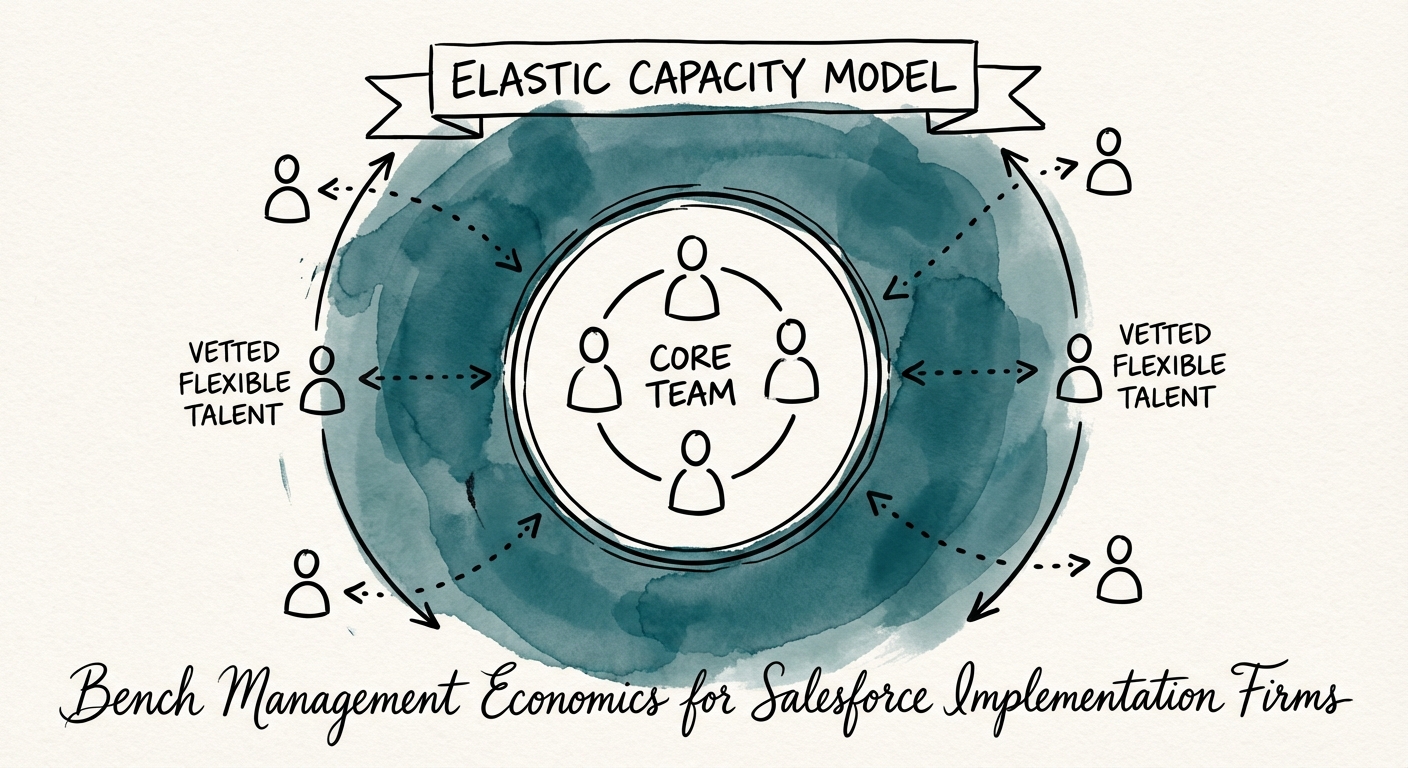
The solution is not to hoard talent. It is to build an Elastic Capacity Model. The most valuable Salesforce partners in 2026 don't own all their delivery assets; they orchestrate them. Instead of a 15% full-time bench, you need a "Warm Bench" of pre-vetted contractors and boutique partners who can spin up in 2 weeks.
The 3-Step Stabilization Playbook:
- Audit Your "Commitment" vs. "Actual": Look at your sales forecast accuracy. If you are hiring full-time heads based on a pipeline that closes at 40%, you are effectively gambling with payroll. Only hire full-time roles for signed backlog, not "verbal commits."
- Implement the 'Rule of 50' for Gross Margin: Your delivery Gross Margin (Revenue - Direct Delivery Costs) must be at least 50%. If it's lower, your bench is too big, or your rates are too low. Use this as your hard deck.
- Price for the Ramp: Stop giving away the first two weeks of a project. Structure your SOWs to include a paid "Discovery & Mobilization" phase. This buys you the 2-week window needed to activate your elastic talent network without eating the cost yourself.
Your valuation depends on your ability to decouple revenue growth from headcount growth. The firms that exit for 15x EBITDA aren't the ones with the most Architects; they are the ones with the most efficient revenue engines.