The practical answer
- Short answer
- Why 85% utilization is killing your Atlassian practice valuation. 2026 benchmarks for Gold and Platinum Solution Partners navigating the Cloud Specialization era.
- Best fit
- Industry: Professional Services. Function: Operations
- Operating path
- Unit Economics → Commercial Performance → Transaction Advisory Services
- Key metric
- 15-30% Increase in Data Center pricing in 2025, forcing rapid migration timelines that break high-utilization teams.
The 85% Utilization Myth: Why It Breaks Atlassian Practices
For most of the last decade, professional services firms viewed 85% billable utilization as the gold standard of efficiency. In the generic IT services world, this logic holds: if you are selling time, you maximize the inventory you sell. However, for Atlassian Solution Partners in 2026, targeting 85% utilization is a strategic error that directly erodes enterprise value.
The shift is driven by the Atlassian Cloud Specialization requirements and the rapid sunsetting of Server/Data Center products. Unlike static ERP implementations, the modern Atlassian ecosystem—encompassing Jira Align, Compass, and Forge-based app development—requires a continuous learning cycle that generic utilization models do not account for. When consultants are billed out at 85%, they have zero capacity to absorb the weekly changes in the Atlassian cloud platform or maintain the certifications required for Platinum status.
The "Certification Tax" on Capacity
Our data from auditing mid-market Atlassian partners shows a distinct correlation between high utilization (85%+) and Net Revenue Retention (NRR) degradation. Firms running "hot" miss the subtle pivot points in client accounts—such as the transition from Jira Software to Jira Service Management (JSM) for ESM use cases—because delivery teams are too buried in ticket resolution to act as advisors. The industry average utilization has dropped to 68.9%, signaling that the broader market is struggling to balance delivery with complexity. For elite Atlassian partners, the target must be 72%—high enough to ensure profitability, but low enough to allow the 8-10 hours per week required for upskilling and "advisory" pivots.
In the Atlassian ecosystem, 85% utilization isn't a badge of honor—it's a leading indicator of churn. You cannot master a platform that changes weekly while billing 40 hours a week.
Benchmarking by Role: The "Cloud Migration" Adjustment
The "lift and shift" era of Atlassian services is dead. The 2026 market demands complex cloud migrations and enterprise service management (ESM) deployments. This shifts the utilization profile for key roles within a partner organization. You cannot measure a Principal Architect leading a Data Center to Cloud migration with the same yardstick as a junior Jira Administrator.
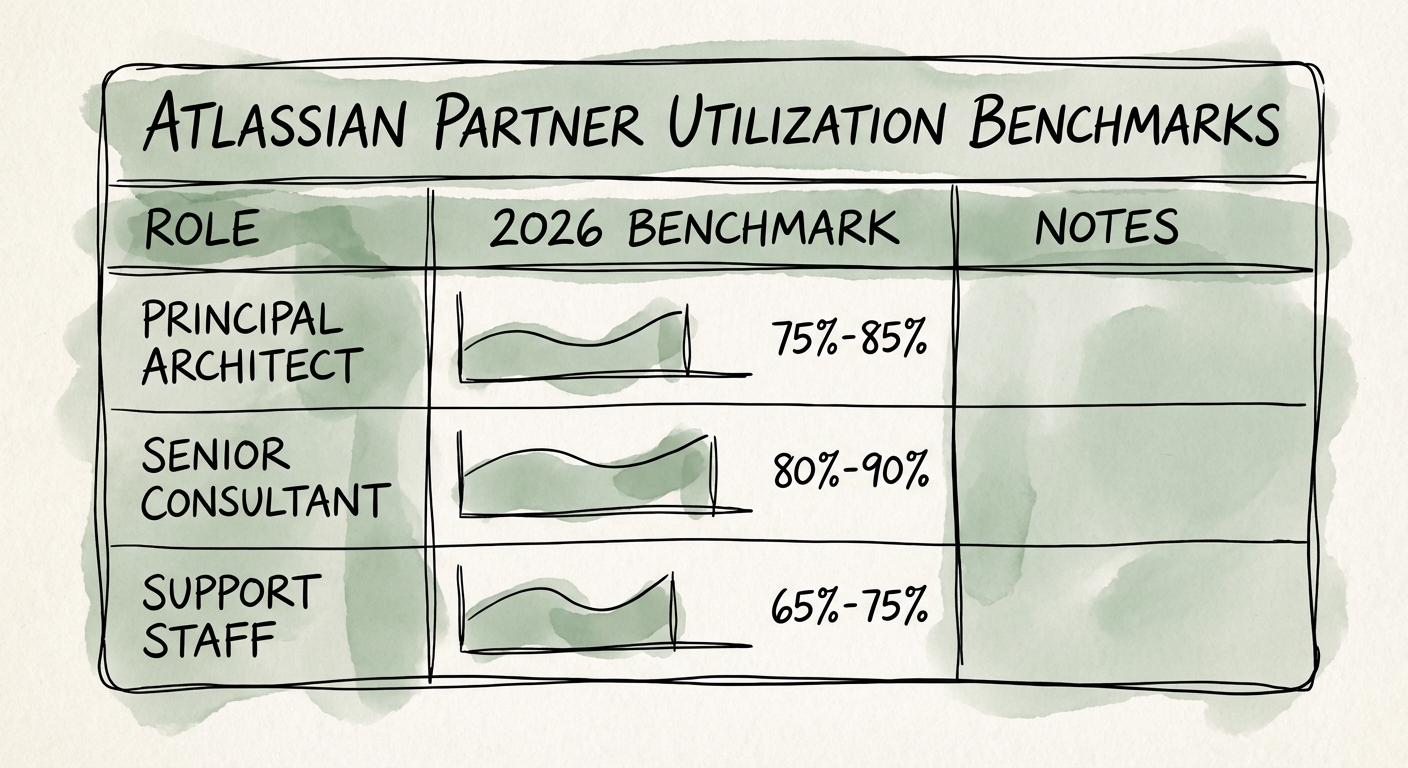
2026 Utilization Targets for Atlassian Partners
- Principal Architects (60-65%): These resources are the "tip of the spear" for complex migrations. Pushing them beyond 65% utilization results in delivery errors during high-stakes cutovers. Their value is in risk mitigation, not hours billed.
- Senior Consultants (70-72%): The workhorses of the practice. They execute the migration plans and configure complex workflows. At 72%, they remain profitable while having capacity to pursue "Cloud Specialized" badges.
- Managed Services / Support (75-80%): This is the only area where higher utilization is sustainable, provided the work is standardized. However, even here, benchmarks from similar ecosystems like AWS suggest that 80% is a hard ceiling before churn spikes.
Partners who ignore these role-specific caps often face the "Delivery Drift" phenomenon, where projects are completed on time but fail to unlock the strategic value (e.g., Jira Align visibility) that ensures renewal. This turns high-margin consulting revenue into low-margin staff augmentation.
Valuation Impact: Why PE Buyers Discount High Utilization
When Private Equity firms evaluate Atlassian partners, they look past the headline EBITDA margin to the quality of that margin. A firm generating 25% EBITDA with 85% utilization is viewed as a "fragile asset." It implies the firm is maximizing short-term revenue at the expense of intellectual property (IP) development and workforce sustainability. This is often flagged as technical debt in the delivery organization.
Conversely, a firm with 18% EBITDA and 72% utilization is often valued at a higher multiple. Why? Because that "missing" 13% of utilization represents embedded growth capacity. It means the team has the bandwidth to cross-sell JSM, adopt new Atlassian Intelligence features, and build proprietary Forge apps that drive recurring revenue. In the due diligence process, we specifically look for the "Training to Billing Ratio." Elite partners invest 10-15% of total hours into non-billable training and internal IP development. If that number is near zero because everyone is 85% utilized, the terminal value of the business is significantly lower.
The Strategic Pivot: Stop optimizing for "efficiency" defined as maximum billable hours. Start optimizing for Effective Yield per Consultant. If a consultant at 70% utilization can bill $275/hour because they are certified on Jira Align, they generate more margin than a consultant at 90% utilization billing $175/hour for basic admin tasks. The math of the Atlassian ecosystem has changed; your operational metrics must follow.