
The practical answer
- Short answer
- New 2025 data reveals average AWS partner utilization has dropped to 68.9%. Learn why 75% is the new operational gold standard for founders.
- Best fit
- Industry: Cloud Consulting / IT Services. Function: Operations / Delivery
- Operating path
- Unit Economics → Commercial Performance → Transaction Advisory Services
- Key metric
- 68.9% Average 2025 Professional Services Billable Utilization (Source: SPI)
The Great Utilization Slide of 2025
If you are running an AWS consulting practice between $10M and $50M in revenue, you are likely feeling a specific type of pain right now: your team is busier than ever, but your EBITDA isn't showing it. You are not alone. According to the 2025 Professional Services Maturity Benchmark by Service Performance Insight (SPI), average billable utilization across the sector has dropped to 68.9%. For a Founder used to the "heroic" days where your core team ran at 90% capacity, this number looks like failure. It isn't just failure; it's a structural trap.
The drop in utilization isn't because your sales team stopped selling. It's because the complexity tax of the AWS ecosystem has skyrocketed. To maintain AWS Premier Tier status or even Advanced Tier competencies, you are now required to carry a heavier load of non-billable training time. With AWS launching over 3,000 new features annually and the AI infrastructure boom demanding entirely new skill sets (Bedrock, Q, SageMaker), your engineers are spending 15-20% of their time just staying relevant. This is the "Training Tax."
However, many firms misdiagnose this. They see 68.9% and react by freezing hiring or pushing the sales team to sell "anything to anyone" to fill the bench. This leads to the most dangerous metric in a services firm: High Utilization, Low Realization. Your engineers are "busy" fixing bad projects, sitting in unbilled pre-sales meetings to close complex deals, or reworking failed migrations. You might see 85% utilization on your timesheets, but if your Realization Rate (the % of that time actually invoiced and paid) is below 80%, you are wasting cash. You are effectively paying your team to lose money.
In the AWS ecosystem, 85% utilization is a vanity metric that often hides a burnout culture. The most profitable firms I see run at 75% utilization with 95% realization—they don't just work hard; they get paid for every hour they work.
The $10M-$50M "Death Zone" Benchmarks
When you were under $10M, you could survive on high margins and founder oversight. Now, you are in the scale-up phase, and the benchmarks have shifted. Based on 2025 market data, here is where high-performing AWS partners actually sit versus the industry average:
1. Billable Utilization Targets
While the industry average is 68.9%, top-quartile (Level 5) firms are achieving 74-76%. Note that this is lower than the traditional 85% target. Why? Because in the modern AWS ecosystem, pushing past 76% billable utilization usually results in attrition. The talent market for certified AWS Solutions Architects is too competitive. If you grind them at 90%, they will leave for a corporate role or a competitor who offers "learning time." The new operational excellence standard is 75% billable, 15% training/IP development, 10% PTO/Admin.
2. Gross Margins by Service Type
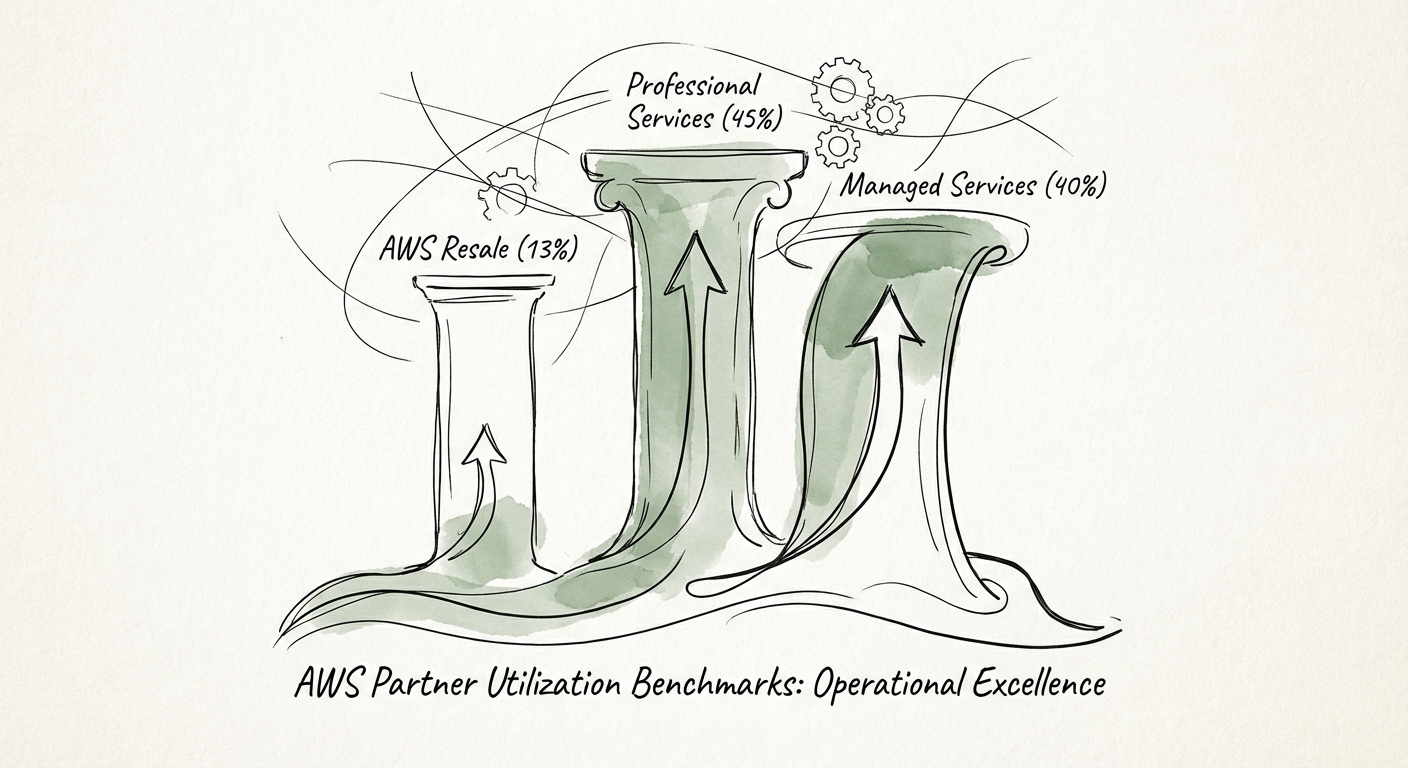
Your utilization must be contextualized by what you are delivering. If you are merely reselling AWS/Marketplace solutions, your margins are capped at 13-18%. The real operational excellence game is shifting your mix toward Managed Services and IP-led delivery. Top-tier partners are seeing 40-45% gross margins on Professional Services sold via AWS Marketplace, and 30-40% on Managed Services. If your blended gross margin is below 35%, your utilization isn't the problem—your Revenue Architecture is.
3. The Multiplier Effect
Operational excellence isn't just about efficiency; it's about leverage. The latest Canalys data indicates that partners with deep specialization (Operational Excellence) generate a $6.40 multiplier for every $1 of AWS compute sold. This comes from attaching advisory, design, migration, and managed services. If your multiplier is closer to $2.00, you are operating as a "Body Shop," not a strategic partner. This low-leverage model makes your business hyper-sensitive to utilization drops, whereas high-multiplier firms have the margin buffer to weather the storms.
From Heroics to Systems: The Operational Fix
So, how do you fix a 68.9% utilization rate without burning out your team? You stop treating utilization as a personnel problem and start treating it as a pipeline problem.
1. Forecast, Don't React
Most founders hire based on the pain of the present. "We are swamped, hire two engineers!" By the time they onboard in 90 days, the project wave has passed, and they sit on the bench. Operational Excellence means implementing a 12-week rolling resource forecast. You must map probability-weighted pipeline opportunities directly to resource slots. If a deal is 70% likely to close in Month 2, you soft-book the resources now. This visibility allows you to use contractors for peaks rather than full-time hires for valleys.
2. Monetize the "Training Tax"
Stop treating training as overhead. Smart AWS partners turn their internal upskilling into external revenue. If your team needs to learn AWS Bedrock, build a "GenAI Readiness Assessment" product. Sell the assessment at a low margin (or break-even) to fund the learning curve on live client data. This converts non-billable training time into billable (albeit lower margin) delivery time, keeping utilization healthy while building the portfolio.
3. The "Bench" is a Product Team
When utilization drops, the bench shouldn't just sit there. In a high-valuation firm, the bench is the R&D department. Assign unbilled engineers to build Terraform accelerators, Migration factories, or SuiteApps. This IP reduces delivery costs on future projects, effectively raising your gross margin over time. You are trading current utilization for future margin expansion. This is how you escape the "time for money" trap and build a firm that commands a 12x EBITDA multiple at exit.