
The practical answer
- Short answer
- New 2025 data reveals why targeting 85% utilization destroys agency EBITDA. Discover the new 72% 'Sweet Spot' for Shopify Plus partners and how to optimize for exit.
- Best fit
- Industry: Ecommerce Agencies. Function: Operations
- Operating path
- Unit Economics → Commercial Performance → Transaction Advisory Services
- Key metric
- 68.9% Average 2025 billable utilization for professional services firms (SPI Research).
The 85% Efficiency Myth: Why "Perfect" Utilization Kills EBITDA
In the boardroom of nearly every scaling Shopify agency, there is a slide dedicated to utilization. The target is almost invariably set at 85%. The logic seems sound: labor is your biggest cost, so maximizing billable hours should maximize profit.
The data tells a different story. According to the 2025 SPI Professional Services Maturity Benchmark, average billable utilization across the industry has dropped to 68.9%, while EBITDA margins have compressed to 9.8%. However, the top 20% of performing firms—those commanding premium valuations—aren't running at 85%. They are deliberately operating at a 72% utilization sweet spot.
The "Red Zone" of Burnout
When an agency pushes utilization beyond 80%, it enters what we call the "fragility zone." At 85% utilization, a 40-hour employee has exactly 6 hours per week for non-billable tasks. This leaves zero capacity for:
- Upskilling: Learning new Shopify APIs (e.g., Hydrogen, Oxygen, or Checkout Extensibility).
- Context Switching: The mental tax of jumping between 4-5 client projects.
- Surge Capacity: Handling an urgent Black Friday/Cyber Monday (BFCM) request without delaying other work.
The result is a "burn and churn" cycle. High utilization correlates directly with high attrition. Replacing a senior Shopify developer costs approximately 150% of their annual salary in recruiting fees, lost billing, and ramp time. A firm running at 85% utilization with 25% attrition is significantly less profitable than a firm running at 72% utilization with 10% attrition.
Agencies that hit—and hold—a 72% utilization rate make peak profit without burning people out. 85% is vanity; 72% is sanity.
The "Hidden" Shopify Tax: Why New Partner Tiers Demand Lower Utilization
Shopify's 2025 Partner Program updates have fundamentally changed the unit economics of agency operations. The introduction of the Certified, Premier, and Plus tiers has shifted the requirement from pure volume (GMV) to technical competency and badge acquisition.
Maintaining "Premier" or "Plus" status now requires continuous investment in Verified Skills Badges and app certifications. If your engineers are billed out at 85%, they physically do not have the time to complete the requisite training to maintain your partner status. You are effectively billing yourself out of the ecosystem.
Benchmarks by Role
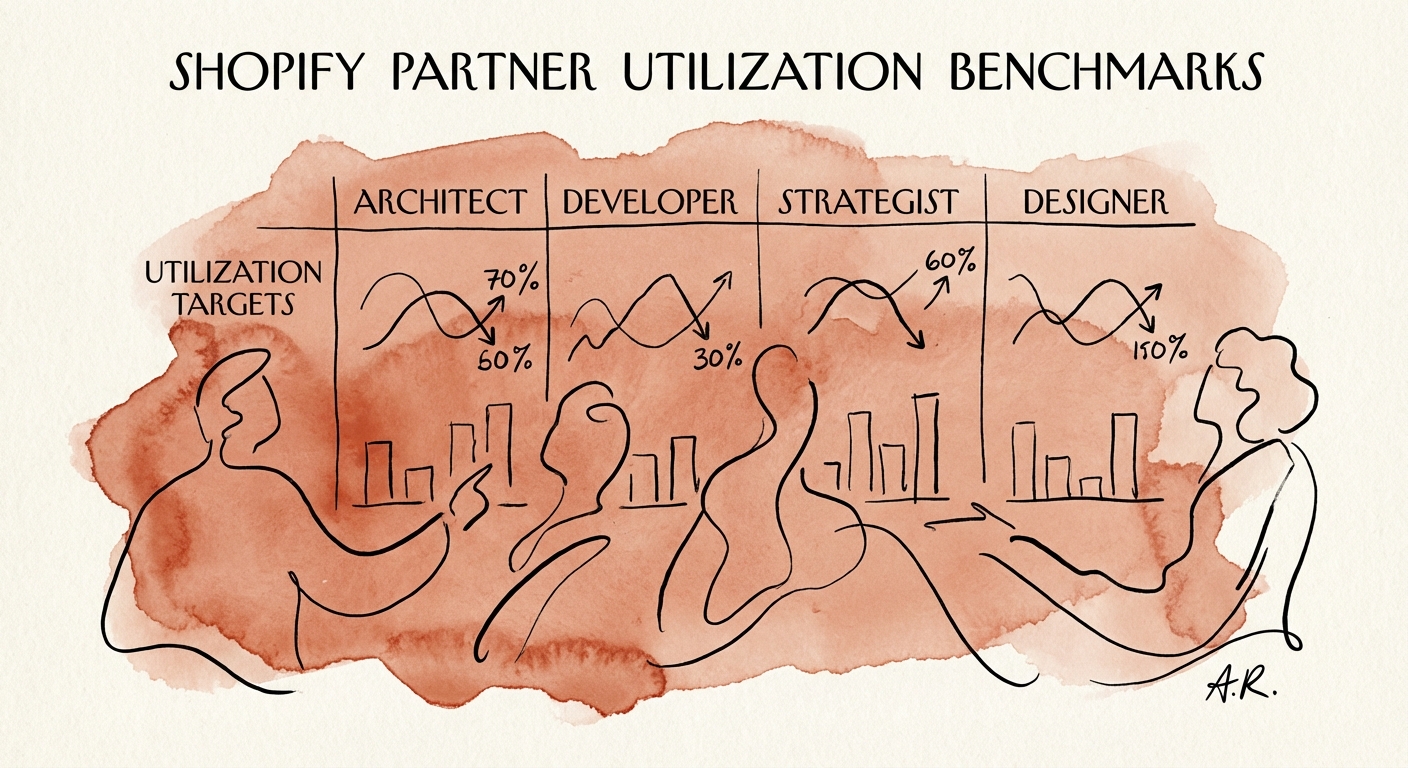
To balance profitability with the requirements of the new partner program, scaling agencies must adopt role-specific utilization targets rather than a blanket agency-wide number:
| Role | 2025 Target Utilization | Reasoning |
|---|---|---|
| Senior Architect | 65% | Must reserve 35% capacity for pre-sales technical validation and mentorship. |
| Mid-Level Developer | 75% | The production engine. Focus is on ticket execution and billable efficiency. |
| Strategist/CRO | 50% | High value, but high non-billable time spent on quarterly business reviews (QBRs) and retention. |
| Designer/UX | 70% | Requires "white space" for creative concepting that clients refuse to pay hourly for. |
Agencies that force Strategists to hit 75% utilization inevitably turn them into "ticket takers," destroying the strategic value that justifies premium retainers.
From Utilization to Effective Yield: The Metrics That Actually Matter
Stop managing to utilization and start managing to Revenue Per Employee (RPE). A firm billing $150/hour at 85% utilization generates roughly $255,000 per employee. A firm billing $225/hour at 70% utilization generates roughly $315,000 per employee—with a happier team and higher client retention.
The Capacity for Exit
Private Equity buyers scrutinize utilization for different reasons than you might expect. They aren't looking for 90%. They are looking for repeatability. An agency running at 90% is a risk; if two key developers leave, the revenue collapses. An agency running at 70-75% has "absorptive capacity"—it can take on a new enterprise account without breaking the existing delivery infrastructure.
To prepare for a premium exit, shift your monthly reporting from "Hours Logged" to "Effective Billable Rate" (Revenue / Total Hours Worked). If your utilization is high but your Effective Billable Rate is dropping, you are leaking value through scope creep—a far more dangerous problem than a bench that is slightly too deep.
For a deeper dive on how utilization impacts valuation multiples, read our guide on Professional Services Utilization Rate Benchmarks 2025.