
The practical answer
- Short answer
- Analysis of Shopify Plus Partner program economics, valuation impacts, and the 'commercial impact' trap. Why the Plus badge costs more than you think.
- Best fit
- Industry: eCommerce Agencies. Function: Partnerships
- Operating path
- Unit Economics → Commercial Performance → Transaction Advisory Services
- Key metric
- 126% Higher revenue per customer for Shopify Plus merchants vs. standard, driving agency demand.
The New Economics of "Sales-Assisted" Growth
For years, the Shopify Partner ecosystem was the gold standard of channel alignment: you brought the merchant, you got 20% of the recurring revenue, and you kept the service margins. In 2025, that equation fundamentally changed for the mid-market. With the introduction of the "Sales-Assisted" Launch Commission (set at 15% for deals contracted with Shopify sales involvement), the economics of being a Plus Partner have shifted from "passive income" to "active arbitrage."
The critical distinction in the 2025 Partner Program updates is the bifurcation of "Partner-Initiated" vs. "Sales-Assisted" revenue. For scaling agencies, the reality is that nearly every enterprise deal involves the Shopify sales team. This effectively caps your platform referral revenue at 15%—a significant haircut from the historical 20% bounty that fueled the early growth of many "OG" Plus agencies.
For founders, this creates a dangerous unit economics trap. If your agency modeled its profitability on a 20% pure referral stream to subsidize lower-margin implementation work, your blended EBITDA is likely eroding. We are seeing PE buyers specifically scrutinize the "Referral vs. Service" revenue mix during Quality of Earnings (QofE). Agencies relying on platform commissions for >15% of their gross profit are trading at a discount, as buyers view this revenue stream as "at risk" of further program policy changes.
The Plus badge is no longer a business model; it's a lead gen channel with a high cost of admission. The agencies winning in 2026 are those that use the badge to get in the room, but use their own IP to stay there.
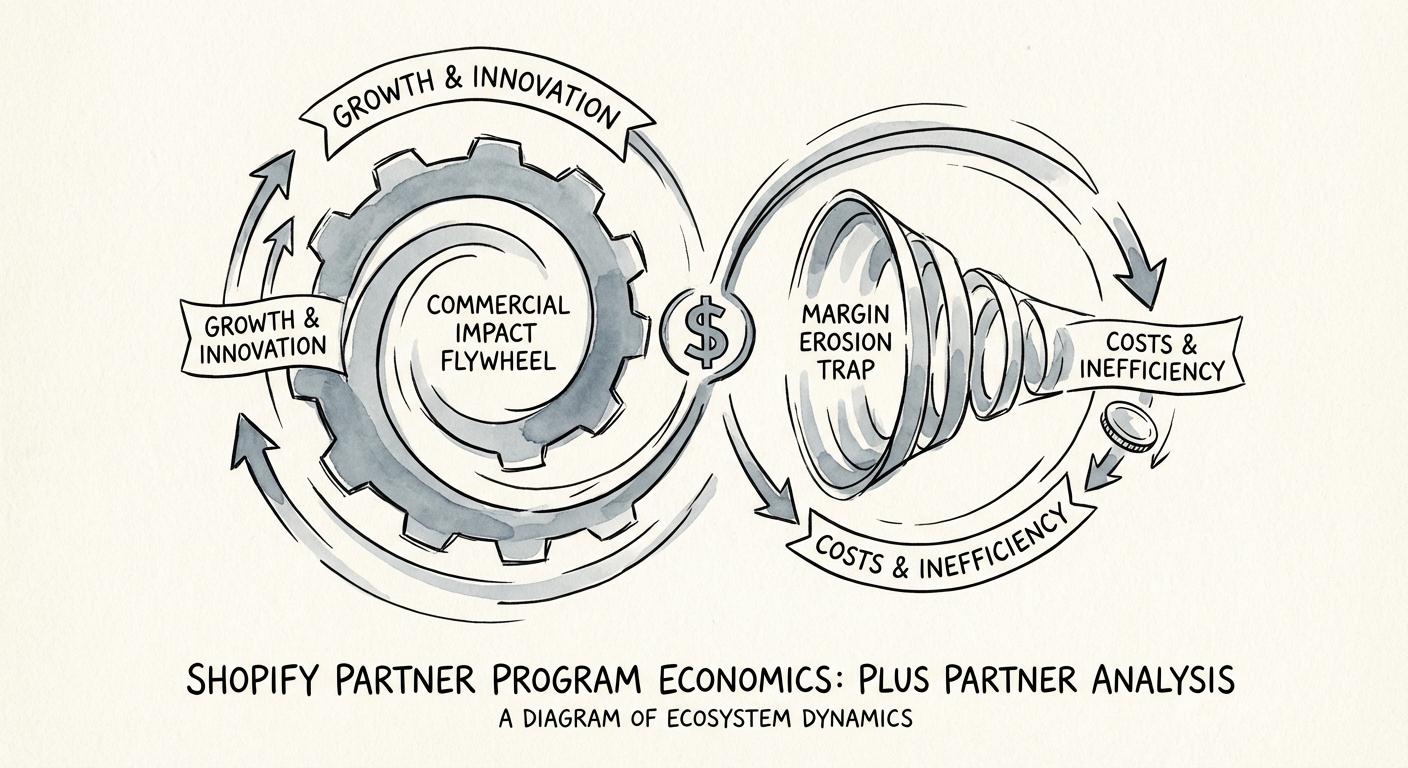
The "Commercial Impact" Hamster Wheel
The hidden cost of the Plus badge isn't the annual fee—it's the Commercial Impact requirement. To maintain Plus status, partners must demonstrate a sustained pattern of bringing "valuable merchants" to the ecosystem. This requirement forces agencies into a volume-based "hamster wheel" that is diametrically opposed to the high-margin, low-volume model that drives premium valuations.
We observe a distinct divergence in agency behavior:
- The "Badge Hunters" (4x-6x EBITDA): These firms chase every possible launch to meet Shopify's referral quotas. They take on bad-fit clients, discount implementation fees to win the "logo credit," and burn out their delivery teams. Their utilization is high (often >85%), but their effective hourly rate (EHR) is plummeting because they are subsidizing the "Commercial Impact" score with free work.
- The "Platform Strategists" (10x-12x EBITDA): These firms treat the Plus badge as a marketing asset, not a business model. They prioritize Net Revenue Retention (NRR) over new launches. They build deep, recurring Managed Services moats around data, headless architecture (Hydrogen), and conversion rate optimization (CRO).
The data is clear: PE firms pay for the second model. They are buying the intellectual property of your delivery process, not your ability to resell Shopify licenses. If your "Commercial Impact" score is high but your Gross Margin is below 50%, you are effectively paying Shopify to be their sales engineer.
Valuation Bifurcation: Theme Builders vs. Composability Experts
The market for Shopify agencies has bifurcated. On one side are the "Theme Builders"—agencies primarily focused on Liquid themes and standard setups. These firms are seeing valuation compression, trading at 4x-5x EBITDA. The barrier to entry has collapsed, and AI tools are commoditizing basic theme development.
On the other side are the "Composability Experts"—partners specializing in complex integrations, ERP connectivity, and Hydrogen/Oxygen headless builds. These firms are commanding 10x-14x EBITDA multiples because they solve the complex technical debt problems that larger enterprises face.
The Exit Readiness Checklist for Plus Partners
If you are planning an exit in the next 18 months, you must decouple your valuation from your Partner Tier:
- Audit Your Referral Dependence: If Shopify commissions disappeared tomorrow, would you still be profitable? If the answer is no, you are not an agency; you are a reseller.
- Shift to Retainers: Move away from "Launch and Leave." Buyers want to see 40%+ of revenue coming from recurring Managed Services contracts that persist post-launch.
- Specialization is King: "Full Service" is a red flag. Be the "B2B Expert" or the "Headless Expert." Generalist Plus partners are trading at a discount due to the "Race to the Bottom" in standard implementation pricing.