
The practical answer
- Short answer
- Analysis of Veeva partner program economics for PE and Founders. Benchmarks on certification costs, Vault CRM migration opportunities, and valuation multiples.
- Best fit
- Industry: Life Sciences Technology. Function: All Operations
- Operating path
- Unit Economics → Commercial Performance → Transaction Advisory Services
- Key metric
- $240k Annual revenue lost to 'over-certification' maintenance exams for a 50-person firm.
The 'Badge Collector' Trap: Why Certification Density Kills Utilization
In most partner ecosystems, more certifications equal higher bill rates and better tiering. In the Veeva ecosystem, this logic is a trap that bleeds EBITDA from unsuspecting services firms.
Veeva operates on a strict three-release-per-year cycle. Unlike Salesforce or Microsoft, where maintenance exams are often annual or non-trivial, Veeva requires every certified professional to pass maintenance exams for every credential they hold, three times a year. If a consultant holds four certifications (e.g., Vault Platform, QualityDocs, RIM, and CRM), they are taking 12 maintenance exams annually.
The Hidden Cost of the 'Full Stack' Consultant
For a firm with 50 consultants, a strategy of "cross-training everyone" creates a massive operational tax. If you push for 4 certifications per head, your team is collectively taking 600 exams per year. Assuming a conservative 2 hours for prep and testing per exam, that is 1,200 non-billable hours annually—roughly the equivalent of burning $240,000 in billable revenue (at $200/hr) just to maintain status quo.
Our data shows that "Generalist" Veeva partners (those with >3 certs per consultant across disparate product lines) run 4.2% lower utilization than Specialists. The winning strategy for 2026 is narrow depth: creating "R&D Pods" and "Commercial Pods" where consultants hold only the 1-2 certifications relevant to their billable work, minimizing the "Maintenance Tax."
Veeva's release cycle is the ultimate utilization killer. If you don't manage your certification density, you are paying a 4% tax on revenue just to keep badges on a slide deck that nobody reads.
The Vault CRM Migration: A Once-in-a-Decade 'market opening' (With a Catch)
Veeva is currently decoupling from Salesforce, migrating its entire CRM install base to the native Vault CRM platform by 2030. For partners, this creates an immediate, massive service revenue spike. However, the economics of this work are bifurcating rapidly.
Commodity Migration vs. Strategic Transformation
There are two ways to price this migration. The "Lift and Shift" approach—simply moving data and configuration from Salesforce to Vault—is rapidly becoming commoditized. Partners competing here are seeing rate pressure, dropping blended rates to $165-$185/hr.
The "Strategic Transformation" approach leverages the migration to implement Veeva AI (Agentic AI) and optimize for the new "Commercial Cloud" data model. Partners positioning the migration as an AI-readiness project are commanding $250-$300/hr for solution architects. The Delta between "Migration Services" and "Commercial Strategy" is effectively 60% in gross margin terms.
Private Equity investors evaluating Veeva partners must ask: Is the firm winning Vault CRM deals because they are the cheapest pair of hands, or because they are the architect of the client's AI future?
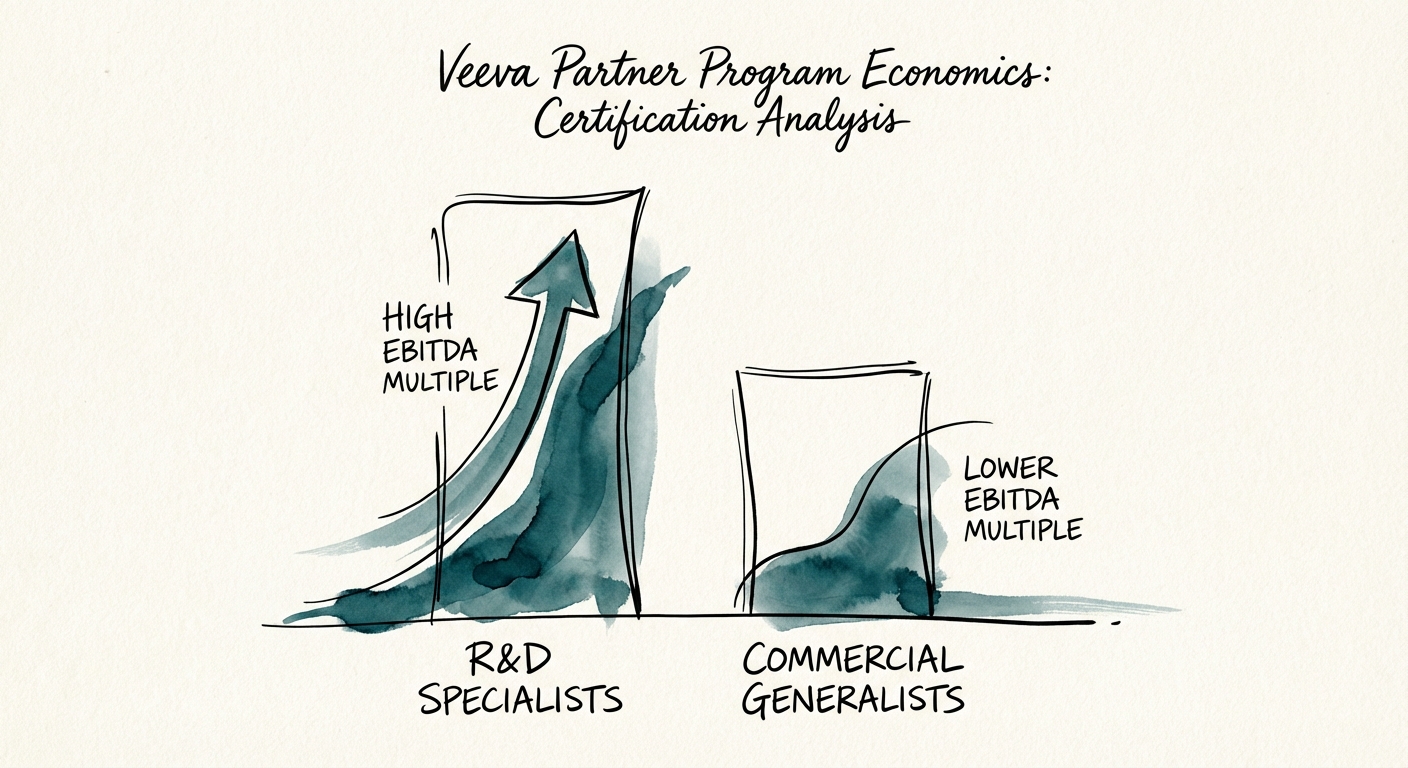
Valuation Bifurcation: R&D Specialists vs. Commercial Generalists
Not every dollar of Veeva revenue is worth the same. The market is currently assigning vastly different multiples to partners based on which "Cloud" they dominate.
The R&D Premium (14x EBITDA)
Partners specialized in Veeva Development Cloud (Clinical, Quality, Regulatory) command the highest multiples. These systems are sticky "systems of record" with high regulatory barriers to entry. A "Preferred" partner in Vault RIM (Regulatory Information Management) is a scarce asset. We are seeing these firms trade at 12x-14x EBITDA because their revenue is defensive and recession-resistant.
The Commercial Discount (8x EBITDA)
Partners focused heavily on legacy Veeva CRM support or generic "Commercial Cloud" managed services are trading lower, typically 8x-10x EBITDA. The risk here is higher due to the platform shift (Vault CRM migration) and the lower barrier to entry for generalist staff augmentation firms.
The Strategy: If you are a Commercial-heavy shop, your immediate goal must be to secure "Preferred" status in a high-growth niche like Veeva Link or Vault CRM AI to break out of the generalist discount.