
The practical answer
- Short answer
- Why pushing Veeva consultants to 85% utilization destroys value. Benchmarks for Clinical, Quality, and Commercial partners, and the impact of the 3x/year release cycle.
- Best fit
- Industry: Life Sciences Technology. Function: Operations
- Operating path
- Unit Economics → Commercial Performance → Transaction Advisory Services
- Key metric
- 68.9% Average billable utilization for professional services firms in 2025, down from 73.2% in 2021.
The 85% Utilization Myth in Life Sciences
In the general IT services world, a billable utilization rate of 80-85% is often the gold standard for profitability. Private Equity operating partners, accustomed to "body shop" mechanics in lower-complexity ecosystems, frequently apply this same benchmark to Veeva Systems partners. This is a fundamental error that leads to talent burnout, certification lapses, and eventual valuation decay.
The reality for premium Life Sciences consultancies is starkly different. Recent data indicates that across the broader professional services landscape, billable utilization has dropped to 68.9%. For specialized Veeva partners, the "Goldilocks Zone"—where profitability is maximized without sacrificing delivery quality or retention—sits between 70% and 72%. Pushing beyond this threshold in a GxP-regulated environment doesn't generate more margin; it generates risk.
Why is the ceiling lower for Veeva partners? Unlike generalist Salesforce or Microsoft shops, Veeva consultants operate at the intersection of complex technology and rigid regulatory compliance (FDA, EMA, PMDA). A "minor" configuration error isn't just a bug; it's a potential compliance finding. High utilization leaves zero margin for the deep work required to navigate these complexities, turning your firm from a strategic advisor into a risky commodity player.
In Life Sciences, a 'fully utilized' consultant is an uneducated consultant. If you aren't leaving 15% of capacity for the release cycle, you aren't building a practice—you're just running a staffing agency.
The 'Release Rhythm' Tax: Why You Can't Bill 2,000 Hours
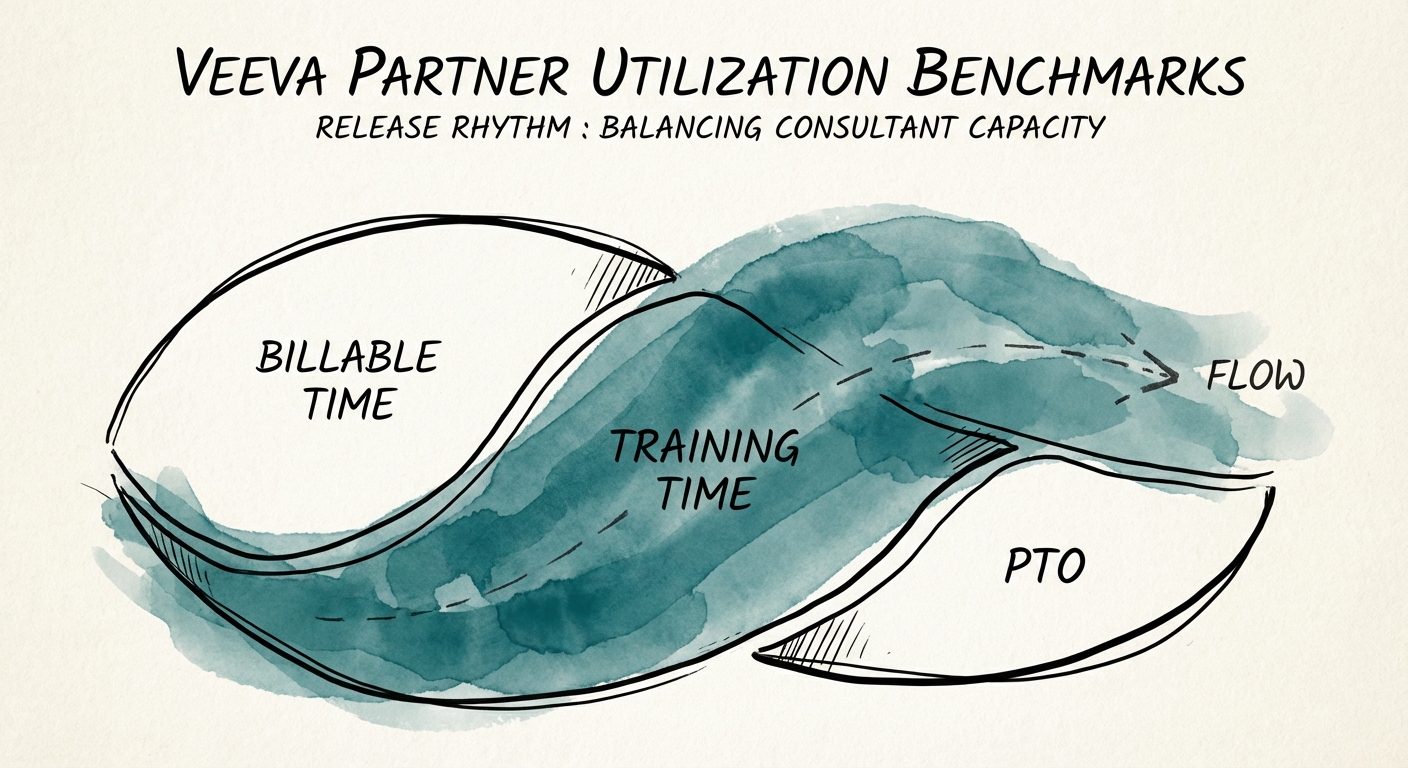
The single biggest suppressor of utilization in the Veeva ecosystem is the platform's aggressive innovation cycle. Veeva pushes three major releases per year. This isn't optional maintenance; it is a forced march of continuous education. Every release introduces new features across Vault Clinical, Quality, Regulatory, and Commercial Cloud that consultants must master to remain relevant.
Consider the math of a "Premier" Veeva partner:
- Mandatory Recertification: Consultants must re-certify annually. A single Vault System Administrator certification can require 11+ hours of exam time, plus dozens of hours of pre-work and study.
- Release Training: With three releases annually, a consultant needs approximately 40-60 hours per year just to stay current on "What's New" documentation and sandbox testing.
- Multi-Cloud Complexity: The highest-value consultants work across clouds (e.g., Clinical and Quality). This doubles the training burden.
If you run your team at 85% utilization (approx. 1,768 billable hours), you leave them with roughly 312 hours for everything else—PTO, holidays, internal meetings, and training. In the Veeva ecosystem, that "everything else" bucket is consumed entirely by the release cycle. The result? Your team stops learning. They become "Paper Tigers"—certified on paper, but practically obsolete on the latest features like Vault CDMS or CRM-to-Vault CRM migrations. In due diligence, buyers spot this immediately when they interview your architects and realize they are solving 2026 problems with 2023 solutions.
Valuation Impact: The 'Body Shop' Discount
In the M&A market, acquirers are becoming sophisticated about the difference between "high utilization" and "high value." A Veeva practice running at 85% utilization is often viewed as a distressed asset in disguise. It signals that the firm is maximizing short-term cash flow at the expense of intellectual property and future readiness.
The Two Profiles of Veeva Partners
1. The Staff Augmentation Shop (85% Utilization):
These firms trade at 5x-7x EBITDA. They are essentially renting out warm bodies. Their consultants are burnt out (Life Sciences burnout rates are hovering near 55%), turnover is high, and they compete solely on rate card. They have no capacity to build proprietary IP or accelerators.
2. The Strategic Consultancy (72% Utilization):
These firms trade at 10x-14x EBITDA. They deliberately cap utilization to allow for:
- IP Development: Building pre-configured validation packs or migration accelerators.
- Cross-Training: turning a "Quality" consultant into a "Quality + Regulatory" expert.
- Centers of Excellence (CoE): Senior staff spending 20% of their time mentoring juniors, reducing the reliance on expensive senior hires.
Actionable Advice: Stop apologizing for sub-80% utilization. Instead, frame it as a strategic investment in Rate Per Hour (RPH). A consultant at 70% utilization billing $300/hr generates more revenue ($436k) than a burnt-out consultant at 85% utilization billing $225/hr ($397k)—and the former is building the IP that drives your exit multiple.