
The practical answer
- Short answer
- An 88% utilization rate is excellent for a delivery analyst and a five-alarm fire for an engagement manager. The 2026 benchmarks by role, and why blended numbers lie.
- Best fit
- Industry: Technology Services. Function: Operations
- Operating path
- Unit Economics → Commercial Performance → Transaction Advisory Services
- Key metric
- 22% Drop in net-new expansion revenue when Engagement Managers are forced to bill over 75% utilization.
One number, four completely different verdicts
Picture a systems integrator where every consultant, regardless of title, runs at 84% billable utilization. The CFO sees a single clean line on the dashboard and calls it a high-performing bench. He's reading the same number four different ways without knowing it. For the delivery analyst, 84% is healthy. For the engagement manager, it's a project about to slip its scope. For the practice director, it's a leadership vacuum. For the partner, it means nobody is filling the pipeline that feeds all three. The blended average buried every one of those signals.
This is the trap I keep finding when I run operational diligence on tech-services firms. In a 2026 review I flagged a portfolio company humming along at a "great" 88% blended rate. Three months after close, three of its senior architects walked to a competitor and took their accounts with them. Nobody had been protecting their time to mentor, to document the integration patterns that lived only in their heads, or to scope the next phase. They were billing like analysts, so they left like analysts who'd been treated wrong.
The aggregate number you put on the board hides this. Service Performance Insight's 2026 Professional Services Maturity Benchmark puts the top-performing firm's target blended utilization at 72.3% — and the reason that figure feels low is that it's the weighted result of holding analysts high and senior people deliberately low. Push the blend up and you're almost always doing it by overworking the exact people you can least afford to lose. McKinsey's analysis on professional services burnout finds that for every 5% you drive utilization above the 80% line, voluntary attrition jumps 12% the following quarter. The blend doesn't tell you who's about to quit. The role-by-role view does.
A partner billing 70% of their time isn't a partner. He's the most expensive senior consultant on your payroll, and you're paying him to not do the one job only he can do.
The benchmark is a staircase, not a line
Read your bench as four separate populations, because the right answer climbs and then deliberately falls as you go up the pyramid. Here's the staircase I hold tech-services firms to in 2026.
Delivery analysts and junior consultants: 85–90%. This is the one tier where a high number is the goal. Their work is execution against a defined scope, and idle analyst time is pure margin leakage. If a first-year is sitting at 60%, you have a staffing problem, not a wellness program.
Senior consultants and engagement managers: 70–75%, and not a point higher. This is where most founders torch value without realizing it. An EM billing 40 hours a week is an EM who isn't running the Thursday risk review, isn't coaching the two analysts under them, and isn't catching the scope drift that turns a $500K implementation into a $2M write-off. Gartner's 2026 IT Services Utilization Benchmarks are blunt about the cost: firms that push engagement managers past a 75% billable target see net-new expansion revenue in those very accounts drop 22%. The unbillable quarter of an EM's week is where the upsell gets spotted and the renewal gets de-risked. Bill it away and you're trading a margin point this quarter for the whole account next year.
Directors and partners: below 45%. Quoting myself from the diligence floor — a partner billing 70% of their time isn't a partner, he's your most expensive senior consultant, and you're paying a premium for him to skip the one job only he can do: bring in work and develop the practice. PwC's 2026 Professional Services KPI Report frames the senior tier's unbillable hours not as overhead but as the firm's R&D, training, and IP engine. That's the part a blended number erases entirely.
Try this Monday: pull last quarter's utilization and re-cut it by these four tiers instead of one average. If your engagement managers are above 78% and your partners are above 55%, you don't have an efficient firm — you have an inverted one, and it's bleeding from both ends. Run the corrected blend through a utilization rate calculator and you'll usually find the "great" firm-wide number was masking two tiers in the red.
How a buyer reads your bench in diligence
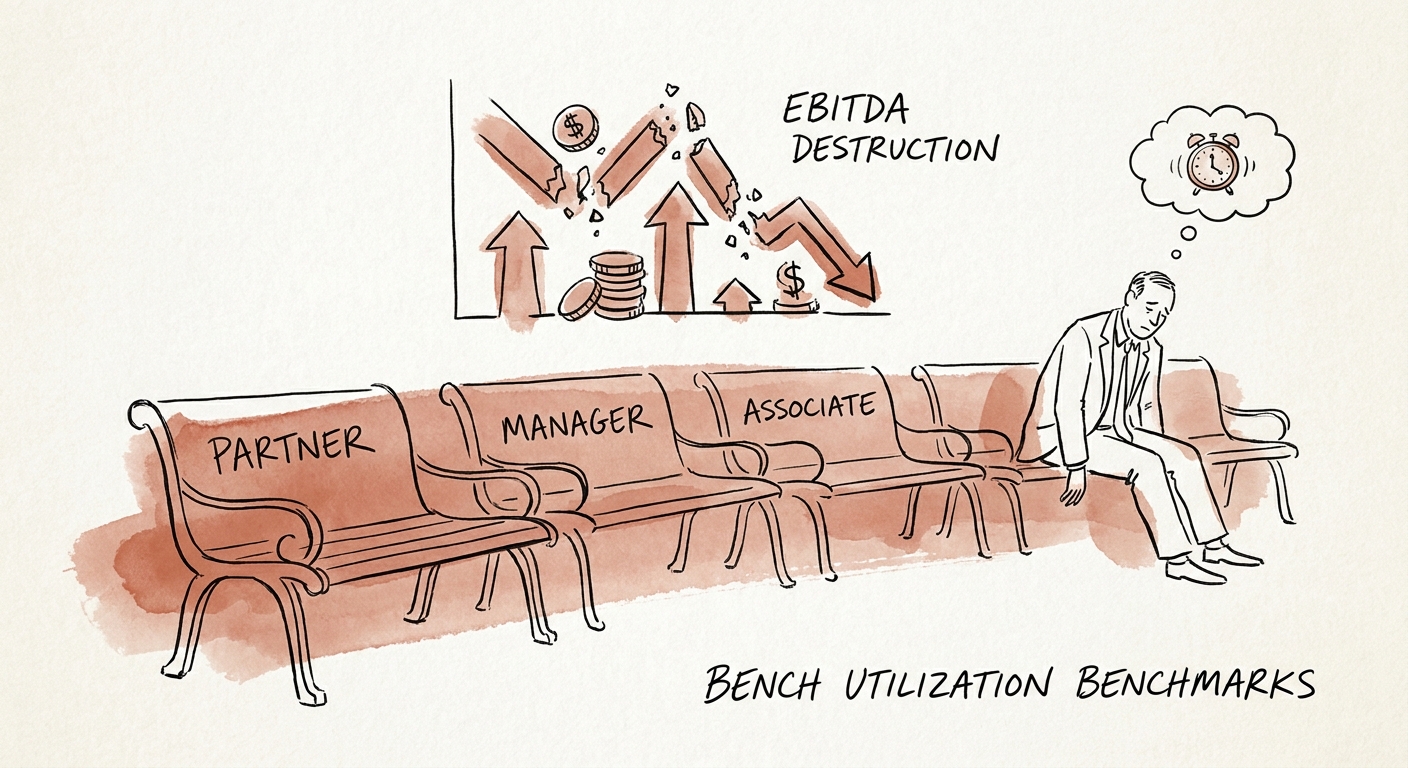
Here's why this stops being an HR conversation the moment you think about selling. A sophisticated acquirer does not take your blended utilization at face value — they decompose it exactly the way I just described, and they do it specifically to find the heroics you're capitalizing as margin. If you show a 25% EBITDA margin built on senior consultants quietly logging 50-hour weeks, the buyer doesn't congratulate you. They normalize it down. They model the hires required to pull that senior tier back to a sustainable 72%, apply a burnout discount, and hand you a lower number.
The math is unforgiving once you see it by role. Say your adjusted EBITDA falls $2M after a buyer re-staffs your over-billed managers and partners. At an 8x multiple, that's $16M of enterprise value that evaporated — not because the business was bad, but because the by-role detail revealed the firm-wide number was borrowed against your people. And the loan comes due either way: Deloitte's 2026 Human Capital Trends report on consulting retention costs puts the all-in cost of replacing a burned-out senior consultant at 1.5x to 2x their base salary once you load in recruiting, ramp time, and the institutional knowledge that walks out the door. You either pay to keep the slack in the system, or you pay more to replace the people the missing slack burned out. This is a large part of why the gap in managed services vs. professional services valuation margins keeps widening — recurring-revenue models bake capacity redundancy into the design, while services firms run their senior bench right up to the red line.
So manage the staircase, not the average. Hold your analysts high, give your engagement managers their quarter back, and let your partners do the work only partners can do. Do that and the by-role detail that a buyer would have used against you becomes the thing that survives diligence intact — a defensible margin instead of a discounted one. That's the difference between a number you can sell and a number you have to apologize for.