
The practical answer
- Short answer
- Why UiPath Diamond status can cost a services firm $1M in lost billable capacity, and why USN certification and a 5:1 service attach ratio actually move your multiple.
- Best fit
- Industry: Intelligent Automation. Function: Partnerships
- Operating path
- Unit Economics → Commercial Performance → Transaction Advisory Services
- Key metric
- 5:1 Target Service-to-License Ratio for High-Value UiPath Practices
The Diamond badge that quietly bills you $1M a year
I sat in a diligence room last year across from a founder who led with his UiPath Diamond status the way some people lead with a Rolex. It was on slide two. It was in the logo lockup. And when I asked him what it cost to keep, he had no idea. So we backed into it from his own utilization report.
Diamond (the tier formerly called Platinum) does real things. It unlocks better resale rebates, deal registration protection so another partner cannot poach your pipeline, and access to co-marketing funds. The UiPath Partner Program Guide spells out the upside in detail. What it does not spell out is the staffing math underneath the badge.
To hold the top tier in 2026 you have to maintain a deep, current bench: Advanced Developers, Solution Architects, Infrastructure Engineers, and now a layer of people certified on Agentic Automation. Certifications expire. Curricula churn. So a top-tier shop ends up with roughly 15 to 20 percent of its technical staff cycling through recertification at any given moment. In a utilization business, that is not a training line item. It is a hole in your billable capacity.
Run the number on your own bench
Pulling your most senior architects off client work to re-pass the latest exam drags practice-wide utilization by 3 to 5 points. On a $20M services firm, a 5-point utilization swing on your billable architects is on the order of $1M in revenue you never recognize. That phantom cost frequently exceeds the incremental license margin the Diamond tier was supposed to deliver. You are paying a million dollars a year for a badge that adds maybe a few points of rebate on resale you would have won anyway.
The fix is not to abandon the program. It is to size the tier to your license volume. If you are not pushing more than roughly $5M in UiPath ARR through your books, the certification overhead almost never math-justifies Diamond. Sit at Advanced, keep the credibility, and redeploy those architects onto revenue. Save the top tier for the day your resale volume genuinely demands the protection.
Diamond proves you can sell licenses. USN proves the bots still run six months later. In diligence I will pay four turns of EBITDA for the second story and discount the first one to a staffing comp.
Stop valuing the license. Value the wrap around it.
Here is the trap most UiPath founders fall into: they think of themselves as being in the resale business. They obsess over rebate percentages and deal registration, because that is the number the vendor program puts in front of them. Meanwhile the actual economic engine of the practice is sitting in a different column entirely.
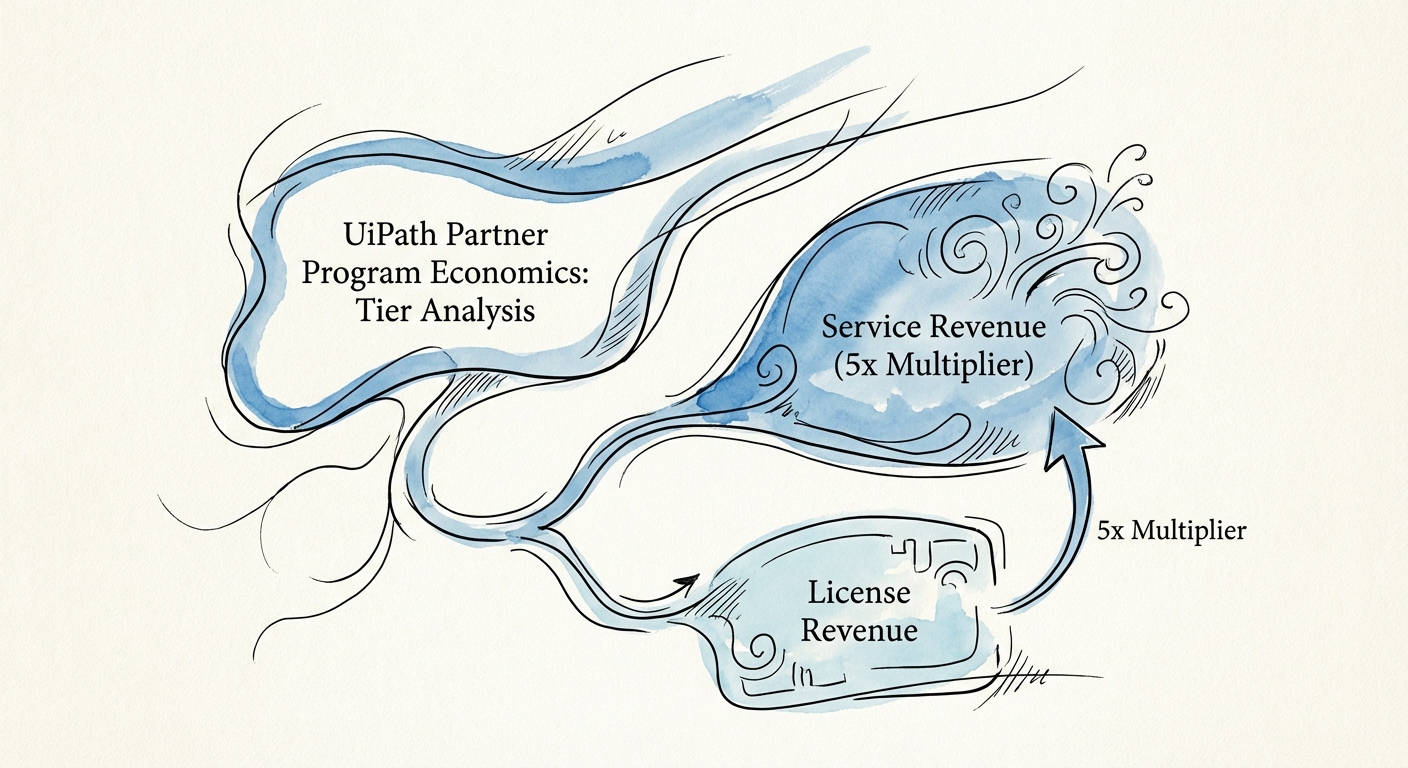
That column is the service-to-license attach ratio: for every dollar of UiPath ARR you resell, how many dollars of your own services revenue does it pull through? IDC's work on the economic impact of UiPath traces an ecosystem opportunity that has widened from roughly 3:1 in the early RPA days toward a 5:1 to 7:1 range as deployments grow more complex. Our portfolio data lands in the same band. The "wrap" is where you make money: discovery, process re-engineering, implementation, infrastructure, and the recurring layer of monitoring and optimizing a fleet of bots and agents.
Why the multiplier splits in two
That ratio is not evenly distributed, and the split is the whole story. The shops still scripting linear, deterministic workflows are watching their attach compress toward 3:1, because that work is now commoditized and increasingly automatable by the platform itself. The firms earning the 6:1 and 7:1 attach are the ones deploying Agentic Automation and AI-driven orchestration, where a deployment is not "build a bot and walk away" but a standing engagement: redesign the process, govern the agents, tune them as the underlying systems change.
Do this exercise on your last ten signed deals. Add up the services revenue, divide by the UiPath ARR. If you are under 3:1, you are not a strategic automation partner. You are a software reseller that happens to keep a few consultants on staff, and a buyer will value you accordingly. That single ratio is the difference between a low single-digit reseller comp and a strategic-services comp, and you can measure it in an afternoon.
What a PE buyer actually scores: USN over Diamond
When a sponsor evaluates a UiPath partner, the Diamond badge in the deck is decoration. The number that moves the offer is recurring revenue, and the credential that moves it is USN, not Diamond.
The reason is mechanical. Diamond is a sales-driven status, gated largely by license volume and headcount. The UiPath Services Network (USN) designation is gated by delivery quality. Getting in means passing technical audits and HackerRank-style assessments of the actual people who will sit on client engagements. One credential certifies that you can move software. The other certifies that the software you deployed still works six months later. In a diligence process, those are not the same asset, and a careful buyer will not pay the same multiple for them.
The two firms hiding behind the same logo
The first is the commodity implementer: high headcount, offshore-heavy, lifting manual tasks into basic scripts. It may well hold Diamond. Its revenue is project-based and lumpy, and it has a structural problem — the maintenance cliff. Once the bot ships, the billing stops, and the firm has to go win the next project to stand still. Buyers treat this as a staffing business. Per the 2025 consulting valuation benchmarks, that is a standard IT-services comp, not a premium one.
The second firm got off the project treadmill. It runs Managed Automation Services: a recurring monthly fee to monitor, repair, and optimize the client's fleet of bots and agents. That converts the maintenance cliff from a revenue problem into a revenue annuity. A USN-certified firm carrying north of 40 percent recurring revenue starts to look and trade like software rather than services, while the project-only Diamond shop next door stalls out as a reseller comp.
Your Monday move
Whether you are buying a UiPath partner or running one, the diagnostic is the same and it fits on an index card. Ignore the tier badge. Pull two numbers: the service-to-license attach (push it past 5:1) and the recurring revenue mix (push it past 30 percent, then toward 40). Then check whether the delivery org could survive a USN-grade technical audit today. If the firm is reselling licenses and billing hours, you have a reseller. If it is selling outcomes and holding long-term management contracts, you have something a sponsor will pay up for — badge or no badge.