
The practical answer
- Short answer
- Two Atlassian partners can look identical and trade three multiple-turns apart. The 2026 diagnostic PE buyers run on service mix, Jira Align, and migration proof.
- Best fit
- Industry: IT Services. Function: M&A
- Operating path
- Exit Readiness → Operational Excellence → Transaction Advisory Services
- Key metric
- 135% Net Revenue Retention (NRR) benchmark for top-quartile Atlassian partners focused on 'System of Work' services.
The renewal report tells you the multiple before the CIM does
Put two Atlassian partners side by side in a data room. Same Solution Partner tier badge on the homepage. Same logos in the case-study carousel. Roughly the same headcount. One closes at 6x EBITDA and the other at 13x, and the thing that decided it wasn't growth rate or pipeline — it was a single report most diligence teams skip: the annual license-renewal run-rate broken out from services.
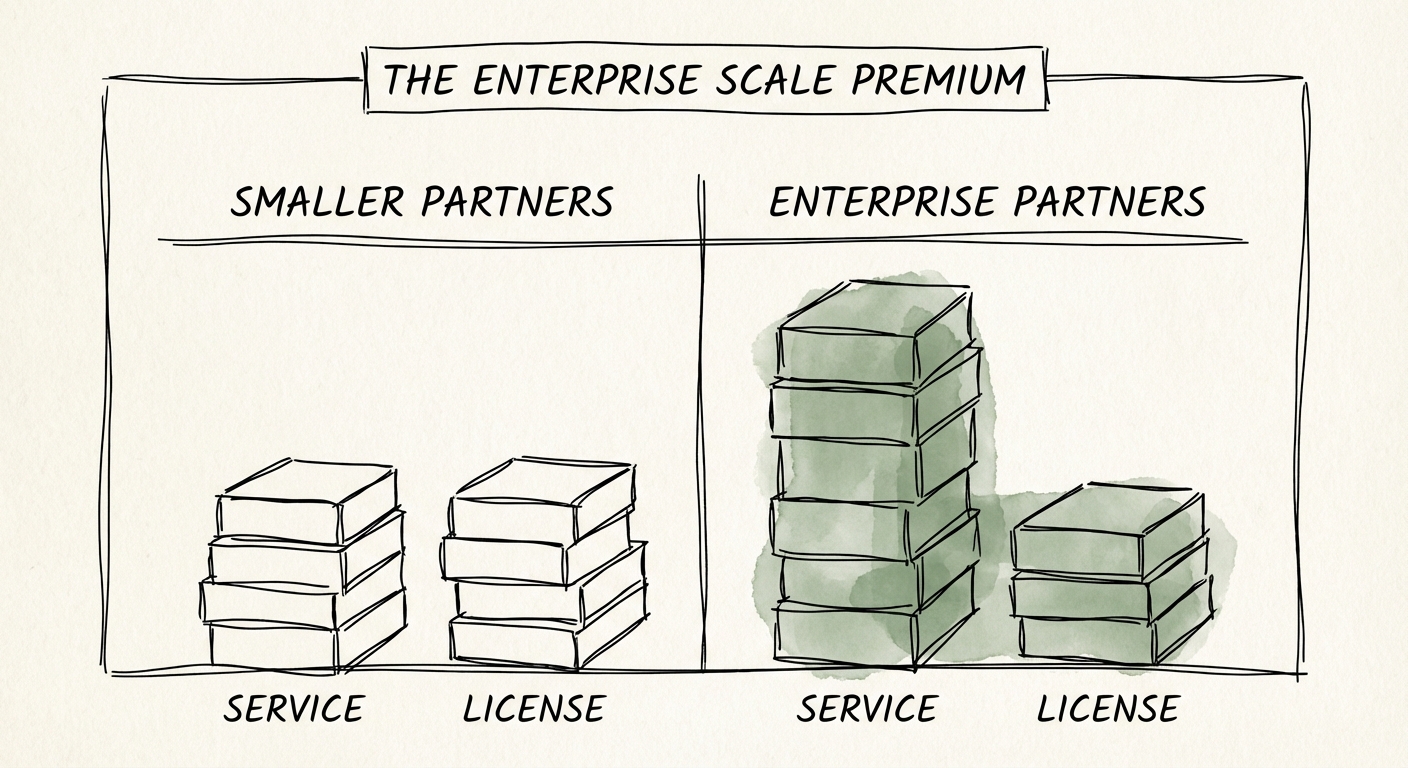
Partner A's renewal report shows $8M of license revenue that re-bills every year whether an engineer touches the account or not. The remaining $2M is “Jira admin” hours and the occasional Confluence cleanup. Partner B's report shows $4M of license pass-through and $6M of billable architecture work — Data Center-to-Cloud cutovers, Jira Service Management standing up to replace a legacy ITSM tool, governance frameworks for engineering orgs running 200 boards. Same top line. Completely different animal.
The reason the gap is widening into a chasm is that Atlassian itself has hollowed out the middleman. As the platform pushed everyone to Cloud and set a hard end-of-support clock on Data Center, basic licensing got commoditized into a procurement line item. A reseller who clips renewal commission has no moat left — the customer can buy that license from anyone, including Atlassian direct. The collapse of the reseller margin didn't shrink the prize; it moved the entire prize to whoever owns the hard, regulated, high-stakes work the platform creates.
Open the renewal report. If 80% of revenue auto-renews whether the partner shows up or not, you're not buying a consultancy — you're buying Atlassian's accounts receivable at a markup.
Jira Align is the tell, not the badge
Here's the part generalists get wrong: they chase certifications, assuming the “Cloud Specialized” badge is the differentiator. In 2026 it's table stakes — everybody has it, so it signals nothing to a buyer. What actually moves a multiple is product mix above the engineering team. A partner selling Jira Align is in the room when the CIO maps quarterly strategy to delivery; that partner gets a call before the budget is set, not after. A partner renewing Confluence seats is in a spreadsheet the procurement analyst opens once a year and tries to negotiate down.
That positioning shows up in the numbers as net revenue retention north of 130% — and it's worth being precise about why. It isn't price increases doing the work. It's a partner who lands a Cloud migration, then expands into cleaning up the technical debt the migration exposed, then sells a governance retainer to keep the new instance from sprawling again. Each engagement seeds the next. The specialist investors funding cloud professional-services platforms aren't paying for the install base — they're paying for that expansion engine.
The richest segment right now is migrating regulated 10,000-seat Data Center instances to Cloud with a zero-downtime guarantee — the kind of cutover where a bank's change-advisory board signs off on a rollback plan before anyone touches production. A partner who has done that for a Fortune 500 financial institution can name a blended rate north of $250/hour and defend it, because the buyer is pricing the cost of getting it wrong, not the cost of the hours. Increasingly that work means displacing a legacy ITSM incumbent — the same playbook running against ServiceNow in the mid-enterprise. A generalist can't reference a single one of those engagements, which quietly locks them out of the only deals that earn the premium.
Run these four tests before you sign the LOI
Whether you're a PE operating partner sizing an add-on or a partner founder trying to read your own exit, the badge count is noise. Pull these four numbers — they're what separates a 6x distribution channel from a 14x platform.
1. Service gross profit vs. net license revenue
The threshold is 1.5:1 — service gross profit to net license revenue — and elite partners run higher. A firm doing $10M with $8M of pass-through licensing is a reseller wearing a consultancy's clothes. Strip the license commission out and look at what's left: if the residual is thin, the multiple is too.
2. The revenue mix above the engineering team
Concentration outside core Jira Software and Confluence is the durability signal. You want Jira Service Management and Jira Align carrying real weight — proof the partner sells to CIOs and CTOs, not just sprint leads. If Work Management and ITSM together sit under 20% of the practice, the firm is one Atlassian pricing change away from margin compression.
3. Whale-account logo durability
Filter retention to the >$50k ARR cohort and look at tenure past three years. Blended churn lies; a healthy long-tail can mask a partner quietly bleeding its largest enterprise agreements. Strategic vendors keep and expand whales. Tactical fixes get swapped out at the next renewal, and a buyer will find that pattern in the cohort data even when the headline number looks fine.
4. Migration proof you can actually reference
Ask for three named regulated Data Center-to-Cloud cutovers at 5,000+ seats — with the rollback plan attached. A partner who can produce them owns the most defensible work in the ecosystem through the Data Center sunset. A partner who hesitates is telling you the premium revenue is aspirational. Start there Monday: if you're the founder, it's also your fastest path to closing the gap between the multiple you want and the one a buyer will underwrite.