The practical answer
- Short answer
- Two GCP partners, same revenue, different multiples: 8x vs 14x. Why production-grade Vertex AI consumption splits the resellers from the platforms in 2026.
- Best fit
- Industry: Cloud Services. Function: M&A
- Operating path
- Exit Readiness → Operational Excellence → Transaction Advisory Services
- Key metric
- 11x Increase in Vertex AI token usage in 2025, driving the scarcity premium for partners who can actually deploy production workloads.
Same revenue. Same logo wall. Half the multiple.
Line up two Google Cloud partners side by side. Both did roughly $18M last year. Both have the Premier badge, both have "Gemini" plastered across the pitch deck, both walk into the data room calling themselves a leader in generative AI. One gets a term sheet at 8x EBITDA. The other clears 14x. The buyers are not confused, and they are not paying for the badge. They are pricing one number neither company puts on the cover of the CIM: how much of the customer's ongoing Vertex consumption the partner actually controls.
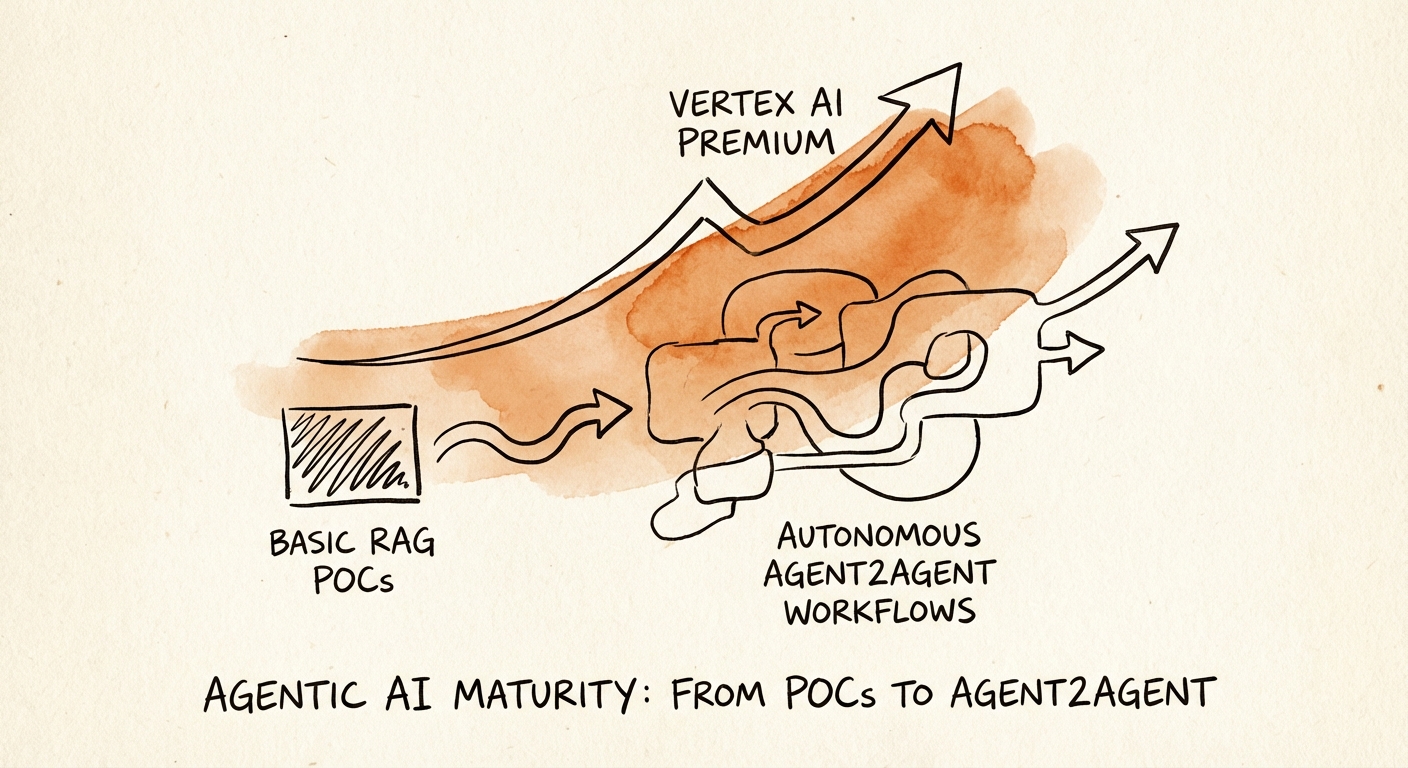
That is the whole game in 2026, and it is specific to how Google bills. A lift-and-shift shop that migrates VMs books linear, one-time revenue — necessary, steady, and valued by private equity as a low-margin utility. A partner that ships a production agent on Vertex AI and Agent Builder does something structurally different: every inference call the customer's agent makes is metered consumption, and the partner who architected it sits on the renewal of that meter. Migration revenue stops when the project ends. Consumption revenue compounds. Buyers stopped paying resell margin and started paying for consumption influence, and the gap between those two ideas is the gap between 8x and 14x.
The scarcity is real, and the numbers say so
This is not narrative inflation. Google Cloud's Vertex AI token processing grew roughly elevenfold across 2025 — the kind of step-change that creates a land grab. But the supply of partners who can actually capitalize on it is thin: the engineering bench that can move a Gemini workload from a clever notebook into something serving live customer traffic is the bottleneck, not the demand. When a capability is that scarce relative to the spend chasing it, the firms that own it get priced like assets, not like staffing agencies. In diligence we now see acquirers do something blunt about this: they strip the low-margin resell line out of the model entirely and apply the premium multiple only to the AI services and recurring consumption revenue. An 80%-resell, 20%-AI business is not an AI company being discounted. It is a reseller with an AI hobby, and the buyer prices it that way.
A reseller bills the migration once. A Vertex-native partner gets paid every time the customer's agent runs a query. Buyers stopped paying for the first thing in 2025 — the multiple now lives entirely in the second.
The four-question diligence test that separates the 14x from the pretender
Every memorandum I read claims production-grade GenAI. Most are describing a few pilots, a couple of fixed-fee demos, and a sales motion that confuses logos for revenue. Here is the diagnostic I run on a GCP partner before anyone argues about multiple — and it takes about an hour with the right people in the room.
1. The production ratio: what fraction of engagements serve live traffic?
Ask exactly this: "Of your AI engagements, how many are in production today handling real user or customer traffic — not a sandbox, not a stakeholder demo?" The honest industry baseline is grim. Across the ecosystem, only a small minority of AI projects ever reach production at all. A premium GCP asset runs well above a third of its engagements live. If everything is perpetually "graduating from pilot," you are looking at a consulting firm with good slides, and you should price it like one.
2. Revenue shape: who pays to keep the model from drifting?
Project revenue is a $50K fixed-fee build that ends. Real Vertex revenue is the monthly retainer to manage what happens after the model is live — the model monitoring, the drift and bias checks, the prompt and pipeline tuning, the on-call when an agent starts hallucinating refund approvals. If the target is not invoicing every month to operate the systems it built, it does not own the customer's operating layer. It performed a stunt and went home. Ask to see the recurring line as a percentage of the AI book, and ask how long the average managed engagement has run. Twenty-four months of unbroken AgentOps retainer is worth more than any case study.
3. The agentic moat: retrieve, or act?
A chat interface over a PDF — basic RAG — is now a weekend project for a competent junior. The premium sits with systems that take action: an agent that updates the ERP record, fires the supply-chain order, closes the support ticket, and reconciles the result without a human in the loop. Ask whether the partner has built anything on Google's Agent2Agent protocol where one agent hands work to another. Action-taking agents are the hardest thing in this market to staff, which is precisely why strategic acquirers are hunting for the capability rather than building it — Google's own 2026 push around autonomous agent commerce tells you where the consumption is heading.
4. Concentration: how much of EBITDA is Google's money?
This is the one buyers under-test. If the partner's reported margin is being propped up by vendor presales funding, you are valuing a subsidy, not a business — more on that below.
If you hold one today: the 12-month re-engineering, not the marketing campaign
You do not market your way from 8x to 14x. The two firms in the opening had the same deck — the difference was in the code, the consumption, and the commercial model, and you have roughly a 12-to-18-month window to change all three before you go to market.
Fix the margin before you fix the story
The structural drag on every AI partner valuation is talent cost. You cannot pay a senior data scientist $250K to do data cleaning and call the result a product margin. The firms clearing the premium have built internal accelerators — proprietary libraries and templates on top of their Vertex pipelines — that let a mid-level engineer ship an agent that used to require a specialist. That IP leverage is what drags gross margin off the services floor and toward something product-shaped, and it is the single line in the model a sophisticated buyer will test hardest, because it is the difference between a body shop and a platform.
Use Google's money to build the base, then wean off it
Google is actively tipping the scales toward exactly the work that earns the premium, funding GenAI workloads far more aggressively than traditional infrastructure projects through partner services funds. A smart operating partner aligns the sales motion to capture that non-dilutive capital, which subsidizes expensive AI presales and lets you show cleaner EBITDA going into a process. But run the concentration test on yourself first: if vendor funding is what makes the margin look good, a buyer will discount it to zero, and rightly. The play is to use Google's dollars to land the customer base — then convert that base into self-sustaining managed consumption revenue that survives whether or not the funding renews. In a sector where managed-services multiples have compressed under crowding, durable consumption revenue is the only thing that reliably defends a premium.
So here is the actual decision in front of you. You can take the cloud-migration firm to market and fight for 8x against a dozen identical shops. Or you can spend the next four quarters making the production ratio real, the recurring book deep, and the agentic IP defensible — and command the 14x that genuinely scarce assets earn. Pick one this quarter, because the window closes quietly.