
The practical answer
- Short answer
- Two Microsoft partners, same Gold badge, same revenue — one trades at 13.6x EBITDA, one at 6.3x. The CSP-vs-services tells you which. A PE diligence read.
- Best fit
- Industry: Private Equity. Function: M&A
- Operating path
- Exit Readiness → Operational Excellence → Transaction Advisory Services
- Key metric
- 13.6x Median EBITDA multiple for Specialized IT Consulting firms in 2025 (vs. 6x for generalists).
Same badge, same revenue, a two-turn gap on EBITDA
Picture two firms in your deal funnel. Both carry the Microsoft "Solutions Partner" designation. Both report roughly $14M in revenue and call themselves a "Microsoft Cloud consultancy." On the surface, you'd value them identically. The market doesn't. One of these prices out near 13.6x EBITDA. The other struggles to clear 6.3x. That spread — per Aventis Advisors' 2025 IT Services valuation report and corroborated in Equiteq's Q1 2025 Microsoft M&A read — isn't a rounding error. It's the difference between a platform asset and a pass-through resale book wearing a consultancy's logo.
The trap is that the badge looks the same from the outside. Microsoft restructured its partner program into the AI Cloud Partner Program (the old "Gold" is gone), and the designations you see in diligence can be earned largely through transaction volume. A firm can rack up enough seats sold to qualify as a Solutions Partner for Infrastructure without having migrated a single complex tenant or written a line of governance policy. The badge certifies that they moved product. It does not certify that they engineer anything.
Here is the cleanest tell I know, and you can pull it before you ever open the data room. Ask what they sell on Microsoft's New Commerce Experience. NCE collapsed the margin on pure license resale into a 3–8% sliver and killed most of the upfront incentive cash that used to make resale look profitable. A firm whose P&L still leans on that line is a firm whose core business Microsoft has already decided to commoditize. You are buying the falling side of the trade.
The 13x firms moved the other direction. They stopped treating the Microsoft 365 or Azure tenant as a thing you sell and started treating it as a thing you own — the permissions model, the security posture, the data governance, the configuration that breaks if anyone but them touches it. That ownership is what turns a transactional reseller into something that behaves like recurring SaaS. And it's why a Solutions Partner badge tells you precisely nothing about which of your two targets is which.
A Solutions Partner badge tells me they hit a volume threshold. It tells me nothing about whether anyone would miss them if they disappeared. Retention on services answers that. Retention on licenses just means switching CSPs is annoying.
The one number that separates the two firms: service attach
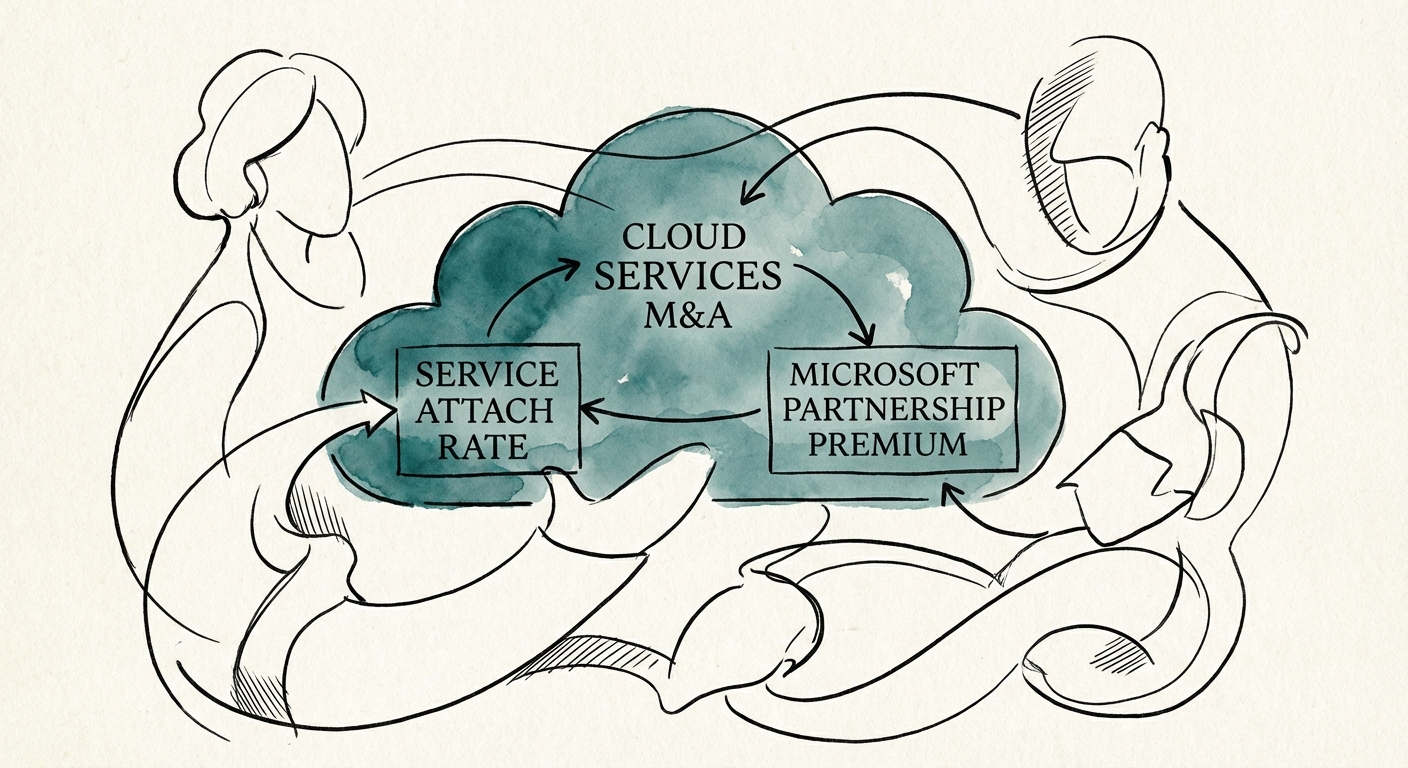
If I get to ask a Microsoft partner exactly one question, it's this: for every dollar of Microsoft licensing you sell, how many dollars of your own services attach to it? A genuine platform consultancy runs $4–$5 of services per $1 of license. A dressed-up reseller runs closer to $0.50. That single ratio explains almost the entire 6x-to-13x gap, because everything that drives the premium downstream is a consequence of high attach.
Three things stack on top of it.
1. Governance work that Copilot can't skip
Every sponsor showing up to an investment committee now has an "AI thesis," and most of them are hallucinating it. Turning on Copilot is a checkbox. Turning it on without it surfacing the CEO's comp spreadsheet to a summer intern is a project. The partners earning real multiples are the ones doing the unglamorous prerequisite work: re-architecting SharePoint permission inheritance, applying sensitivity labels, tuning the Semantic Index so retrieval stays inside the right walls. It bills high, it's project-shaped going in, and it converts into standing governance retainers because the customer can never let those controls drift. IT ExchangeNet's read on driving multiples in the Microsoft ecosystem lands in the same place — depth in this layer is what acquirers pay up for.
2. Vertical IP on the Power Platform
A generalist drops Dynamics 365 in out of the box and bills hourly to configure it. A premium firm has built something reusable on top of the Power Platform — say, a revenue-cycle workflow for outpatient clinics, or a supply-chain visibility layer for mid-market distributors — that it deploys to client after client. That IP does two things to the multiple at once: it lifts gross margin (build once, sell many) and it raises switching costs (rip-and-replace now means losing the workflow the business runs on). Decoupled from hourly billing, that revenue starts to look like a product line, and product lines clear higher than time-and-materials.
3. The 70% rule, measured on gross profit not revenue
Sponsors love a "70% recurring" headline. Then they measure it wrong. They count CSP contracted revenue — your monthly license pass-through — as recurring, which it technically is and which is also nearly worthless, because it carries a 3–8% margin and Microsoft, not the partner, sets the price. The number that earns the premium is 70% of gross profit coming from value-add managed services: Managed Detection and Response on Sentinel, managed Azure infrastructure, governance retainers. Same revenue line on a tearsheet, opposite ends of the valuation curve.
Three questions that price the firm before the QofE arrives
Standard Quality of Earnings work is built to catch accounting games. It is not built to catch the technical sleight of hand that decides whether a Microsoft partner is a 6x book or a 13x platform — a QofE will happily bless high-retention license revenue as durable. So before you commit diligence dollars, put these three to the founder directly and watch how fast the answer comes.
- "What's your CSP margin against your services margin?" If license margin is the larger of the two, the consultancy framing is marketing. You're buying a reseller, and the resale line is shrinking under NCE. Price it accordingly.
- "How many of your accounts have paid you for a data-governance engagement in the last 18 months?" If the honest answer is near zero, the AI story is a slide, not a P&L. The firms that will compound through the Copilot cycle are already billing for the cleanup it requires.
- "Show me net retention on managed services, with license renewals stripped out." This is the question that ends the conversation honestly. Customers don't churn licenses because re-tenanting is a migraine, so license retention always looks heroic and proves nothing. Services retention measured on its own tells you whether anyone would actually miss this firm.
The generalist Microsoft shop — the one whose moat is a CSP agreement and a badge — is a business Microsoft itself has chosen to commoditize. The premium has moved to the firms that own the architecture, the governance, and a vertical no one else can rebuild cheaply. If you're holding a Microsoft partner in the portfolio, run the attach-rate and gross-profit-mix tests now, while you still have runway to push the services line up before you take it to market. If you're buying, price the badge at zero and pay for what the firm actually engineers.