
The practical answer
- Short answer
- Two Databricks partners with the same revenue can sell at 8x and 14x EBITDA. The gap is DBU pull-through, Brickbuilder IP, and Agent Bricks proof. Here's the diligence test.
- Best fit
- Industry: Data & AI Services. Function: M&A & Strategy
- Operating path
- Exit Readiness → Operational Excellence → Transaction Advisory Services
- Key metric
- 14x Average EBITDA multiple for Databricks partners with proprietary 'Brickbuilder' IP and GenAI capabilities.
Same revenue, same logo, double the multiple
Picture two Databricks partners on the same banker's desk this quarter. Both do roughly $18M in services revenue, both are listed in the partner directory, both have a wall of certified data engineers. One signs a term sheet at 8x EBITDA. The other clears 14x. The acquirer is the same PE platform. The difference is not the logo on the deck — it's what happens inside the workspace.
That gap exists because Databricks built a consumption business, and partners get valued on which side of the consumption they sit. With Databricks now carrying a $134 billion valuation as of its early-2026 round, capital is chasing anything in the orbit — and that's exactly the trap for an operating partner doing diligence on a data consultancy. Proximity to the brand is not a moat. The platform's own economics decide your multiple.
The 8x firm sells migration capacity: Hadoop-to-Lakehouse lift-and-shift, notebook conversion, pipeline rebuilds priced by the engineer-week. Useful work — it drives Databricks Unit (DBU) consumption — but the firm is interchangeable, talent walks out the door at renewal, and every project starts from an empty notebook. The 14x firm sells DBU pull-through it can prove: deployed assets that keep generating platform consumption after the consultants leave. When a buyer can trace recurring DBU spend back to your specific solution sitting in a customer's account, you've stopped being a body shop and started being an annuity. As we noted in our analysis of Snowflake partner valuations, buyers pay for outcomes that persist, not hours that already billed.
A diligence team can read your real margin in twenty minutes: they pull your project list and count how many engagements started from a Brickbuilder asset versus a blank notebook. Certified-engineer headcount is what you tell them. Reusable IP is what they verify.
The Brickbuilder test: 60% pre-written, or a blank notebook
Here is the single fastest way a diligence team separates the two firms above. They ask for your project list, then they count how many engagements opened from a validated Brickbuilder solution versus how many opened from scratch. A Brickbuilder designation isn't a badge for the partner page — it's documentary proof that you codified tribal knowledge into a repeatable asset Databricks itself reviewed.
The practical difference: the blank-notebook firm scopes every retail-forecasting or financial-risk project as net-new, so margin lives entirely in the heads of the senior engineers — and those engineers are the ones a buyer worries about losing. The Brickbuilder firm starts each of those same projects with roughly 60% of the architecture pre-built and validated, which is why deal flow consistently rewards two or more validated solutions with a materially higher EBITDA turn. You're not selling velocity as a slogan; you're selling a delivery cost structure the acquirer can model.
It also functions as a hedge. As basic ETL gets absorbed by automated tooling inside the platform, the firm whose value is "we build pipelines" watches its margin compress in real time. The firm that owns the business logic — the demand-forecasting model, the risk-scoring rules, the domain mappings baked into a Brickbuilder asset — sits above the commodity layer because the hard part was never the pipeline. For how specialization compounds this effect, see The Data and AI Specialization Premium. If you can't produce that codified asset in diligence, you're a staffing company that happens to use Databricks.
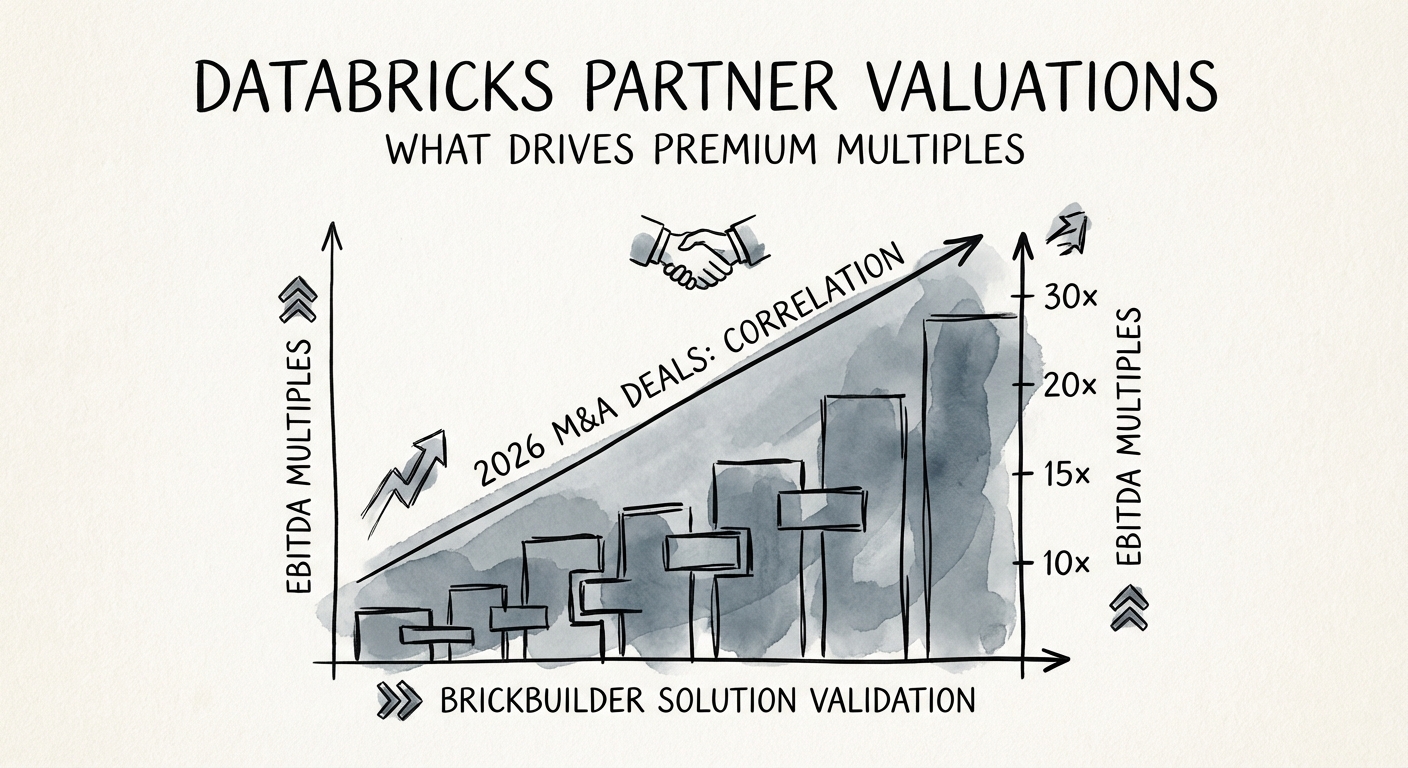
What the 14x term sheets actually buy: Agent Bricks proof, not Big Data slides
The goalposts moved when Databricks absorbed MosaicML and pushed into Agent Bricks. The premium is no longer "we build data lakes" — it's "we ship Compound AI Systems that run in production." And acquirers have gotten specific about what counts, because they've been burned by demos that never survived a real workload. As Channel Futures documented in its read on Databricks partners going all-in on AI, the field is now sorting hard between firms that talk AI and firms that operate it.
In a diligence call, "AI-enabled" gets stress-tested against three concrete things, and vague answers cost you turns:
- Vector Search and RAG in production: not a notebook demo — a Retrieval Augmented Generation system serving live queries with latency and accuracy numbers you can show.
- Fine-tuned open models: using MosaicML to train smaller domain-specific models a client owns, instead of reselling an API call to someone else's frontier model. The first is IP; the second is a markup.
- Unity Catalog governance: the lineage, permissions, and audit layer that makes an enterprise legal team comfortable putting AI near regulated data. This is the difference between a pilot and a rollout.
This is the same decoupling we tracked in IT Services M&A trends — AI-native delivery pulling away from commodity infrastructure work. So before the next banker conversation, do the audit yourself: pull your active engagement list and mark each one body-shop migration, Brickbuilder-anchored, or Agent-Bricks production. The ratio across those three buckets is the number a buyer will reverse-engineer anyway. If it's mostly the first bucket, that's a roadmap to fix, not a reason to discount the ask — but pitch "Big Data" into a room that's pricing "AI Agents," and you'll watch four to six turns of EBITDA evaporate on the spot.