
The practical answer
- Short answer
- Specialized Databricks partners trade at 14x EBITDA, while generalists stall at 6x. A data-driven exit guide for founders and PE sponsors.
- Best fit
- Industry: Data & AI Services. Function: Executive Leadership
- Operating path
- Exit Readiness → Operational Excellence → Transaction Advisory Services
- Key metric
- 31% YoY Growth in Databricks Partner Ecosystem (2025)
The Databricks Valuation Bifurcation: Body Shops vs. Data Intelligence
The market for data and AI services is red hot, with Databricks reaching a $100B valuation in August 2025. However, this rising tide does not lift all boats equally. In the private equity markets, we are seeing a massive bifurcation in how Databricks partners are valued, creating a gap of up to 8 turns of EBITDA between "generalist" firms and "strategic" partners.
For generic IT services firms—those simply supplying certified bodies to staff augmentation contracts—valuation multiples have compressed to the 6x to 8x EBITDA range. These firms are viewed as commoditized labor pools, susceptible to rate pressure and displacement by lower-cost offshore alternatives.
Conversely, specialized partners with "Brickbuilder" solutions and deep industry IP are commanding 12x to 14x EBITDA. Buyers are not paying for the headcount; they are paying for the capacity to deliver outcomes on the Data Intelligence Platform. The primary driver of this premium is the transition from "Lift and Shift" (moving Hadoop to the cloud without optimization) to "Modernization" (re-architecting for Unity Catalog and Serverless).
The Brickbuilder Premium
The single strongest indicator of a premium valuation is the presence of a Brickbuilder Solution. These are partner-developed, Databricks-validated IPs that solve specific industry problems (e.g., "Retail Demand Forecasting" or "Healthcare Interoperability"). Having a validated Brickbuilder solution signals to acquirers that your revenue is defensible and repeatable, moving you out of the "Time & Materials" discount bin and into the "Productized Service" premium tier.
In 2026, buyers aren't asking 'How many data engineers do you have?' They're asking 'How much consumption do you influence?' The former gets you 6x; the latter gets you 14x.
The New Quality of Earnings: Influenced Consumption
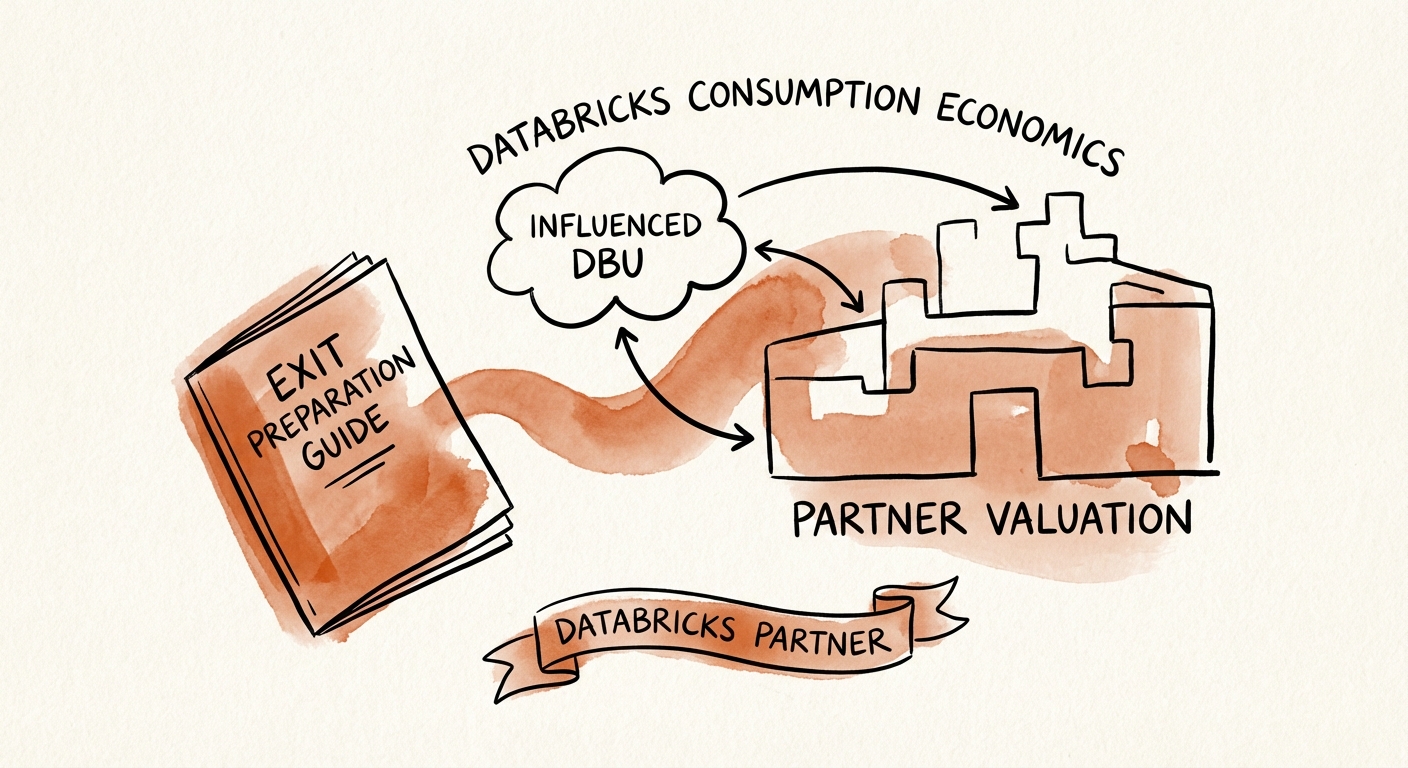
In traditional professional services M&A, Quality of Earnings (QofE) focuses on gross margins and customer concentration. For Databricks partners, there is a new, critical metric: Influenced Consumption.
Because Databricks monetizes via Databricks Units (DBUs), they value partners who drive consumption, not just implementation fees. Strategic acquirers (like global SIs and PE-backed platforms) scrutinize this metric to determine if a target firm actually controls the customer roadmap.
A partner generating $10M in services revenue but only $500k in influenced consumption is viewed as a transactional "install shop." A partner generating $10M in services revenue and $5M+ in influenced consumption is viewed as a strategic advisor embedded in the client's long-term data strategy. The latter commands the 14x multiple.
Why Consumption Data Matters in Due Diligence
Buyers use consumption data to verify revenue quality. If your "Influenced DBU" chart is up and to the right, it proves your implementations are successful and your clients are scaling their usage of the platform. If consumption is flat or churning, it indicates your projects are becoming "shelfware," regardless of what your recognized revenue says. For a deeper dive on how revenue recognition can mislead buyers, read our Revenue Quality Audit guide.
The Governance Moat: Unity Catalog & GenAI
The technical due diligence for Databricks partners has shifted from "Can you write Spark code?" to "Can you govern AI?" With the rise of the Mosaic AI acquisition and the push for "Data Intelligence," the ability to implement Unity Catalog has become a primary valuation driver.
Unity Catalog is not just a feature; it is the governance moat that enables enterprise GenAI. Partners who specialize in complex governance migrations—moving clients from fragmented access control to a unified lineage model—are trading at a premium because they unlock the "GenAI wallet" for their clients. Generalist partners who ignore governance in favor of quick data engineering tasks are seeing their bill rates stagnate.
Similar to the dynamics we see in the Snowflake partner ecosystem, the market rewards specialization. The "Azure Databricks" partner who also understands the broader Azure security context (as detailed in our Azure Data & AI analysis) creates a stickier customer relationship than a pure-play open-source Spark shop.
Exit Readiness Checklist for 2026
- Certify on Unity Catalog: Ensure 80%+ of your technical staff holds the latest governance badges.
- Launch a Brickbuilder Solution: Package your best project into a repeatable, validated IP.
- Track DBU Influence: Start reporting on "Influenced Revenue" in your monthly board deck alongside EBITDA.
- Diversify Beyond "Body Shopping": Aim for a revenue mix of 40% Managed Services/IP and 60% Project Work.