
The practical answer
- Short answer
- Why some Snowflake partners trade at 14x EBITDA while others struggle at 6x. A diagnostic guide for PE investors and founders on the 'Elite' premium.
- Best fit
- Industry: Data & Analytics Services. Function: M&A
- Operating path
- Exit Readiness → Operational Excellence → Transaction Advisory Services
- Key metric
- 14x EBITDA multiple for Elite partners with Vertical IP and Managed Services revenue streams.
The Great Bifurcation: Why Service Revenues Are Not Created Equal
In the private equity landscape of 2026, the data services market has bifurcated into two distinct asset classes that look identical on a P&L but trade at radically different multiples. On one side, you have the Generalist Implementer: these firms migrate on-premise data warehouses to the cloud. They bill by the hour. They trade at 6x to 8x EBITDA. They are effectively staffing agencies with a Snowflake logo on their website.
On the other side, you have the Strategic Data Partner. These firms do not just move data; they build data products. They leverage Snowpark to build custom applications, they deploy proprietary accelerators that cut migration times by 40%, and they possess deep vertical expertise (e.g., Healthcare Data Clouds or Financial Services Data Mesh). These assets trade at 12x to 15x EBITDA. Why? Because they are not selling hours; they are selling outcomes and intellectual property.
For a PE Operating Partner, the danger lies in the "Certification Illusion." A firm may boast 100 SnowPro certifications, but if those consultants are merely executing "lift and shift" migrations without a layer of proprietary IP or managed services, you are buying a low-margin labor arbitrage business, not a high-growth technology asset. The 14x multiple is reserved for partners who have successfully transitioned from serving the platform to building on the platform.
You don't get a 14x multiple for moving tables from Oracle to Snowflake. You get it for building the 'Financial Services Data Mesh' that runs the bank's fraud detection models.
The Consumption Alignment: Valuation Tied to NRR
Snowflake's own valuation—and its internal incentive structure—is driven by consumption, not just booked revenue. Consequently, the most valuable partners are those that drive Net Revenue Retention (NRR) for the platform itself. In our analysis of recent M&A transactions, partners that demonstrated a correlation between their services and sustained client consumption growth commanded a 3-turn premium over those focused solely on initial implementation.
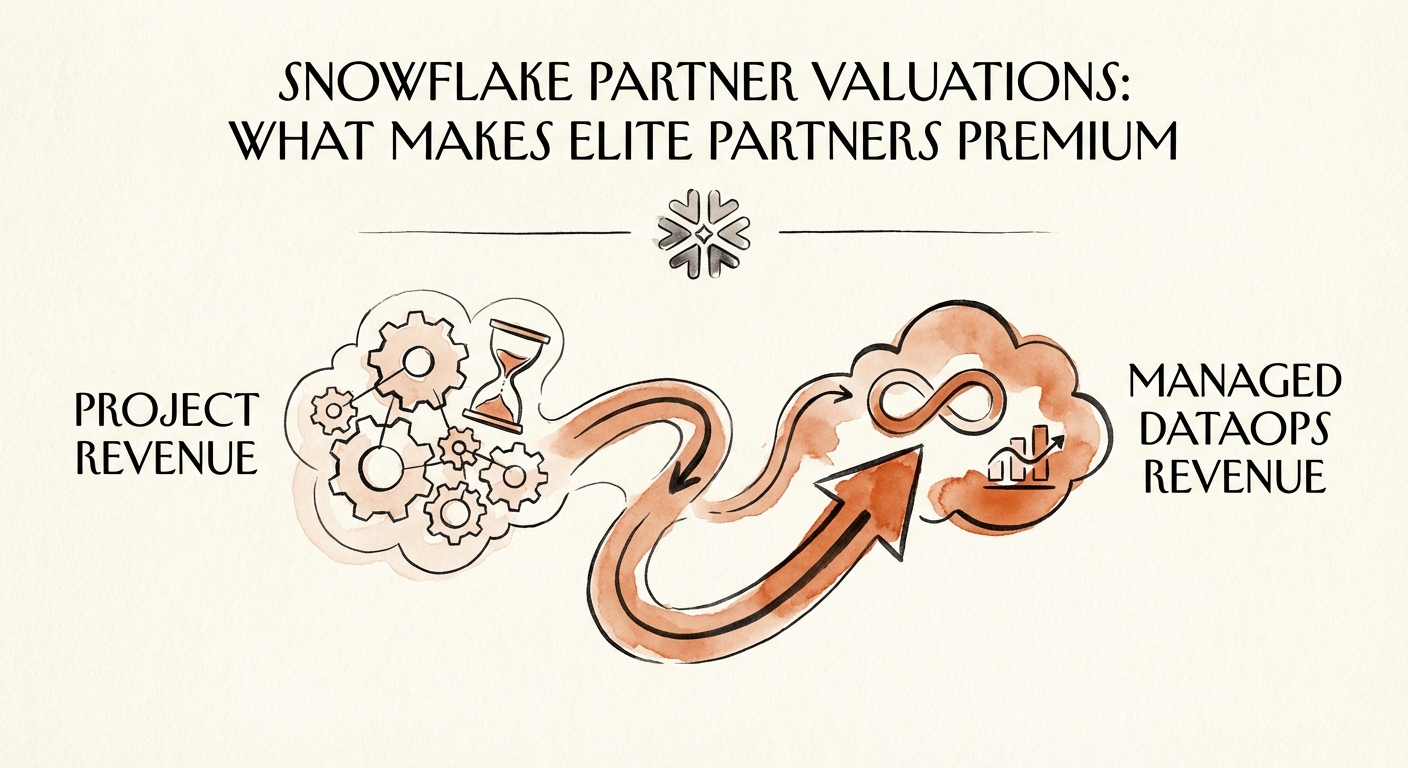
This is the "Day 2" problem. A Generalist Implementer walks away after the go-live. A Strategic Partner stays to optimize compute, manage DataOps, and implement consumption-based managed services. This creates a recurring revenue stream that mimics SaaS economics. If your portfolio company's revenue is 90% project-based with no recurring "DataOps" or "Managed Data Estate" contracts, you are leaving massive value on the table.
Furthermore, the introduction of Snowflake Native Apps and Cortex AI has shifted the goalposts. Buyers are now looking for partners who can deploy AI models inside the data perimeter. A partner that can demonstrate a track record of deploying GenAI use cases using Cortex or Snowpark is effectively future-proofing the client's data stack. This capability transforms the partner from a vendor into a strategic necessity, reducing churn and increasing the "stickiness" that drives multiple expansion.
Verticalization: The Only Escape from Commoditization
The days of the "horizontal" data shop are numbered. The 2025 valuation data is clear: generalist firms are seeing multiple compression as basic data engineering becomes commoditized by AI and automation. The premium valuations are migrating to Industry Cloud specialists. A Snowflake partner specializing in Retail Consumer Data Cloud implementation with pre-built connectors for Shopify and Salesforce Marketing Cloud is worth significantly more than a generic "Big Data" consultancy.
We advise portfolio leaders to audit their data assets for "Vertical IP." Does the firm have pre-packaged code, data models, or governance frameworks specific to an industry (e.g., HIPAA-compliant data sharing for Healthcare)? If the answer is no, the first 100 days of value creation must focus on packaging tribal knowledge into vertical accelerators. This is not just marketing; it is defensive engineering. It prevents price erosion and positions the firm as a scarcity in a crowded market.
Finally, look at the partner's status. "Elite" status in the Snowflake Partner Network is not a vanity metric; it requires specific consumption targets and co-selling validation. However, do not blindly trust the badge. Verify the source of that status. Is it driven by low-margin volume or high-margin strategic projects? The former is a trap; the latter is a springboard to a premium exit.