
The practical answer
- Short answer
- Why specialized B2B Shopify partners trade at 14x EBITDA while D2C agencies stall at 6x. A diagnostic for PE sponsors and founders.
- Best fit
- Industry: Ecommerce. Function: M&A
- Operating path
- Exit Readiness → Operational Excellence → Transaction Advisory Services
- Key metric
- 109% Year-over-year growth in Shopify B2B Gross Merchandise Volume (GMV) in Q1 2025.
The Great Valuation Bifurcation: D2C Agencies vs. B2B Specialists
For the last decade, Private Equity firms treated Shopify agencies as a homogeneous asset class: low-barrier-to-entry professional services firms trading at 5x to 7x EBITDA. The logic was sound for the Direct-to-Consumer (D2C) era. A typical D2C agency suffers from high client churn (often 25%+ annually) because their clients—venture-backed startups—frequently go out of business or replatform when growth stalls.
However, 2025 marked a distinct decoupling in the market. While generalist D2C agencies continue to face valuation compression, a new breed of B2B Commerce Specialists has emerged, commanding valuations of 12x to 14x EBITDA. The driver is not just revenue growth, but revenue quality.
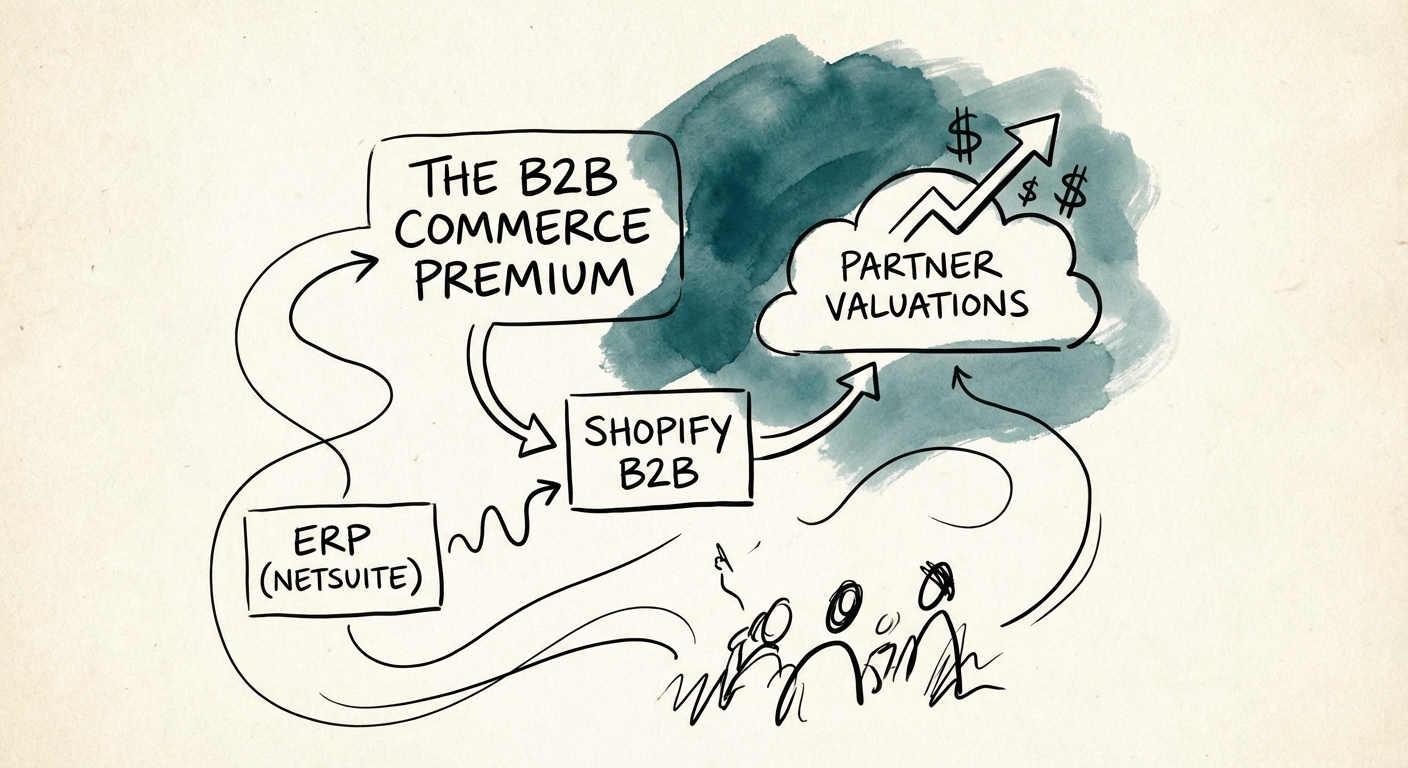
Shopify’s aggressive pivot into the $36 trillion B2B market has created a vacuum for partners who can handle complex wholesale workflows. Unlike D2C brands that buy on emotion and churn on cash flow issues, B2B manufacturers and distributors buy on logic and retain for decades. When a partner successfully migrates a legacy industrial distributor to Shopify Plus—integrating complex price lists, net payment terms, and ERP data—they aren't just building a website; they are rewiring the client's operational nervous system. The resulting retention rates for B2B specialists often exceed 95%, creating the predictable cash flow streams that PE buyers covet.
We are not just growing our piece of the pie; we are growing the pie itself. That is our superpower.
The Integration Moat: Why B2B Revenue is 'Sticky'
The valuation premium for B2B specialists is anchored in technical complexity. A standard D2C implementation might involve a theme customization and a Klaviyo integration. This is easily commoditized. In contrast, a B2B implementation is an exercise in enterprise architecture. It requires deep integration with ERPs like NetSuite, Acumatica, or Microsoft Dynamics 365 to handle real-time inventory for thousands of SKUs, customer-specific pricing tiers, and credit limit validations.
This complexity creates a defensive moat. Once a partner has built the middleware connecting a distributor’s NetSuite instance to Shopify B2B, displacing that partner becomes operationally risky for the client. The switching costs are astronomical. This dynamic shifts the partner's revenue profile from 'project-based' to 'infrastructure-critical,' justifying a multiple closer to SaaS (10x+ Revenue) than traditional services (6x EBITDA).
Furthermore, the expansion revenue (Net Revenue Retention) in B2B is naturally higher. As the manufacturer grows, the complexity of their data needs grows, leading to ongoing managed services contracts that are not optional maintenance, but essential operational support. This aligns with the margin dynamics we see in the NetSuite ecosystem, where partners with deep integration capabilities protect their margins against commoditization.
The 2026 M&A Playbook: Pivoting from 'Theme Builder' to 'Commerce Architect'
For PE operating partners holding generalist Shopify agencies, the path to a 14x exit involves a deliberate pivot to B2B. This is not a marketing rebrand; it is a fundamental restructuring of the delivery organization. The talent mix must shift from creative designers to solution architects and backend engineers capable of middleware development.
To capture the B2B premium, firms must demonstrate specific metrics in the Data Room:
- B2B GMV Penetration: What percentage of client GMV flows through wholesale channels? Buyers look for >40%.
- ERP Integration Density: The ratio of clients with active, bi-directional ERP syncs. High density signals high stickiness.
- ACV Expansion: Evidence of moving clients from $50k initial builds to $150k annual retainers via managed services structures.
The window to establish market leadership is now. With Shopify B2B GMV doubling year-over-year, the ecosystem is starved for partners who can deliver enterprise-grade wholesale solutions. Those who cling to the D2C 'theme building' model will find themselves in a race to the bottom, while 'Commerce Architects' will trade at a premium comparable to specialized Shopify Plus partners.