
The practical answer
- Short answer
- Oracle's ACS now competes for the post-go-live support revenue NetSuite partners built valuations on. Here's the math on what it costs you and how to pivot.
- Best fit
- Industry: Professional Services. Function: Revenue Operations
- Operating path
- Financial Infrastructure → Commercial Performance → Valuations
- Key metric
- 15-22% Erosion in generalist partner recurring revenue due to ACS displacement in the last 18 months.
The renewal call that didn't come
Picture the account manager at a mid-sized NetSuite Solution Provider opening the pipeline on a Monday. Three of the support retainers due to renew this quarter have gone quiet. Not churned over a service failure, not poached by a cheaper shop down the street. The clients went to Oracle. Specifically, they signed onto Advanced Customer Support (ACS), billed direct, and politely declined the renewal that everyone assumed was automatic.
For a decade the NetSuite partner model rewarded a specific kind of laziness. Land the implementation, bank the 20-30% first-year Solution Provider commission on the license, then bolt on an "admin-on-demand" retainer that funded payroll while requiring almost nothing. The retainer was treated as recurring revenue. In a sale, a buyer paid recurring-revenue multiples for it. That was the whole game.
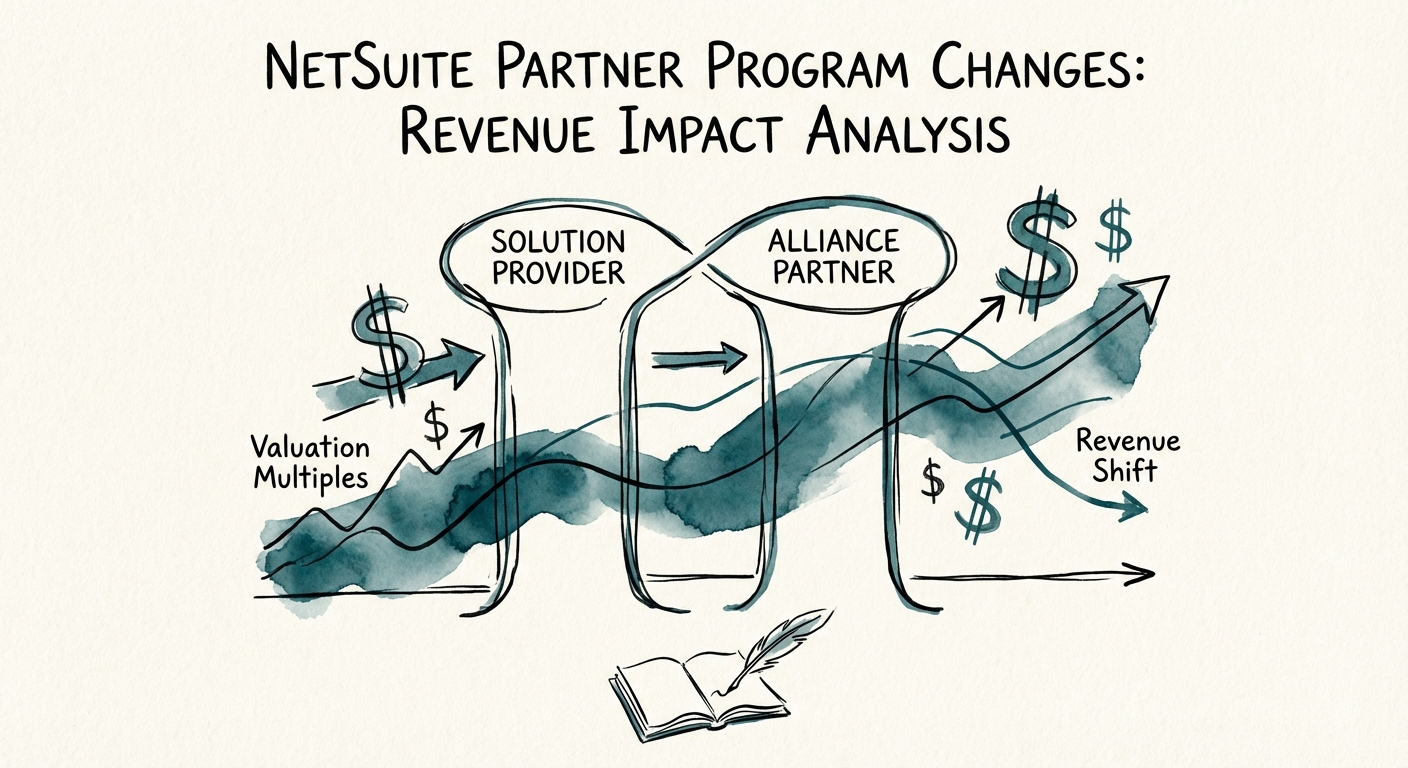
The problem is that retainer was never defensible. It survived only because Oracle hadn't bothered to compete for it. As of 2025 that changed: NetSuite expanded ACS from a break-fix safety net into a full optimization tier that pitches the same post-go-live work your team does, with the credibility of "we built the product" stapled to every proposal. When a CFO can buy tuning, release management, and configuration support straight from the vendor, the partner retainer stops looking like a relationship and starts looking like a markup. We've watched generalist partners shed 15-22% of recurring services revenue inside 18 months as accounts defect to ACS for vendor-direct assurance. That is not a soft patch in the market. It is Oracle reclaiming the high-margin tail of the customer lifecycle and leaving partners the capital-intensive implementation work at the front. The economics of that are documented plainly in the ACS service tier breakdown and the partner program terms themselves.
A NetSuite admin retainer was never a moat. It was a placeholder Oracle hadn't gotten around to billing for yet. Now they have.
Run the number a buyer is going to run
Here is the math that turns a quiet quarter into a valuation event. Say a partner loses one $50k-a-year support account to ACS. The cash hit is obvious. The enterprise-value hit is the part owners miss. Recurring NetSuite support revenue, when it's genuinely sticky, can trade at 8x or better in a sale. Lose $50k of it and you haven't lost $50k — you've erased roughly $400-500k of enterprise value. Now replace that gap by selling another $50k of one-off implementation hours. Project revenue trades at maybe 1x to 1.5x. You filled the cash hole and the company is still worth a third of a million dollars less.
This is exactly the line a private-equity buyer's diligence team pulls apart first. They are no longer asking "how much recurring revenue do you have." They are asking "how much of it can Oracle take with a phone call." License commissions tied to net-new tiers that keep ratcheting up, plus support revenue exposed to ACS, reads to a sophisticated buyer as low-quality revenue dressed up as recurring. The discount is brutal and it is applied silently.
The NetSuite ecosystem is splitting into two firms that look similar on a P&L and could not be more different at the term sheet:
- The generalist reseller. Chases license tiers it increasingly misses, watches ACS pick off the support book, and bids implementation work on price against three other shops doing the same. Whatever the spreadsheet says, the multiple caps near 1x revenue because none of the income is protected.
- The micro-vertical specialist. Largely walks away from the license-commission game, often shifting to the Alliance Partner model, and builds deep IP for a narrow industry — NetSuite configured for solar installers, for FDA-regulated manufacturers, for franchise field-service operators. These firms grow on the order of 5x faster and bill at rates ACS structurally can't match, because Oracle doesn't staff support engineers who understand a specific vertical's compliance reconciliation. The program's tilt toward BPO and outcome-based services only widens that gap.
What you can move on this week
The pivot is not "work harder on retention." Retention loses when the vendor is the competitor. The pivot is to become a consultancy that happens to run on NetSuite, so that what you sell is judgment ACS can't ship from a service catalog.
Audit your support book by defensibility, not by dollars
This week, take every recurring contract and sort it into two columns: work ACS could quote tomorrow (admin tasks, generic optimization, release support) versus work that requires knowing your client's industry cold. The first column is already lost — price it accordingly and stop pretending it's an annuity. The second column is your actual enterprise value. If almost everything sits in column one, you now know why diligence would gut your multiple.
Drop the license-commission addiction
If license commissions still drive your model, the Alliance Partner path deserves a hard look. Giving up the resale margin removes the conflict that lets Oracle's direct team paint you as a markup. You stop being the reseller defending a position and become the neutral expert the client trusts against the vendor's own sales motion. That posture is what preserves advisory margin.
Build one productized vertical asset
A SuiteApp or proprietary accelerator for a specific industry is the moat ACS cannot cross, because the work is too niche for Oracle to staff. With the SuiteApp.AI Marketplace live, partners embedding genuinely useful AI into a vertical solution — say, an agent that automates a distributor's supply-chain reconciliation rather than selling vague "AI readiness" — are seeing win rates climb meaningfully. The strategic call between broad and narrow is already settled for you; the case for going vertical over horizontal is the only one the numbers support. Build the missing-link feature your niche needs, and Oracle quietly becomes your distribution channel instead of the firm cannibalizing your renewals.