The practical answer
- Short answer
- In 2026, Splunk partners face a bifurcated market. Learn why 'Log Collectors' stall at 6x EBITDA while 'Security Intelligence' firms command 14x multiples.
- Best fit
- Industry: Cybersecurity & Data Analytics. Function: Executive Strategy
- Operating path
- Exit Readiness → Operational Excellence → Transaction Advisory Services
- Key metric
- 14x EBITDA multiple for Splunk partners with proprietary 'Agentic AI' IP and >50% recurring revenue.
The 2026 Reality: The End of the 'Log Collector'
In January 2026, the dust has finally settled on Cisco’s $28 billion acquisition of Splunk, and the partner landscape has bifurcated violently. For the last decade, building a Splunk practice was relatively straightforward: you sold licenses, you deployed forwarders, and you billed for professional services to ingest data. If you were competent, you grew.
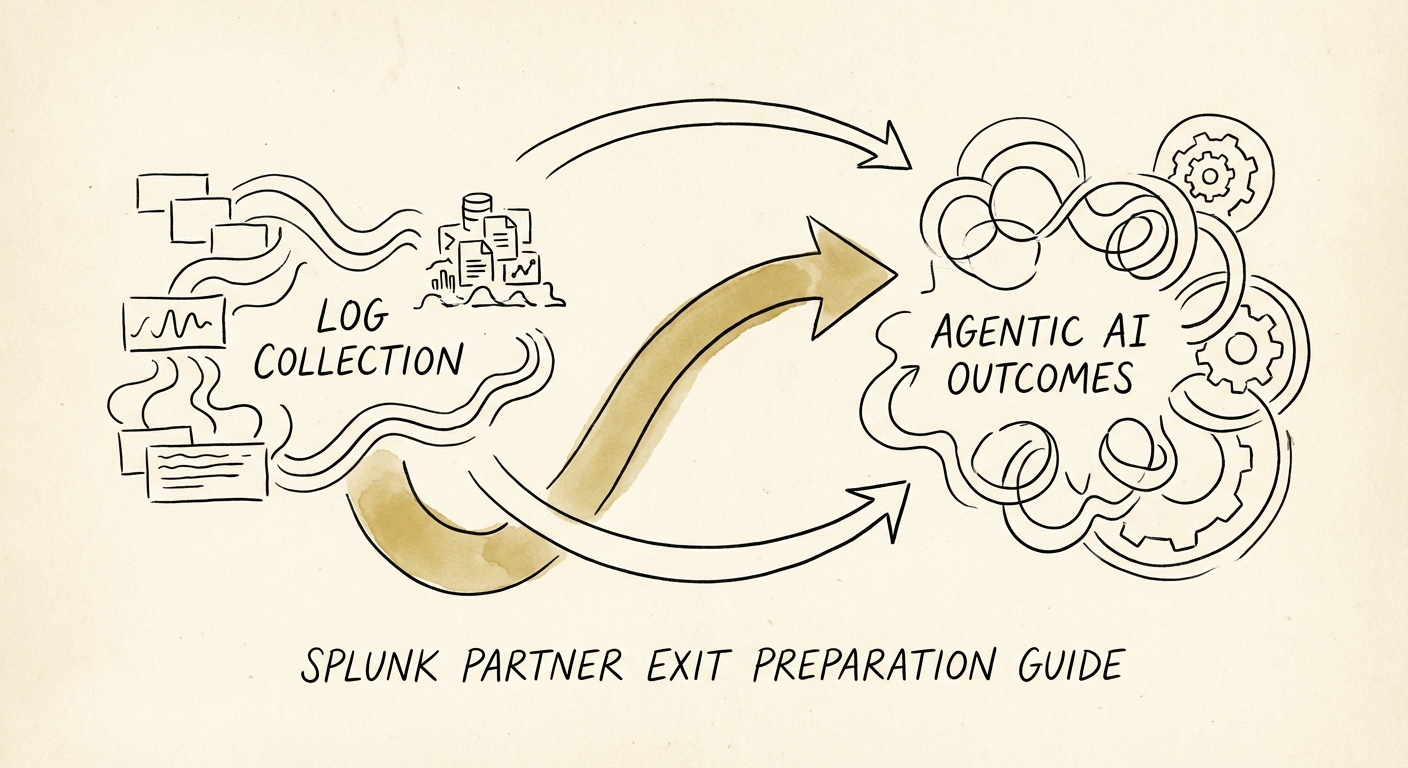
That era is over. The launch of the Cisco 360 Partner Program in February 2026 has drawn a hard line in the sand. Private Equity (PE) buyers and strategic acquirers have adjusted their valuation models accordingly. They are no longer paying premiums for “plumbing”—the basic ingestion and normalization of logs. In the eyes of a 2026 acquirer, plumbing is a commodity service trading at 5x to 7x EBITDA.
The premium capital—the 12x to 14x EBITDA multiples—has shifted entirely to “Security Intelligence” and “Agentic Automation.” Buyers are looking for partners who translate Splunk data into autonomous security outcomes. If your team is still billing hours to write basic SPL queries or manage on-prem indexers, you are effectively trading at a 50% discount to your potential value. The Cisco integration impact has created a “Platform Premium” where value is derived from cross-stack observability (AppDynamics + ThousandEyes + Splunk), not just log management.
In 2026, nobody is buying 'Splunk capacity.' They are buying the intellectual property that makes Splunk autonomous. If your team is manually writing queries for every client, you're building a job, not an asset.
The 'Ingest Trap' vs. The Agentic Premium
The single biggest valuation killer we see in Splunk partner due diligence is the “Ingest Trap.” This occurs when a firm’s revenue is tied linearly to data volume or engineering hours spent moving data. While this generates cash flow, it kills exit multiples because it mimics a low-margin staffing model rather than a high-margin IP model.
The 14x Model: Agentic AI & MDR
Conversely, firms trading at the top of the market have pivoted to Agentic AI and Managed Detection and Response (MDR). These partners utilize Splunk’s new AI capabilities to automate Tier 1 and Tier 2 SOC analyst tasks. They aren't selling “hours of monitoring”; they are selling “Mean Time to Remediation (MTTR) reduction.”
Consider the metrics that drive a 14x valuation in 2026:
- Proprietary Detection Content: Do you own a library of use cases (e.g., for SAP, healthcare protocols, or OT environments) that deploys instantly? This is viewed as software-like IP.
- Cisco XDR Integration: Are you bridging the gap between Splunk Enterprise Security and Cisco XDR? Partners who own this “connective tissue” are prime targets for PE platform acquisitions.
- Managed Service Revenue Mix: Acquirers demand >50% of revenue from recurring managed services, not one-off deployments.
The market is signaling that human-heavy SOCs are liabilities. The asset is the automation layer that sits on top of Splunk.
The 18-Month Exit Roadmap
If you plan to exit in late 2026 or 2027, you must restructure your P&L to match the “Security Intelligence” profile. A generic “Elite” partner badge is no longer a differentiator; the Cisco 360 “Partner Value Index” focuses on capabilities and performance, not just volume.
1. Purge Low-Margin Resale
Stop chasing low-margin license resale deals that bloat your top line but dilute your EBITDA margin. PE buyers will strip out pass-through hardware/software revenue to calculate your true valuation. Focus on high-margin services attachment.
2. Productize Your Knowledge
Take your top 5 consulting use cases and package them into deployable apps or “Accelerators.” Even if you don't sell them on Splunkbase, using them internally to deliver projects 40% faster improves your gross margins and demonstrates IP value during diligence.
3. The 'Cisco Synergy' Play
Position your firm as the bridge. A pure-play Splunk shop is less attractive than one that can also navigate Cisco’s network security stack. Cross-train your team. The ability to speak “Network” (Cisco) and “Data” (Splunk) fluently is a rare skill set that commands a strategic premium.