
The practical answer
- Short answer
- Splunk partner valuations are bifurcating. Why 'Elite' security partners trade at 14x EBITDA while generalist resellers stall at 6x in the Cisco era.
- Best fit
- Industry: Cybersecurity & Observability. Function: M&A Strategy
- Operating path
- Exit Readiness → Operational Excellence → Transaction Advisory Services
- Key metric
- 14x EBITDA multiple for Elite Splunk partners with >40% Managed Security revenue.
The Cisco Effect: A $28B Market Reset
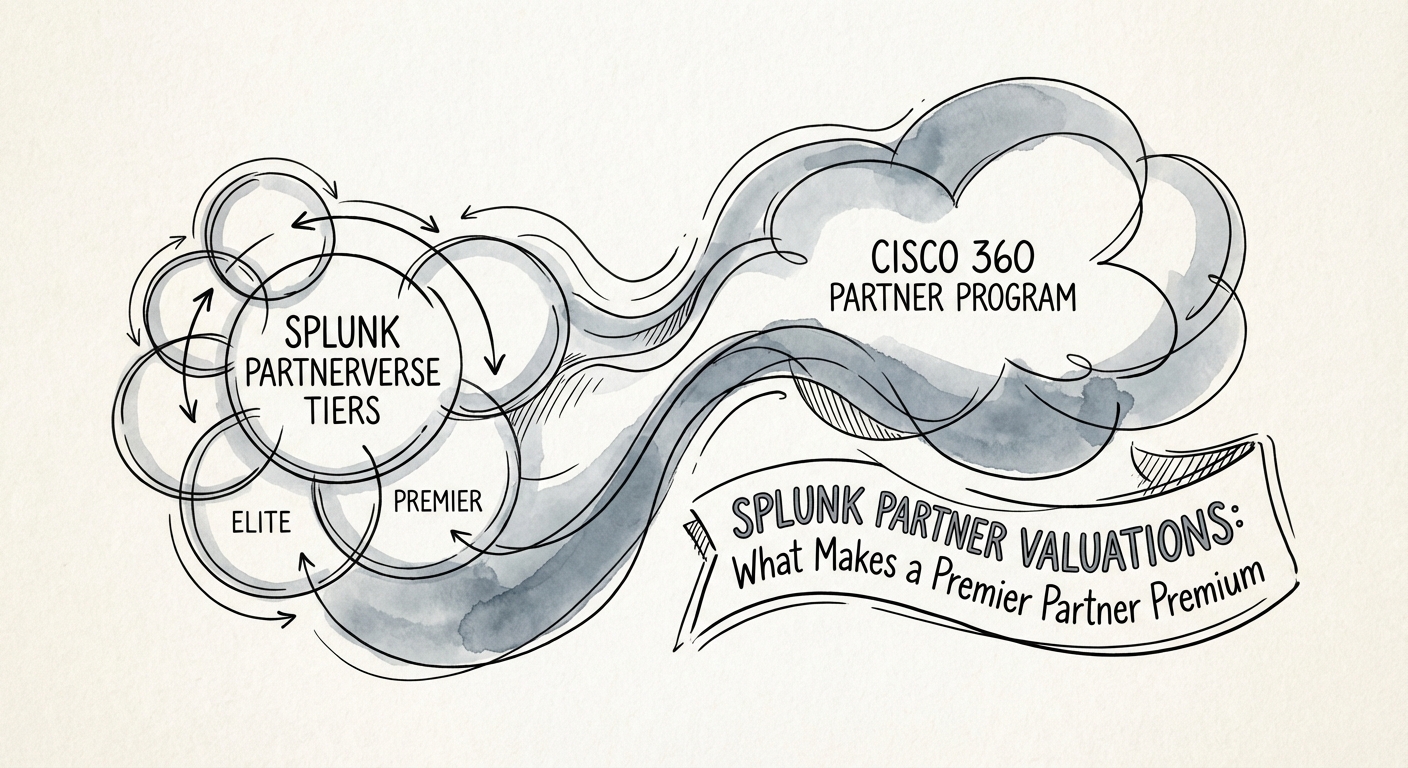
For over a decade, the Splunk partner ecosystem was a relatively straightforward hierarchy of resellers, implementation shops, and managed service providers. That hierarchy has been shattered. Cisco’s $28 billion acquisition of Splunk hasn't just consolidated technology; it has radically bifurcated partner valuations. As we approach the full integration of the Splunk Partnerverse into the Cisco 360 Partner Program in February 2026, the market is no longer valuing "Splunk capacity"—it is valuing "Security Intelligence."
For Private Equity investors and founders, this distinction is worth millions in enterprise value. The valuation gap between a partner that simply resells and installs Splunk (often referred to as "log collectors") and a partner that provides Managed Detection and Response (MDR) or Full-Stack Observability is now wider than ever. While generic resellers are seeing multiples compress to 4x–6x EBITDA due to margin pressure and automation, elite partners with proprietary IP and deep security operations capabilities are commanding 12x–14x EBITDA.
The driver of this premium is not just revenue growth; it is the strategic scarcity of partners who can execute the "Cisco + Splunk" cross-sell thesis. Cisco needs partners who can take a legacy network environment and overlay Splunk’s observability and security analytics to tell a C-suite story. Partners who can bridge that gap are trading at a massive premium because they are the engines of the acquisition's success.
The market has stopped paying for 'Splunk capacity.' We can hire bodies anywhere. We pay 14x for the partners who turn Splunk's raw data into Board-level security intelligence. If you're just collecting logs, you're a commodity.
The Valuation Hierarchy: From Resale to "Build"
In 2026, not all Splunk badges are created equal. Buyers are scrutinizing the composition of revenue and the depth of technical talent more than the badge on the website. Here is how the market is pricing these assets today:
Tier 3: The License Reseller (4x–6x EBITDA)
These firms focus on "Sell" motions. Their revenue is dominated by low-margin license resale (often 10-15% margin) with minimal professional services attached. They rely on volume and are most vulnerable to direct sales teams taking their largest accounts. In the PE playbook, these are "synergy targets"—bought cheaply to be folded into larger platforms.
Tier 2: The Implementation Specialist (8x–10x EBITDA)
These partners have "Premier" or "Elite" status and strong professional services (PS) teams. They deploy complex Splunk environments, handle data ingestions, and build dashboards. Their limitation is the "project-based" nature of their revenue. Every January 1st, the revenue counter resets to zero. They trade higher than resellers because of their technical talent (Certified Architects), but they lack the recurring revenue "flywheel" that drives premium multiples.
Tier 1: The Security & Observability Platform (12x–14x+ EBITDA)
This is the "Premium" tier. These firms have successfully pivoted to Managed Services (MSSP). They don't just install Splunk; they operate it. They sell outcomes: 24/7 monitoring, threat hunting, and incident response. They often have proprietary apps on Splunkbase (the "Build" partner motion) that create sticky, high-margin IP revenue. Buyers pay a premium here for the predictability of recurring revenue and the high switching costs associated with embedded security operations.
The "Premium" Drivers: What Buyers Are Hunting
If you are looking to position a Splunk partner for a premium exit, or assessing a target, four specific factors drive the multiple from 8x to 14x:
1. The "Build" Motion & IP Strategy
Partners with certified apps on Splunkbase trade at software-like multiples for that portion of their revenue. An app that automates compliance reporting or integrates a specific industry vertical (e.g., Healthcare HL7 data) into Splunk creates a defensive moat. It transforms the business from "hours for dollars" into a scalable platform.
2. High-Fidelity Managed Security (MDR)
The market is flooded with "alert factories"—MSPs that simply forward Splunk alerts to the client. The premium valuation goes to partners offering Managed Detection and Response (MDR). These firms take action on the alerts, filtering out noise and remediating threats. This shift from "notification" to "remediation" doubles the retention rate and significantly increases gross margins.
3. The Certification "bench" Strength
In due diligence, the ratio of Splunk Certified Architects to Splunk Certified Admins is a key quality indicator. Admins can keep the lights on; Architects can design the complex, multi-site architectures that enterprise clients (and Cisco) demand. A high concentration of "Consultant II" and "Architect" certifications signals a team capable of high-bill-rate strategic work rather than commodity maintenance.
4. Observability Expansion
While Security (SIEM) is the bread and butter, Observability is the growth engine. Partners who have successfully cross-sold Splunk Observability Cloud into their install base demonstrate the ability to capture the DevOps budget, not just the CISO budget. This diversifies the revenue stream and aligns perfectly with Cisco's "Full-Stack Observability" strategic pillar.