The practical answer
- Short answer
- Generalist GCP partners trade at 8x EBITDA. Looker-specialized firms trade at 14x. Here is the valuation data, the M&A drivers, and the pivot playbook for 2026.
- Best fit
- Industry: Cloud Consulting / Data Analytics. Function: M&A Strategy
- Operating path
- Exit Readiness → Operational Excellence → Transaction Advisory Services
- Key metric
- 13.6x Median EBITDA multiple for specialized IT Consulting (Data/AI) in 2025, vs 8.8x for generalists.
The Great Bifurcation: 8x vs. 14x in the Google Cloud Ecosystem
For the last five years, the mantra in the Google Cloud Platform (GCP) ecosystem was simple: capacity. If you had certified engineers, you had a business. PE firms rolled up generalist SIs (System Integrators) to capture the cloud migration wave, paying a healthy 10x-12x EBITDA for "bodies in seats" that could execute lift-and-shift projects.
That wave has crashed. In 2026, the "Generalist Discount" is real, and it is brutal. According to 2025 transaction data, generalist IT services firms without a proprietary wedge are seeing multiples compress to 8.8x EBITDA. The market has saturated; infrastructure migration is now a commodity service with shrinking margins.
However, a different story is playing out in the data layer. Specialized consultancies focused on the Modern Data Stack—specifically those mastering Looker, BigQuery, and the Semantic Layer—are trading at a premium that defies the broader market slowdown. These firms are commanding valuations of 13.6x to 15x EBITDA.
Why the massive delta? Because in the era of Generative AI, "infrastructure" is just plumbing. Data readiness is the product. Acquirers—whether strategic buyers like Accenture and Deloitte or PE-backed platforms like SADA (post-Insight acquisition)—are not buying capacity anymore. They are buying the intellectual property of data modeling. They are paying for the ability to turn a messy data swamp into a clean, governed semantic layer that can feed GenAI models.
If you are a GCP partner doing $20M in revenue, the difference between positioning yourself as a "Cloud Reseller" and a "Data Intelligence Partner" is roughly $40M in Enterprise Value.
In 2026, the 'Generalist Discount' is real. Acquirers aren't buying capacity anymore; they are buying the ability to turn a messy data swamp into a clean, governed semantic layer for AI.
Why Looker is the Valuation Lever (It's Not About Dashboards)
The mistake most founders make is thinking Looker is just a BI tool. If you position your practice around "building dashboards," you are competing with Tableau and PowerBI in a race to the bottom on billable rates. The premium valuation comes from positioning Looker as the Semantic Layer for AI.
Strategic acquirers pay premiums for Looker practices because of three specific mechanics that drive downstream revenue:
1. The Consumption Drag
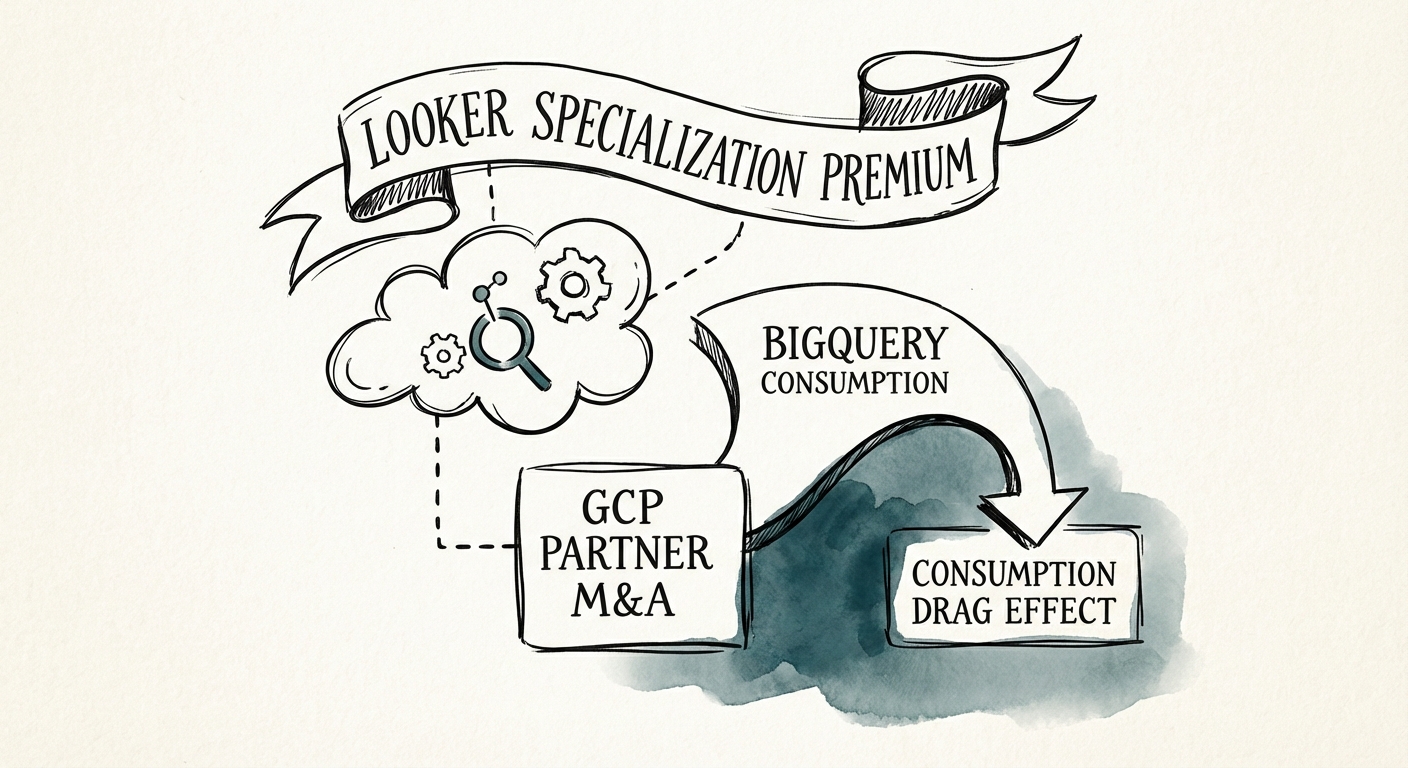
Every dollar of Looker implementation drags approximately $12-$15 of BigQuery consumption annually. Google knows this. Acquirers know this. A Looker-led engagement isn't a one-off project; it is an anchor that secures the customer's data gravity. Unlike a VM migration which can be optimized away, a semantic model becomes the operating system of the business. Churn rates for Looker-embedded customers are structurally lower (often <3% annually) compared to pure infra-managed services.
2. The GenAI Gateway
You cannot build enterprise GenAI on raw, unmodelled data. You need a trusted semantic layer to prevent hallucinations. Looker's LookML is effectively the "governance API" for LLMs. Partners who have productized "Chat with your Data" interfaces using Looker and Gemini are seeing 500% YoY growth in transaction value on the GCP Marketplace. This is not services revenue; this is high-margin, IP-led revenue that trades at SaaS-like multiples.
3. Embedded Analytics (The Sticky Revenue)
The highest valuation multiple (15x+) is reserved for partners who build Embedded Analytics solutions. This moves the engagement from "internal IT project" to "revenue-generating product" for the client. When you build the customer portal that their customers use, you are no longer a vendor; you are critical infrastructure. These contracts are multi-year, high-margin, and incredibly sticky.
The Pivot: From "Body Shop" to "Data Product Studio"
If you are currently a generalist GCP shop, you don't need to fire your infra team, but you do need to re-architect your revenue mix before you go to market. A buyer looking at your CIM (Confidential Information Memorandum) will discount your infra revenue and premium-price your data revenue. The goal is to shift the mix.
1. Productize the Semantic Layer
Stop selling "hours of data engineering." Start selling industry-specific data models. If you have done five implementations for Retail, package the LookML blocks into a "Retail Intelligence Accelerator." Documented IP assets increase transferability and directly impact the Quality of Earnings (QofE). Buyers pay for assets, not just cash flow.
2. Shift to Managed Data Services
Project revenue is lumpy and trades at 1x revenue. Recurring revenue trades at 4x-6x revenue. Launch a "DataOps Managed Service" where you don't just build the Looker instance, you maintain the data pipelines and semantic integrity for a monthly fee. If you can demonstrate that 30% of your revenue is recurring DataOps, you unlock the "Platform Premium."
3. The "Design & Build" Multiplier
Align your service delivery with Google's high-value partner incentives. The "Design" and "Build" phases of the partner flywheel now account for nearly 50% of the partner multiplier opportunity. Focusing here not only improves your margins today but aligns your story with the exact thesis strategic buyers are looking to validate. They want to see that you are drafting behind Google's biggest growth bets, not cleaning up their legacy debt.
The window to claim this premium is open, but it is narrowing as the large GSIs consolidate the mid-market leaders. You can trade at 8x, or you can trade at 14x. The difference is whether you are selling people or data.