
The practical answer
- Short answer
- The Cisco-Splunk integration is creating a valuation gap for partners. Why integrated 'Observability' shops trade at 14x while legacy Splunk partners stall at 8x.
- Best fit
- Industry: Cybersecurity & Observability. Function: M&A Strategy
- Operating path
- Exit Readiness → Operational Excellence → Transaction Advisory Services
- Key metric
- 14x EBITDA multiple for Splunk partners with integrated Cisco Security & Observability services.
The 'Log Management' Discount vs. The FSO Premium
The March 2024 completion of Cisco’s $28 billion acquisition of Splunk didn’t just consolidate two technology giants; it bifurcated the partner ecosystem. For over a decade, Splunk partners thrived on a straightforward model: resell license, deploy the SIEM (Security Information and Event Management), and bill for ingestion-based architecture services. This model, characterized by “capacity planning” and “log management,” traditionally commanded respectable 8x-10x EBITDA multiples in private equity markets due to high retention rates.
That era is over. The integration of Splunk into Cisco’s Full-Stack Observability (FSO) ecosystem has fundamentally changed the valuation calculus. Buyers are no longer paying premiums for partners who simply “keep the lights on” in the SOC (Security Operations Center). The new valuation premium—reaching 14x EBITDA in recent deal flow—is reserved for partners who have bridged the gap between Cisco’s network fabric and Splunk’s data analytics.
This shift is driven by the convergence of Observability and Security. In the new “Cisco 360” partner program logic, a standalone Splunk practice is merely a feature of a broader security posture. To command a premium, a partner must demonstrate the ability to correlate network telemetry (Cisco) with log data (Splunk) to predict and prevent outages, not just report on them. This is the difference between a “Reactive Log Shop” (8x) and a “Proactive Resilience Partner” (14x).
The 14x multiple isn't for the partner who sells the most Splunk license. It's for the partner who can prove their managed service prevents the network outage that the firewall missed.
The Cisco 360 Valuation Drivers: Badges, Badges, Badges?
With the sunsetting of the Splunk Partnerverse and its absorption into the Cisco 360 Partner Program (fully operational by FY27/February 2026), the definition of “strategic asset” has changed. The old logic of accumulating individual certifications is being replaced by the Partner Value Index (PVI), which heavily weights cross-architecture capabilities.
1. The Cross-Architecture Multiplier
Partners who have successfully integrated Cisco’s XDR (Extended Detection and Response) or AppDynamics with Splunk deployments are seeing a 3-turn EBITDA expansion compared to single-stack competitors. The valuation thesis is simple: customer stickiness. A client relying on a partner for both network security (Firewall/ISE) and data observability (Splunk) has a significantly higher switching cost than a client using a partner solely for SIEM administration.
2. The 'Resale' Trap in the New Ecosystem
Under the Splunk Partnerverse, high-volume resale could mask low-value services revenue. Cisco’s incentive structure, however, is aggressively shifting margin away from pure resale and toward Lifecycle and Adoption services. For PE buyers, this creates a specific due diligence red flag: “Splunk Elite” partners whose revenue mix is >60% resale are effectively facing a margin cliff as they migrate to Cisco’s program. Their historical EBITDA is artificially inflated by rebates that may not exist in the same form within the Cisco 360 framework. Real value lies in Managed Detection and Response (MDR) IP that sits on top of the Splunk/Cisco stack, not the margin on the license itself.
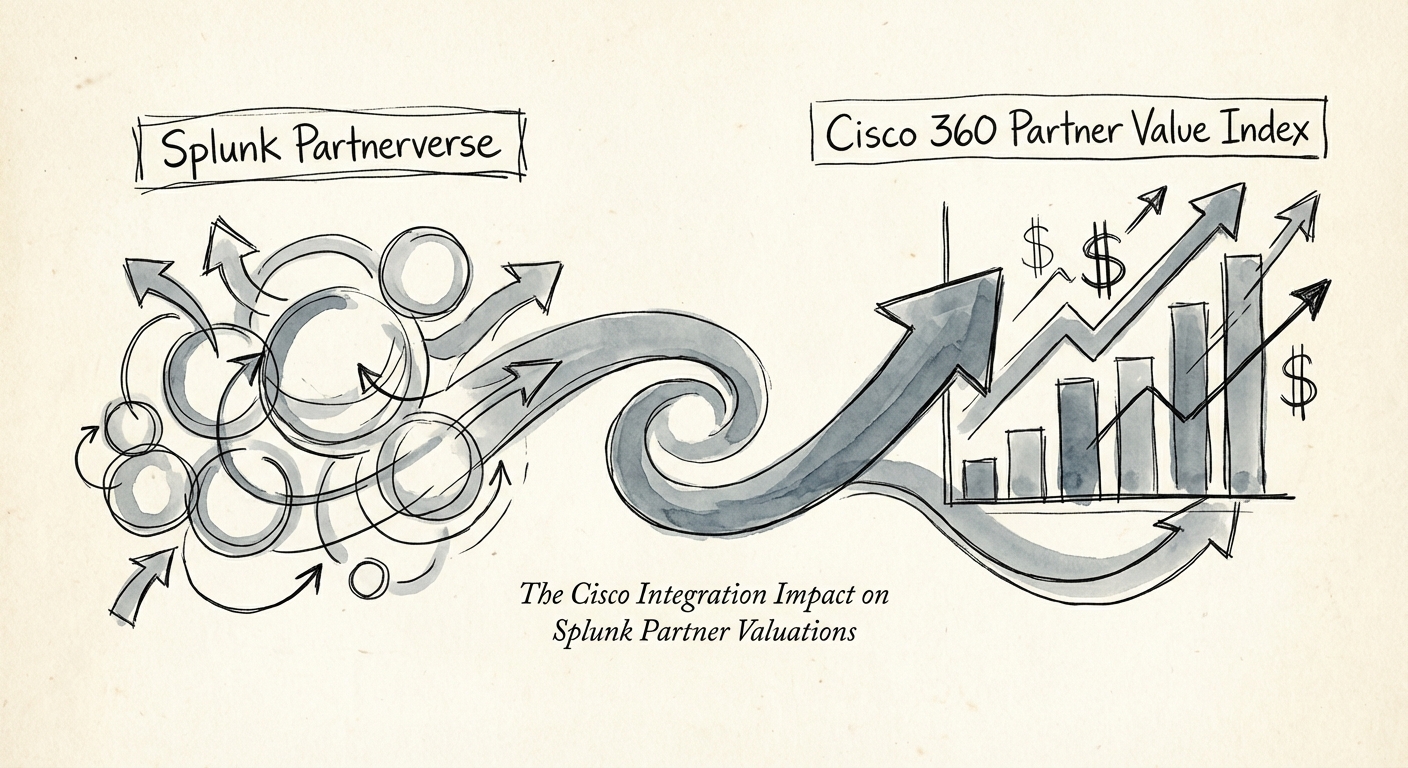
The Deal-Killing Gap: Legacy Apps vs. The AI Canvas
The most dangerous landmine for acquirers of Splunk partners in 2026 is Technical Debt disguised as “Proprietary IP.” Many Splunk brokerages tout their custom apps and TAs (Technology Add-ons) as value drivers. However, Cisco’s roadmap—specifically the Cisco AI Canvas and the Unified Observability Platform—threatens to deprecate heavily customized legacy Splunk environments.
We are seeing “IP-rich” partners trade at discounts because their “assets” are actually liabilities: custom XML dashboards and Python scripts that break with every Splunk Cloud update or are incompatible with Cisco’s new data fabric. A true “Tech-Enabled” multiple (12x-14x) requires IP that is forward-compatible with the Cisco Security Cloud, such as automated remediation workflows (SOAR) that trigger Cisco network actions based on Splunk alerts. If the “IP” is just a better way to visualize logs, it’s worth zero. If it’s an automated response engine that links Splunk intelligence to Cisco enforcement, it’s a 14x asset.
For portfolio companies, the play is clear: stop building custom visualizations and start building cross-platform automations. The buyer market is actively searching for the “missing link” partners who can make sense of the combined Cisco + Splunk data lake, not just the ones who can query it.