
The practical answer
- Short answer
- Stop hiring generic Splunk Admins. Discover why 'Resilience Architects' drive 2.8x higher bill rates and how to pivot your talent strategy for the Cisco 360 era.
- Best fit
- Industry: Data & Security. Function: Talent & Operations
- Operating path
- Team & Hiring → Operational Excellence → Transaction Execution Services
- Key metric
- $135 vs $350 Hourly bill rate gap between a 'Core Admin' and a 'SOAR Architect' in 2026.
The Certification Paradox: Why 'Core Certified' Is a Liability
In the legacy Splunk Partnerverse, volume was victory. Partners raced to accumulate Splunk Core Certified Power User and Admin badges to climb tiers. In 2025, with the transition to the Cisco 360 Partner Program, this strategy is not just obsolete—it’s a margin killer.
The market has bifurcated. On one side, you have 'Maintenance Ops'—routine upgrades, agent deployments, and log ingestion. These tasks are increasingly automated by Splunk Cloud Platform or handled by low-cost offshore resources. If your bench is stacked with 'Admins,' you are competing in a race to the bottom where bill rates struggle to break $135/hr.
On the other side is 'Resilience Architecture.' These are engagements centered on Enterprise Security (ES), SOAR, and Observability Cloud. Here, clients aren't paying for 'uptime'; they are paying for risk reduction and business insight. Our data shows that partners specialized in these high-value domains command a 2.8x revenue multiplier per headcount compared to generalist shops. The dangerous trap for founders is hiring for the former while pitching the latter.
Clients don't pay $300 an hour for someone to parse logs. They pay for someone to tell them why the logs matter. The gap between a 'Splunk Admin' and a 'Security Architect' is the difference between a 6x and a 12x exit.
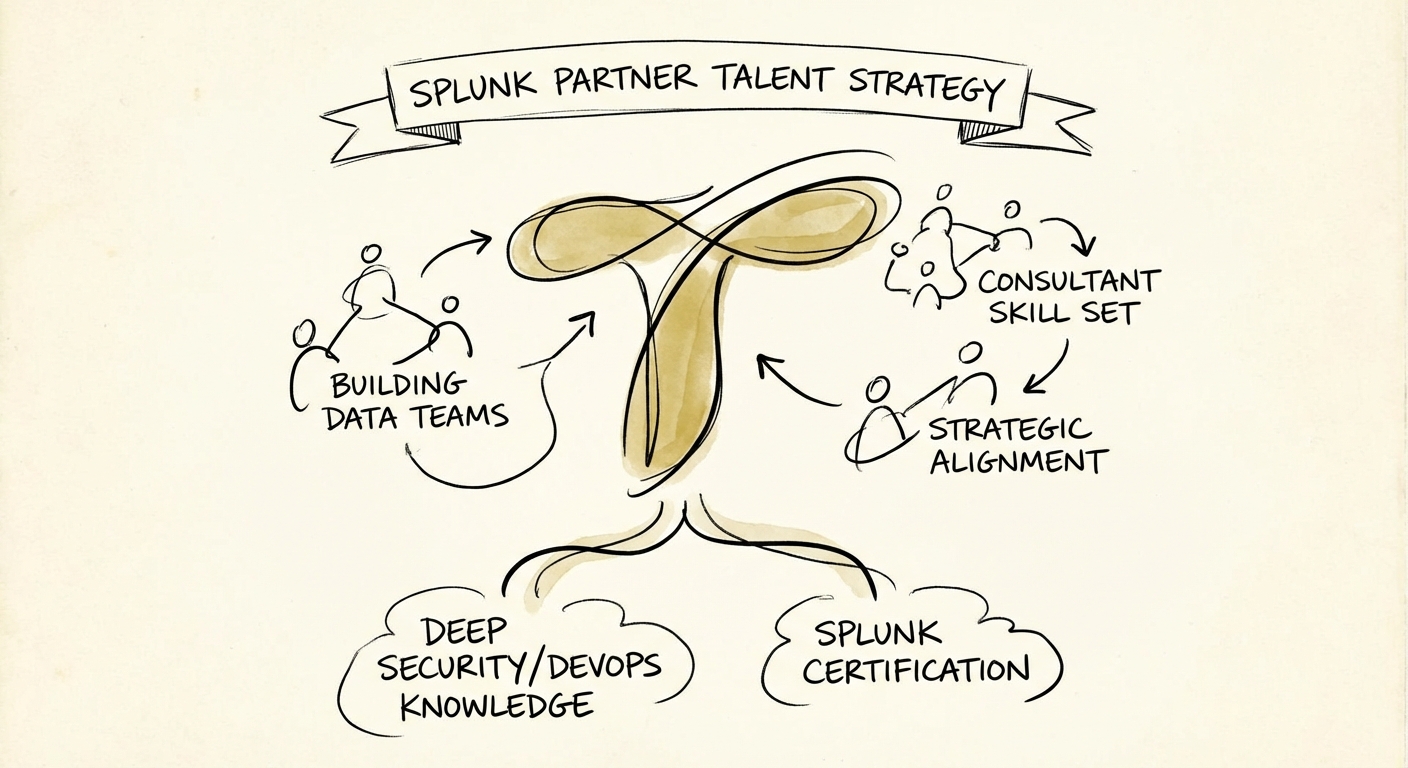
The 'T-Shaped' Splunk Consultant: A New Hiring Profile
To capture the 'Cisco Data Fabric' opportunity, you must stop hiring 'Splunkers' and start hiring 'Engineers who know Splunk.' The distinction is subtle but financial dynamite.
1. The Security Architect vs. The SIEM Admin
A SIEM Admin asks, 'How do I parse this log?' A Security Architect asks, 'How does this data source reduce our MTTR for ransomware?' You need talent capable of leading SOAR implementations, where the value lies in automating response playbooks, not just ingesting alerts. Look for candidates with Python scripting skills and CISSP certifications, then train them on Splunk Phantom/SOAR. They bill at $275/hr+, whereas a pure Splunk Admin caps at $150/hr.
2. The Observability Engineer vs. The Infrastructure Monitor
With the Cisco acquisition, Full-Stack Observability is the new frontier. Clients need engineers who understand the application layer (APM), not just server logs. Hiring developers who understand distributed tracing and OpenTelemetry will allow you to sell high-margin 'App Modernization' retainers rather than low-margin 'Infrastructure Monitoring' support blocks.
The Economic Impact: Optimization for Exit
Private Equity buyers in 2026 are scrutinizing the quality of revenue, not just the quantity. A Splunk practice built on 'Staff Augmentation' (body shop model) trades at roughly 6x-8x EBITDA. A practice built on 'Specialized IP and Advisory' (consultancy model) trades at 12x-14x EBITDA.
Why the gap? Because 'Staff Aug' revenue is fragile—it walks out the door when the contract ends or the talent leaves. 'Advisory' revenue is sticky because it is embedded in the client's security posture and operational workflows. By shifting your talent strategy from 'Volume of Badges' to 'Depth of Specialization,' you don't just increase your bill rates today; you double your exit multiple tomorrow.
Actionable Pivot: Audit your bench today. If more than 60% of your certified staff hold only Core/Admin badges, you have a 'Badge Trap.' Freeze hiring for generalists and open requisitions for Splunk Accredited SOAR Consultants and Observability Architects immediately.