
The practical answer
- Short answer
- Stop hiring 'Paper Tigers'. Learn why generic Salesforce talent fails in Veeva practices and how to build high-valuation teams for regulated industries.
- Best fit
- Industry: Life Sciences / Tech Services. Function: Talent Strategy
- Operating path
- Team & Hiring → Operational Excellence → Transaction Execution Services
- Key metric
- 40% Failure rate of generic Salesforce architects placed in lead Veeva Vault roles without GxP training.
The Force.com Fallacy: Why Salesforce Talent Fails in Pharma
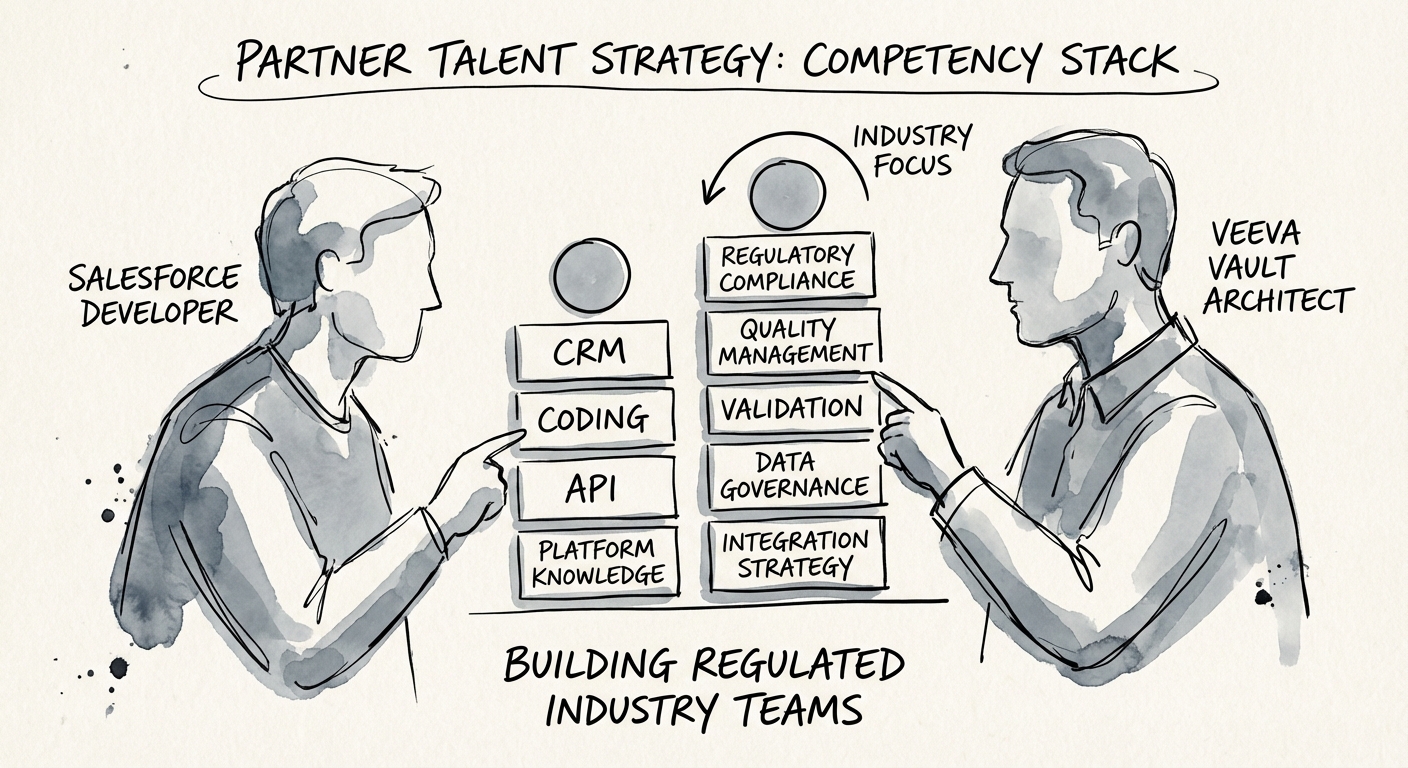
In the high-stakes world of Life Sciences IT, a dangerous misconception is eroding margins across the partner ecosystem: the belief that a Senior Salesforce Developer is automatically a Veeva Vault Architect. This "Force.com Fallacy" is the primary driver of project failure in scaling Veeva practices. While Veeva Vault is built on a cloud architecture that shares DNA with Salesforce, the application of that technology requires a fundamentally different competency stack.
We consistently see Private Equity-backed services firms attempt to scale their Veeva practices by aggressively hiring generic Salesforce talent, assuming a certification bootcamp will bridge the gap. The data suggests otherwise. A developer who can write perfect Apex code but doesn't understand the difference between a Trial Master File (TMF) and a promotional claim will not just delay a project; they will introduce compliance risk. In regulated industries, a technical error isn't a bug—it's a potential audit finding. The result is what we call the "Paper Tiger" hire: a consultant with a chest full of badges who cannot sit in a room with a Director of Regulatory Affairs and speak the language of 21 CFR Part 11.
The financial impact of this misalignment is severe. Our diagnostics on the cost of bad tech hires indicate that replacing a senior "Paper Tiger" in a regulated practice costs approximately $250,000. This figure includes recruitment fees, wasted salary during the 6-month ramp, lost billable hours, and—most critically—the remediation costs required to fix the validation errors left behind.
In Life Sciences, a technical error isn't just a bug—it's an audit finding. The partners commanding 14x multiples are the ones selling compliance assurance, not just configuration hours.
The 'Domain-First' Hiring Matrix: GxP Over Apex
To build a Veeva practice that commands a premium valuation (12x-14x EBITDA), you must invert the traditional systems integrator hiring model. Instead of hiring for technical proficiency and hoping for domain absorption, the most successful partners are hiring for Life Sciences domain fluency and training for technical configuration. This is the "Regulated Industry Team" strategy.
Your hiring rubric must test for "Validation Readiness." Can the candidate articulate the impact of a configuration change on the system's validation status? Do they understand why electronic signatures must be non-repudiable? If they cannot answer these questions, they belong in a generic CRM practice, not a Vault implementation. This distinction is vital because, unlike standard SaaS implementations where "move fast and break things" is a virtue, in Life Sciences, "move fast and document everything" is the law. As detailed in our analysis of Healthcare IT due diligence, buyers will heavily discount practices that treat compliance as an afterthought.
The 3-Tier Competency Model
Effective Veeva practices structure their teams into three distinct tiers to balance cost and compliance:
- Tier 1: Domain Architects. These are your "unicorns"—often former Life Sciences IT directors or deep industry consultants. They own the client relationship and the solution design. They speak "Pharma," not just "Cloud."
- Tier 2: Validation Engineers. Specialized technical staff who understand Computer System Validation (CSV) and ensuring the platform meets GxP standards.
- Tier 3: Configuration Specialists. This is where your junior technical talent lives. They execute tickets under strict supervision. This is the only safe place for generic Salesforce talent to enter your ecosystem.
Valuation Impact: The 'specialist' Premium
The talent strategy you choose directly correlates to your exit multiple. Private Equity buyers are becoming increasingly sophisticated in distinguishing between "Veeva Resellers" and "Life Sciences Transformation Partners." The former trades at standard IT services multiples (6x-8x EBITDA), while the latter—firms that can act as strategic advisors on clinical, quality, and regulatory operations—command significant premiums (12x-16x EBITDA).
Why the gap? Because a "Transformation Partner" owns the business outcome, not just the software license. They reduce the client's regulatory risk profile. When you staff your team with individuals who understand the drug development lifecycle, you move from being a vendor to being a partner in bringing therapies to market. This creates "sticky" revenue and high Net Revenue Retention (NRR), which are key drivers of valuation.
Conversely, relying on a generic talent pool forces you into a commodity race to the bottom on bill rates. If your team looks like every other Salesforce shop, you will be priced like every other Salesforce shop. To break the $20M revenue ceiling and unlock the specialist premium, your talent strategy must be as regulated and rigorous as the industry you serve.