
The practical answer
- Short answer
- Adobe's tier ladder rewards certified headcount, not margin. How partners stop overpaying for AEM Architects, spot the exam-dump 'Paper Tiger,' and build a bench that bills.
- Best fit
- Industry: Adobe Partner Ecosystem. Function: Human Resources / Operations
- Operating path
- Team & Hiring → Operational Excellence → Transaction Execution Services
- Key metric
- 30% Salary premium commanded by Adobe Certified Experts over non-certified developers.
The badge math that quietly eats your gross margin
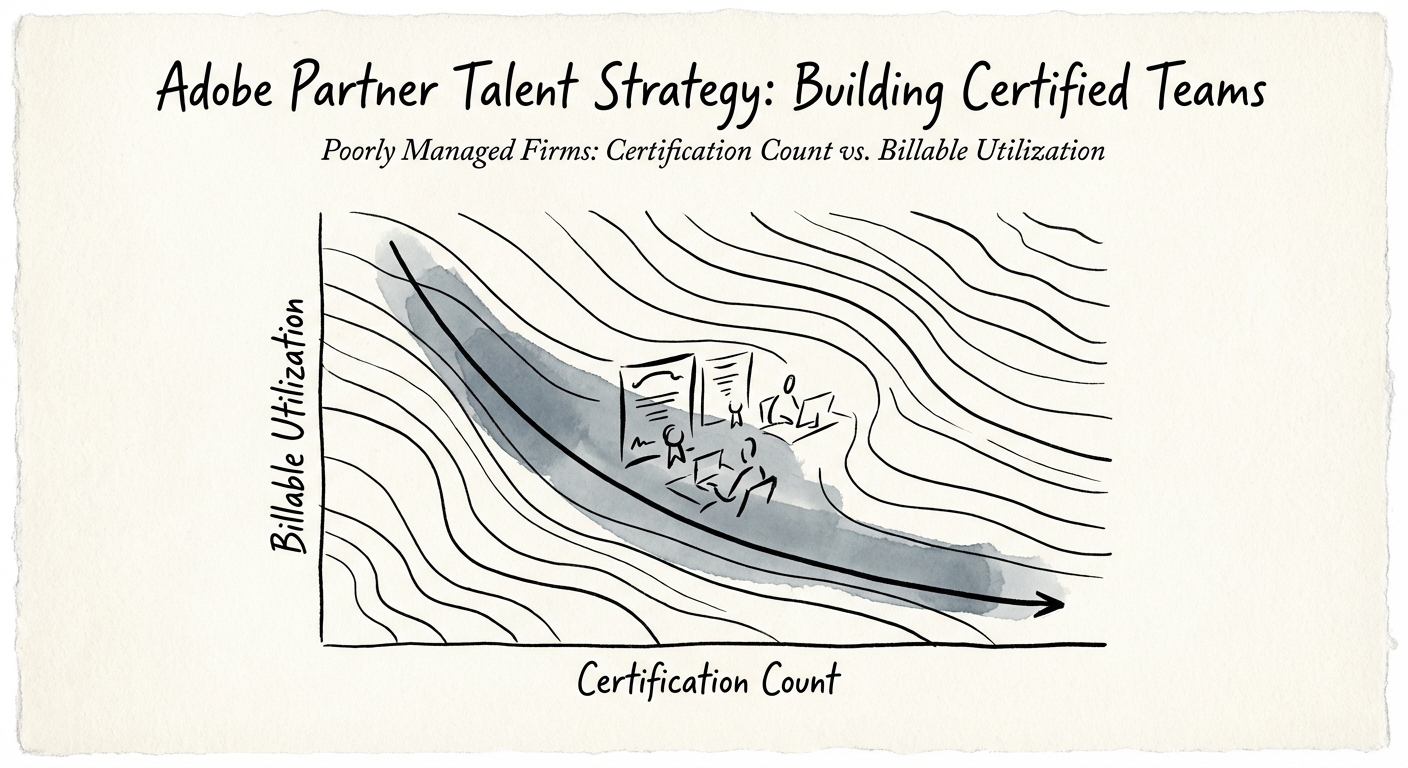
Here is the trap, in one sentence: to move from Silver to Gold to Platinum in the Adobe Solution Partner program, you need a headcount of certified Adobe Certified Experts and Architects on the books. Adobe counts heads. It does not count whether those heads are billing. So the program itself, with the best of intentions, is paying you to do the one thing that destroys a services firm's economics: hoard expensive people who don't carry a utilization number.
Watch how it plays out. AEM Architects are scarce, and the partner ecosystem all chases the same shortlist at once. The result is a wage bubble — certified AEM and Marketo talent commands a salary premium of 15-30% over equally capable non-certified engineers. As of early 2026, a senior AEM Architect in the U.S. runs a $160,000-$200,000 base, with contract rates north of $250 an hour. You're already paying top of market just to keep your tier intact.
Then the badge starts working against you. Your most expensive architect gets pulled into pre-sales calls to flash "bench strength" at a prospect or an Adobe field rep. They're nodding through a discovery deck instead of debugging a Sites deployment. Their billable hours crater. So your single costliest resource is functionally a sales engineer who happens to hold an Architect cert. Do the arithmetic on your own roster: if that person is billing under 68.9% utilization, your Platinum status isn't a growth asset — it's actively draining EBITDA every week they sit in that chair.
And the bubble compounds. The talent pool is thin to begin with — set against a projected global shortage of 4 million developers by 2025 — so when you hire purely to satisfy a tier threshold, you take whoever clears the cert, not whoever can deliver. Those hires are mercenaries by construction. They jump every 18 months for a $20k bump, and each exit leaves a hole that runs close to $300k to refill once you total agency fees, ramp time, and the projects that slipped while the seat was empty.
A Platinum badge that costs you twenty margin points isn't a credential. It's a subsidy you're paying Adobe to keep three people who'll leave the moment a competitor offers them $20k.
The five-minute test that separates a certified expert from someone who passed the exam
The Adobe cert exams are gameable. There's a brisk market in exam dumps, and a smart person can memorize their way to "Certified Expert" without ever having stood up a production AEM instance. These are the candidates I call Paper Tigers — flawless on your partner scorecard, useless the night a client's Sites implementation throws a critical indexing failure or a custom Marketo-to-CRM sync silently stops firing leads. The badge says they can handle it. The 2 a.m. incident channel says otherwise.
I looked at one mid-sized Adobe partner that proudly listed 40-plus certifications and still bled money on a delivery defect rate that wouldn't come down. When we dug in, more than 60% of their "Certified Experts" had never owned a project end to end. They were a wall of badges and a shortage of practitioners — which is exactly the team the tier ladder incentivizes you to build.
You don't need a take-home project to catch this. You need three questions in the technical interview, each aimed at a specific AEM/Adobe fault line:
- Make them describe a failure. "Walk me through a time an implementation broke in production." A Paper Tiger recites the happy path and the documented best practice. A practitioner gets specific and uncomfortable — a dispatcher cache misconfiguration that served stale pages for a day, an OSGi bundle that wouldn't resolve after a deploy, a content tree that ground the author instance to a halt. The texture is the tell.
- Probe the version gap. Someone certified on AEM 6.5 who can't articulate what actually changed moving to AEM as a Cloud Service — the shift to immutable content, Cloud Manager pipelines, the death of in-place upgrades — is certified on a platform your clients are leaving. The exam lags the product; your client's roadmap doesn't.
- Force the "why," not the "how." Anyone can wire up Adobe Target. Ask whether a given client should even use Target versus a lightweight A/B tool, and why. If they can only configure and can't reason about when the spend is justified, you've found a technician, not a consultant — and technician margins are the margins you're trying to escape.
Stop buying architects at the top of the market — manufacture them
The only durable way out of the badge trap is to stop competing for finished AEM Architects in a bidding war and start growing your own. The most profitable Adobe partners I work with don't recruit architects; they convert mid-level Java developers into them on a deliberate timeline. The raw material is everywhere — AEM is a Java/OSGi stack at its core, so a solid Spring or backend developer is two-thirds of the way there before they ever open an AEM component tree.
The on-ramp is cheaper than partners assume. Bronze-and-above partners get a 33% discount on certification, which knocks the test fee down to a rounding error. The real spend isn't the exam — it's the protected, non-billable training time and a senior architect who actually mentors instead of just shipping. That's the line item firms flinch at, and it's exactly the line item that builds a moat.
Run the comparison on your own numbers. Buying a senior AEM Architect: roughly $180k salary plus a ~$45k recruiting fee, and a real risk they walk in 18 months. Building one from a $110k Java developer: figure 12 months of ramp, carry the 20% non-billable training drag, and — say a 30-person partner doing this with two developers — the homegrown architect typically crosses into profitable around month nine and stays. They stay because they can see a career arc inside your firm, not just a paycheck waiting to be outbid.
That's the difference between a credential strategy and a talent strategy. Badges you bought are a liability an acquirer will discount the moment they realize the value walks out the door at 5 p.m. A bench you built is transferable enterprise value. If your entire Platinum status rests on three mercenaries who could resign tomorrow, you don't own a business — you own their notice periods.