
The practical answer
- Short answer
- Stop badge collecting. Learn how to build a Microsoft Dynamics competency mix that drives Partner Capability Scores (PCS) and billable revenue. Diagnostic for scaling partners.
- Best fit
- Industry: Technology Services. Function: Operations
- Operating path
- Team & Hiring → Operational Excellence → Transaction Execution Services
- Key metric
- 35 Maximum 'Skilling' points available in the Partner Capability Score. You cannot certify your way to a designation without performance.
The 'Badge Collector' Fallacy: Why Your Skilling Score Is a Liability
In the old Microsoft Partner Network (MPN) days, you could study your way to Gold status. You hired a few smart grads, locked them in a room with Udemy and practice exams, and emerged a week later with a 'Gold Competency' badge to slap on your website. That playbook is dead, and if you are still running it, you are burning cash.
Under the Microsoft AI Cloud Partner Program (MAICPP), 'Skilling' accounts for exactly 35 out of 100 possible points in your Partner Capability Score (PCS). The remaining 65 points come from Performance (Net Customer Adds) and Customer Success (Usage Growth and Deployments). Here is the diagnostic reality: If you are maximizing your Skilling points but struggling to hit the 70-point threshold for a Solutions Partner for Business Applications designation, you have a delivery problem, not a certification problem.
I see firms doing $15M in revenue carrying a 'bench' of certified consultants who have never deployed a live instance of Finance & Operations (F&O). These are 'Paper Tigers.' They pass the MB-300 series exams (or their 2026 equivalents) but cannot troubleshoot a blocked posting routine on a Friday afternoon. In 2026, the market doesn't pay for badges; it pays for outcomes. If your certified staff aren't generating Usage Growth (active monthly users), Microsoft’s algorithm penalizes you, and your P&L bleeds margin on non-billable training time.
The Skilling Trap
Scaling partners often over-index on 'Intermediate' certifications (worth 20 points max) because they are easier to get. They ignore the 'Advanced' certifications (worth 15 points) because they require deeper expertise. The result? You hit a ceiling at 20 Skilling points and zero Customer Success points, leaving you stranded at a PCS of 45/100—unable to earn incentives, unable to get rebates, and invisible to Microsoft field sellers.
In 2026, the market doesn't pay for badges; it pays for outcomes. If your certified staff aren't generating Usage Growth, Microsoft’s algorithm penalizes you.
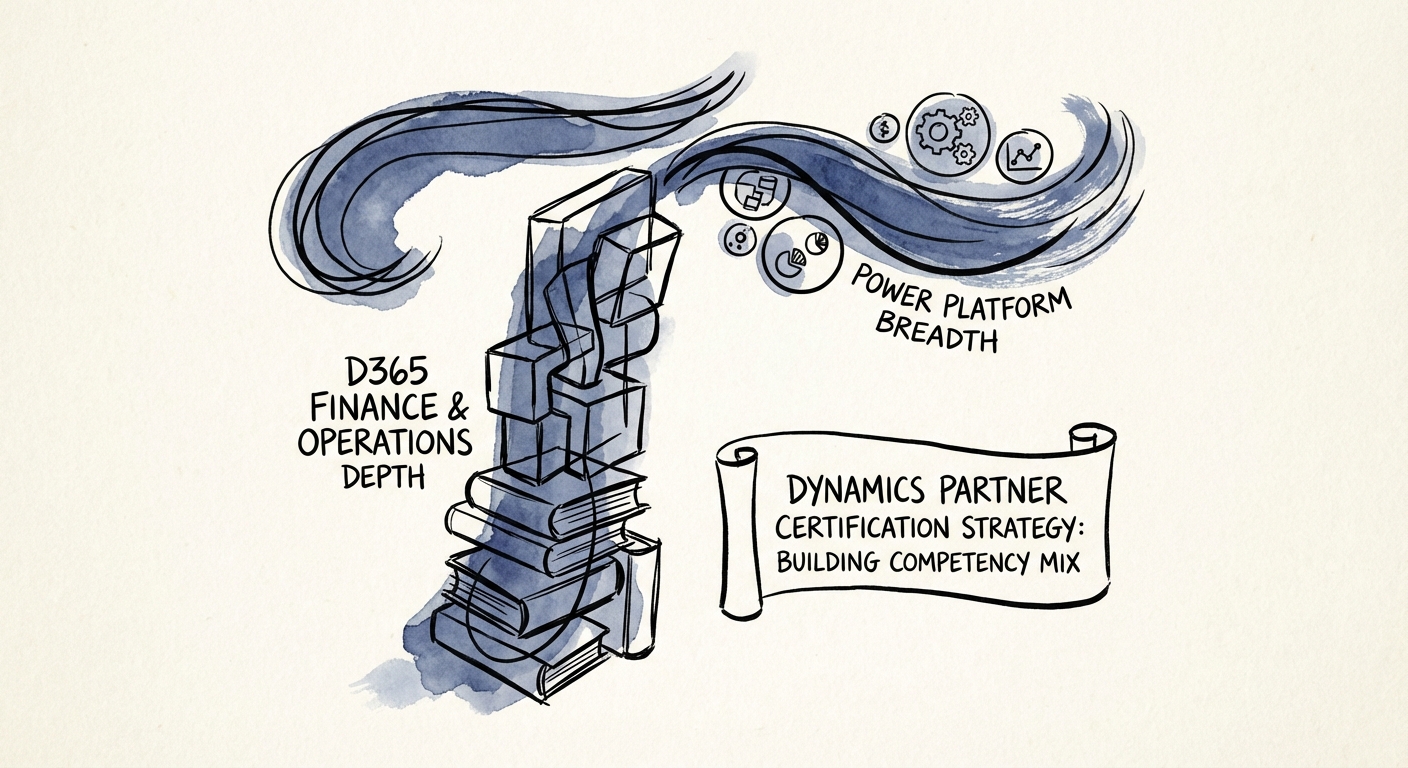
The 2026 Competency Matrix: The 'T-Shaped' Consultant
Stop hiring generic 'Dynamics Consultants.' The market has bifurcated. The high-value billable resources in 2026 are specialized hybrids. To build a competency mix that drives both your PCS score and your EBITDA, you need to map certifications to two specific archetypes.
1. The F&O Architect (The High-Value Anchor)
Certifications: Dynamics 365: Finance and Operations Apps Solution Architect Expert (MB-700).
Why: F&O talent is the scarcest resource in the ecosystem. With salary premiums for F&O Architects hitting 22% above the baseline in 2025, these are your margin drivers. You cannot build a practice on Business Central (BC) alone; the deal sizes are too small to support a heavy overhead structure. You need F&O capability to unlock enterprise tiers.
2. The Platform Hybrid (The Utility Player)
Certifications: Power Platform Functional Consultant Associate (PL-200) + Dynamics 365 Sales/Service (MB-210/230).
Why: This is where most partners fail. They certify for Dynamics CRM (CE) but ignore the Power Platform. In 2026, you cannot effectively deploy Dynamics Sales without deep Dataverse and Power Automate skills. A consultant who knows Sales but can't build a flow is a liability. By enforcing a 'Hybrid' certification path, you ensure your team can actually deliver the modern Microsoft stack, which drives the 'Deployments' metric in your PCS.
The 'Usage' Correlation
Microsoft tracks Monthly Active Users (MAU) or consumption. A 'Paper Tiger' implementation team configures the system but fails to drive adoption. A 'Competent' team (T-Shaped) builds automations and workflows that force user adoption. The latter directly feeds your 'Customer Success' score (30 points). Your certification strategy must focus on the skills that drive stickiness, not just configuration.
Retention Economics: Protecting the Asset
The most expensive line item on your P&L isn't software; it's the consultant you paid to certify who leaves for a $20k raise three months later. With tech turnover rates hovering around 20-25%, your certification strategy must include a retention wrapper.
The 'Vest and Verify' Framework
Don't hand out exam vouchers like candy. Structure your competency program with economic guardrails:
- The 12-Month Clawback: If the firm pays for training and certification, that cost is a loan forgiven over 12 months. If they leave in Month 6, they owe you the remaining 50%. This stops the 'get certified and quit' cycle.
- The Project Gate: Do not promote a Junior Consultant to Senior based on certifications alone. Require billable evidence. They must hold the certification AND have logged 500 billable hours on a relevant deployment. This aligns their incentive with your revenue, not just their LinkedIn profile.
- The 'Advanced' Premium: Tie your biggest variable comp boosters to the 'Advanced' certifications (e.g., Solution Architect Expert). These are the hardest to get and the most valuable for your PCS score (worth ~2.14 points per person in Enterprise tracks). Reward the behavior that actually moves the needle on your partner designation.
Your goal is not a wall of certificates. It is a Partner Capability Score above 70 and a Utilization Rate above 75%. If a certification doesn't contribute to one of those two numbers, it is a vanity metric. Cut it.