
The practical answer
- Short answer
- Workday certification costs have doubled while utilization rates fell to 68.9%. A diagnostic guide for Service Partners on calculating true ROI, avoiding the 'Paper Tiger' trap, and structuring high-margin teams.
- Best fit
- Industry: Professional Services. Function: Operations
- Operating path
- Team & Hiring → Operational Excellence → Transaction Execution Services
- Key metric
- $12,000 Estimated fully-loaded cost to onboard and certify a new Workday consultant (Training + Exam + Non-Billable Time) in 2026.
The New Math of Workday Partnership: Costs Up, Utilization Down
For the better part of a decade, the formula for Workday Service Partners was simple: Hire smart athletes, pay for their HCM Core certification, and bill them out at $175 an hour. The certification was the golden ticket—a one-time entry fee that yielded 3-4 years of high-margin returns. In 2026, that math has fundamentally broken.
Two converging forces have eroded the traditional partner model. First, the cost of compliance has skyrocketed. As of late 2025, certification costs have effectively doubled, with recertification requirements morphing from simple open-book updates to proctored, paid exams ($200 per seat, per module). A fully certified lead with HCM, Financials, and a specialty module like Adaptive Planning now represents a capital investment approaching $12,000–$15,000 when you factor in training units, exam fees, and lost billable time.
Second, utilization has collapsed. Industry benchmarks for 2025 show professional services utilization dipping to 68.9%—well below the 75% "safe zone" required to protect EBITDA margins. The market is flooded with "Paper Tigers": consultants who hold 4+ certifications but lack the implementation reps to lead a project solo. You are paying a premium for their badge, but clients are refusing to pay premium bill rates for their lack of practical experience.
The "Paper Tiger" Discount
In due diligence, we often see rosters stacked with "Workday Pro" badges. On the surface, it looks like a high-value asset. In reality, it's a liability. A consultant with 5 certifications and 6 months of experience is a flight risk, not a revenue generator. They command a market salary premium of $20k–$30k because recruiters filter by keywords, yet they cannot bill at the Senior Consultant rate ($180/hr+) that justifies their compensation.
The most expensive asset on your P&L isn't the software—it's the consultant who just got certified on your dime and is answering Recruiter InMails during billable hours.
The ROI Calculator: Which Badges Actually Bill?
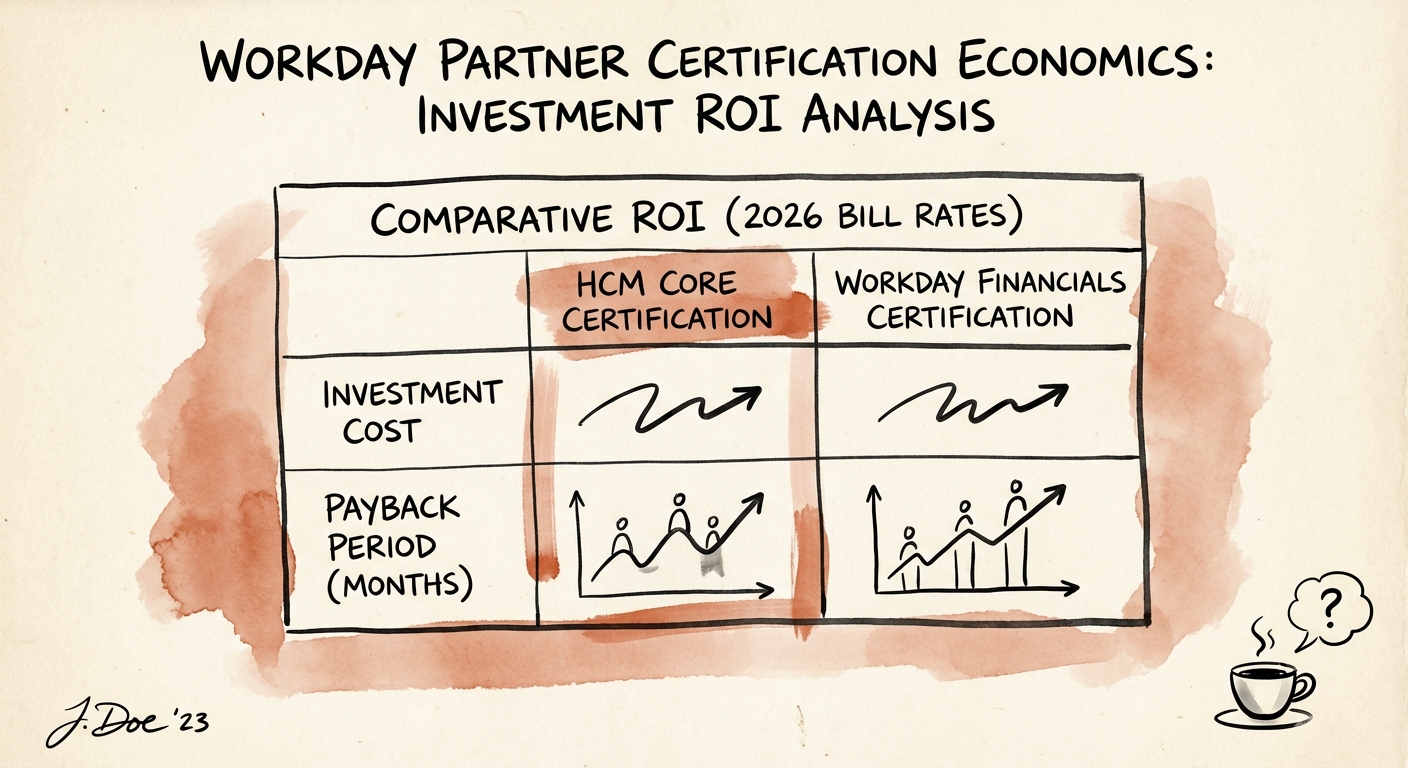
Not all certifications are created equal. If you are running a generic "Staff Augmentation" shop focused on HCM Core, you are fighting a race to the bottom. The bill rate for generalist HCM support has compressed to $105–$120/hr in the sub-contracting market. At those rates, the payback period on a $5,000 certification investment stretches to nearly 6 months of full utilization—a dangerous timeline given the current attrition rates in the ecosystem.
To restore margins, you must pivot your certification strategy from "Volume" to "Value." Our analysis of 2025 partner economics shows that three specific tracks consistently deliver EBITDA-accretive returns:
- Workday Financials & Accounting Center: As Workday Financials outpaces HCM in new logo growth, the shortage of functional consultants who understand both debits/credits and object-oriented configuration is acute. These resources command $165–$200/hr and, more importantly, enjoy longer project durations (12–18 months vs. 6–9 months for HCM).
- Adaptive Planning: The "office of the CFO" is the new battleground. Consultants certified in Adaptive Planning are seeing utilization rates 15% higher than their HCM peers because the work is cyclical and sticky—clients need constant modeling updates, creating a recurring revenue stream that resembles SaaS.
- Workday Extend & Integrations (Studio): This is the moat. While AI agents (Workday Illuminate) threaten to commoditize basic configuration, complex custom integrations remain "human-heavy." A Studio-certified architect is an insurance policy for your project margins, preventing the "red accounts" that bleed profit.
The 10-15% Niche Premium
Data consistently shows that consultants with these "niche" certifications command a 10-15% bill rate premium over generalists. However, the real ROI driver isn't just the rate—it's the retention of the account. A partner who can solve a complex revenue recognition issue with a Financials expert keeps the client for the Phase 2 rollout. A partner who only offers HCM support gets displaced by a cheaper boutique once the system is live.
Structuring for Retention: The "Certification Cliff"
The most dangerous day for a Workday partner is the day an employee adds a new certification to their LinkedIn profile. In a talent-short market (despite the tech cool-down), a triple-certified consultant is a target for every headhunter and competitive GSI. If you treat certification as a "reward" without tying it to a retention mechanic, you are essentially funding your competitor's recruiting budget.
Successful partners are moving to a "Vesting Certification" model. Instead of paying 100% of training costs upfront with no strings attached, structure the investment as a forgivable loan or a retention bonus tied to billable milestones. For example, the firm covers the $4,000 course fee, but the employee "earns" it back by billing 500 hours on that specific module. If they leave before hitting the milestone, they owe a pro-rated portion back. This discourages "badge collecting" and aligns the investment with revenue generation.
Furthermore, stop hiring for badges and start hiring for aptitude + staying power. The "Grow Your Own" model—hiring functional experts (former HR practitioners or Controllers) and teaching them Workday—yields a 40% lower attrition rate than hiring mercenaries from the ecosystem. It takes longer to ramp (4-6 months to full billability), but the Unit Economics over a 3-year period are superior due to lower base compensation and higher loyalty.