
The practical answer
- Short answer
- The Workday talent shortage is eroding partner margins. Learn how rising labor costs and the contractor-driven labor market impact your EBITDA, and how to fix it.
- Best fit
- Industry: Professional Services. Function: Operations
- Operating path
- Team & Hiring → Operational Excellence → Transaction Execution Services
- Key metric
- 15-20% Wage inflation for senior Workday consultants in key tech hubs (YoY)
The Mathematics of a Broken Market
If you run a Workday partner firm, you are currently fighting a war you cannot win with checkbooks alone. The fundamental economics of the ecosystem have shifted. Five years ago, the arbitrage play was simple: hire a certified consultant for $120,000, bill them out at $250/hr, and pocket a healthy 50% gross margin. Today, that same consultant costs $160,000—if you can find them—and your rate card likely hasn't moved enough to compensate.
The data paints a difficult picture of supply and demand. According to analysis of the ecosystem, we are approaching a 1:1 ratio of open job requisitions to total certified professionals. In niche areas like Prism, Accounting Center, and Professional Services Automation (PSA), the ratio is even worse. This scarcity allows consultants to dictate terms, driving wage inflation of 15-20% YoY in key hubs like San Jose and New York.
For a founder operating between $10M and $50M in revenue, this is an existential threat. You don't have the balance sheet of a Deloitte or Accenture to absorb margin compression, nor the brand power to attract talent at a discount. Every time you win a project and have to staff it with a contractor at $180/hr because your full-time team is tapped, you are effectively servicing the client for free. You are exchanging revenue for risk, with zero contribution to EBITDA.
You cannot out-bid the market when the market is broken. If your growth strategy relies on finding 'ready-made' seniors at 2020 prices, you aren't scaling—you're gambling.
The "Body Shop" Trap: Why Buying Talent Kills EBITDA
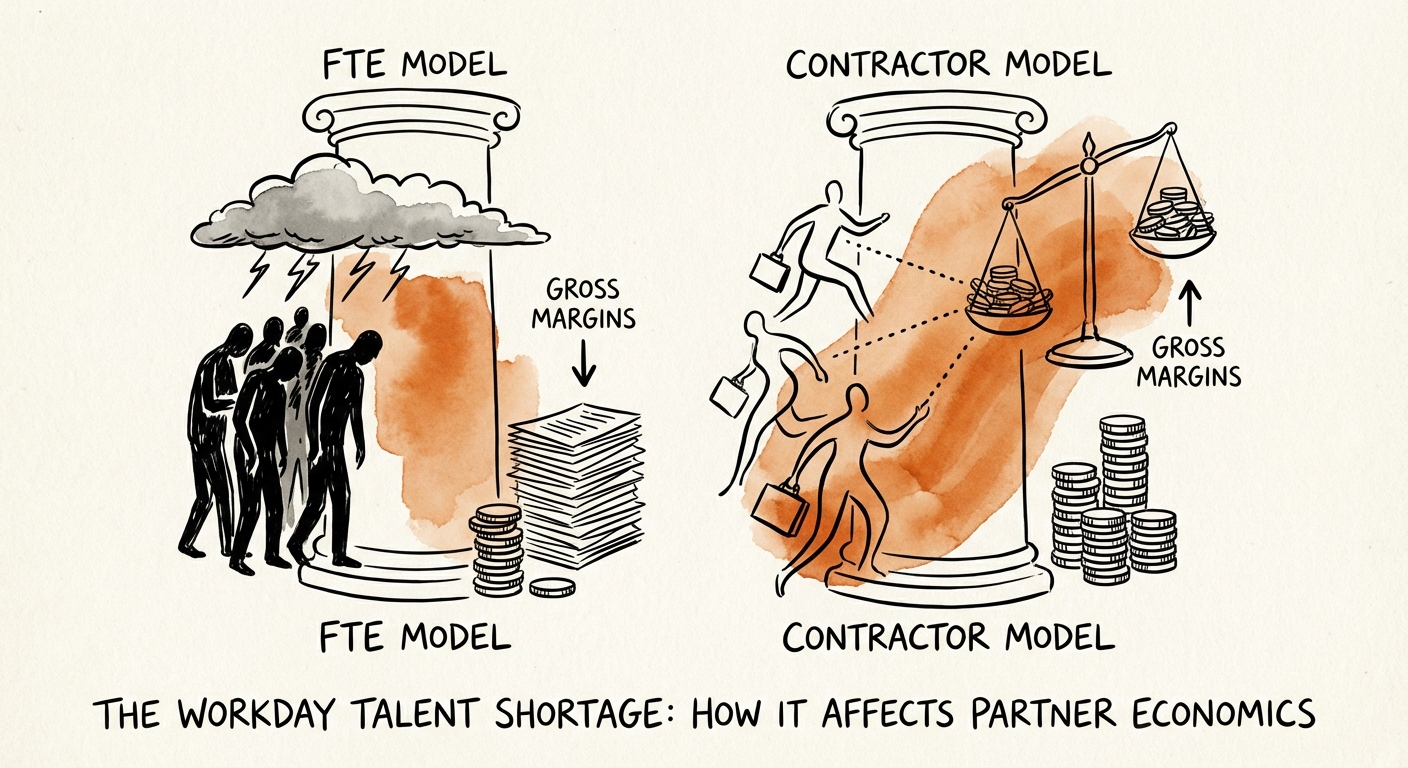
The most common reaction to this shortage is the "Mercenary Strategy": frantically hiring senior independent contractors or poaching expensive talent from competitors to fill seat requirements. This is a trap. While it solves the immediate delivery problem, it destroys the enterprise value of your firm.
Consider the unit economics. A full-time employee (FTE) at $140,000 annual cost (fully loaded) billing 1,600 hours generates significant margin. A contractor billing you $150/hr to do the same work leaves you with "pass-through" margins—often as low as 15-20%. In the eyes of a Private Equity buyer, that revenue is low-quality. It's not repeatable, it's not scalable, and it creates massive key-person dependency.
The Hidden Cost of the "Grand Rewrite"
Beyond the direct financial cost, reliance on mercenaries creates technical debt. Contractors are incentivized to close tickets, not to build scalable architecture. They rarely document processes, and when they leave, the tribal knowledge leaves with them. This forces you into a perpetual cycle of "cleanup" projects that you often have to eat the cost for, further eroding margins. You aren't building a firm; you're running a high-end temp agency.
The Fix: Build the "Academy" Model
The only sustainable way to protect margins in a 1:1 supply-constrained market is to stop buying talent and start manufacturing it. The most successful boutique partners we advise have shifted to an "Academy" model: hiring high-aptitude juniors (often with adjacent ERP experience or strong finance backgrounds) and pairing them with a Senior Architect in a structured mentorship ratio (typically 3:1).
This requires a shift in your engagement model. You must sell outcomes, not hours. If you sell "one Senior Consultant," the client expects a unicorn. If you sell "a delivery pod," you can leverage cheaper resources for configuration and testing while the Senior Architect focuses on high-value design. This blends your effective hourly cost down, restoring your 50%+ gross margins.
Furthermore, retention becomes your new acquisition strategy. With 51% of business leaders citing talent shortages as a primary concern, your trained staff are targets. You must defend them not just with salary, but with clear progression paths into those high-value niches like Financials and Adaptive Planning. If you can't show them a path to the $180k tier within your walls, they will find it outside them.