
The practical answer
- Short answer
- Stop hiring 'Ticket Takers.' To command premium multiples, Zendesk partners must pivot talent strategy from administration to AI orchestration and CX architecture.
- Best fit
- Industry: Professional Services. Function: Talent Management
- Operating path
- Team & Hiring → Operational Excellence → Transaction Execution Services
- Key metric
- $175k Average salary for a Zendesk Solution Architect, compared to $110k for a standard Admin.
The Era of the 'Ticket Taker' is Over
For the last decade, the Zendesk partner ecosystem ran on a simple arbitrage model: hire junior administrators at $90,000, certify them in Zendesk Support, and bill them out at $175 an hour to configure triggers, macros, and views. It was a volume game, fueled by the explosive growth of mid-market companies needing a better help desk.
That game is over. The introduction of Zendesk AI, AI Agents, and the Sunshine platform has fundamentally bifurcated the market. Enterprise clients no longer need help configuring ticket queues; they need automated resolution architectures. They don't want a "help desk"; they want a "service layer" that integrates with Shopify, Salesforce, and AWS to resolve 80% of inquiries without human intervention.
Yet, most partners are still hiring for the 2018 playbook. They stack their benches with "Certified Support Administrators"—a role that is rapidly becoming a commodity. In 2026, the valuation gap between a "Ticket Shop" (staffed by admins) and a "CX Consultancy" (staffed by architects) is the difference between a 5x and a 12x exit multiple.
The Talent Bifurcation
The market has split your talent pool into two distinct economic units. Failing to recognize this distinction is why your utilization is high but your margins are stagnant.
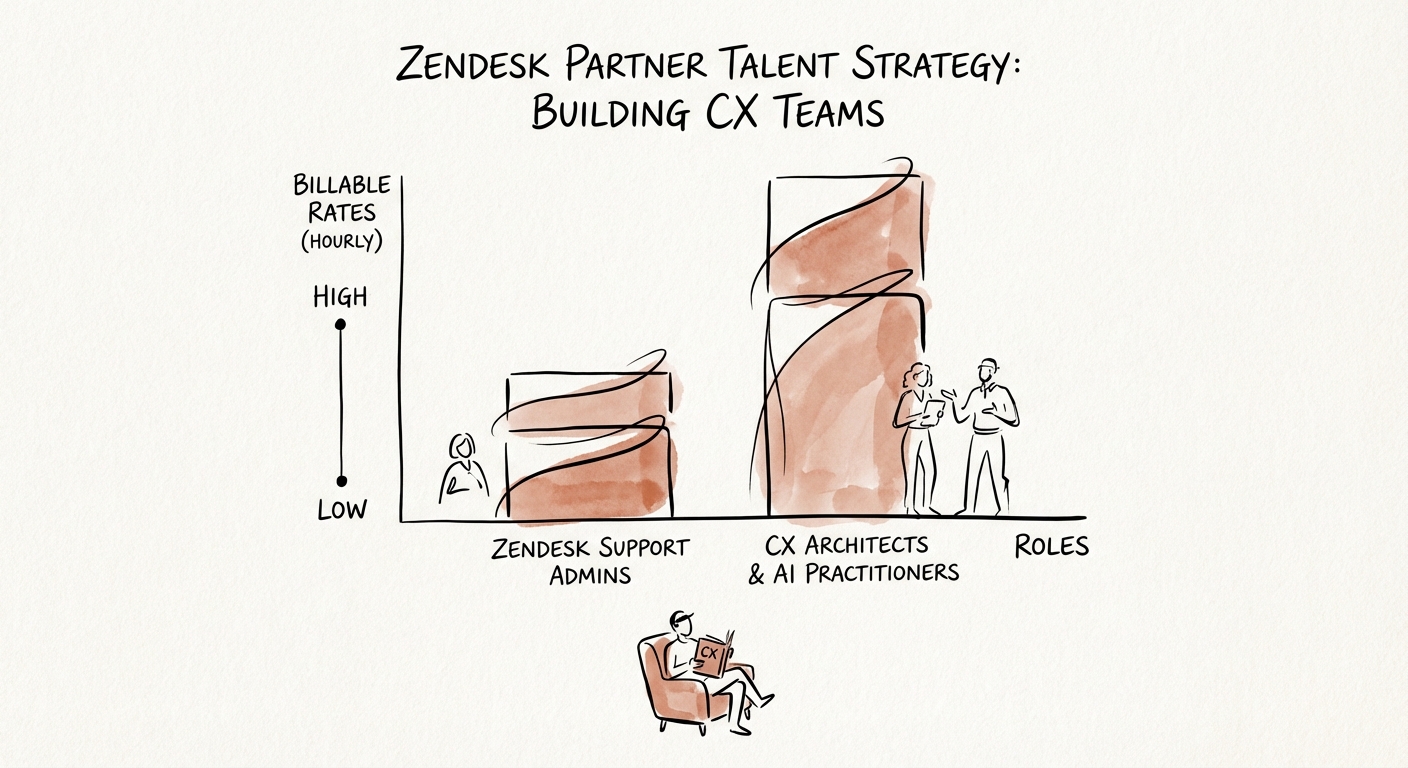
- The Administrator (The Commodity): capable of configuring the core Support and Guide products. They manage users, groups, and basic routing. Market Billable Rate: $150–$185/hr. Salary Cost: $95k–$115k.
- The CX Architect (The Asset): Capable of designing "human-in-the-loop" AI workflows, integrating Sunshine Conversations, and building custom apps on the Zendesk framework. Market Billable Rate: $275–$350/hr. Salary Cost: $155k–$175k.
If your talent strategy focuses on volume hiring of Administrators to "feed the beast" of implementation projects, you are building a low-margin services firm in a high-tech wrapper.
Enterprise clients no longer need help configuring ticket queues; they need automated resolution architectures. They don't want a 'help desk'; they want a service layer.
The 'Paper Tiger' Certification Illusion
In due diligence, we often see Zendesk partners present a "deep bench" of 50+ certified consultants. On paper, it looks impressive. A closer look reveals the "Paper Tiger" problem: 90% of those certifications are for Zendesk Support Administrator.
While necessary for basic partner tier compliance (Select vs. Premier), these certifications do not correlate with the ability to deliver the high-value work that enterprise buyers demand today. A bench full of Support Admins cannot deliver an AI-driven transformation project. They cannot write the JSON needed for complex API integrations, nor can they architect the data flows for a headless commerce support experience.
The New Competency Mix
To pivot your firm toward the "CX Consultancy" valuation tier, your hiring and certification roadmap must shift immediately toward technical depth. The most valuable badges in 2026 are not "Support Admin," but rather:
- Zendesk AI Practitioner: Validates the ability to configure AI agents, intent models, and automated workflows. This is the entry point for $300/hr work.
- App Developer I / II: Validates the ability to build custom private apps that extend Zendesk functionality. This is where "sticky" IP is created.
- Sunshine Conversations Specialist: The messaging backbone that allows brands to support customers across WhatsApp, Apple Business Chat, and SMS seamlessly.
Strategic Benchmark: A healthy, high-valuation practice should aim for a ratio of 1 Architect : 2 Developers : 3 Consultants. Most stalling firms operate at 0 : 0 : 10.
The Economics of the 'Pod' Model
Stop assigning individual "Admins" to projects. The complexity of modern Zendesk deployments—often involving AWS middleware, custom middleware, and AI training—requires a cross-functional unit. We call this the "CX Pod."
A CX Pod consists of:
- 1 Solution Architect (Lead): Owns the overall design, data model, and AI strategy. Billable at $350/hr.
- 1 Technical Consultant (Dev): Handles the API integrations, custom app development, and script writing. Billable at $250/hr.
- 2 Implementation Consultants: Handle the configuration, training, and documentation. Billable at $185/hr.
Why This Works: This structure allows you to blend rates effectively. You can offer a blended rate of ~$240/hr to the client while utilizing lower-cost resources for the bulk of the configuration work. More importantly, it prevents the "Hero Syndrome" where your one senior technical person is dragged into every sales call and every fire drill, killing their billable utilization.
By structuring your team around capabilities rather than just capacity, you unlock the ability to sell high-margin managed services post-implementation. A client will not pay $5,000/month for "admin support" (which they can hire internally), but they will pay $15,000/month for "AI Optimization and Continuous Improvement"—a service that only a technical pod can deliver.