
The practical answer
- Short answer
- Why "SnowPro Core" counts are a vanity metric. A diagnostic guide for PE sponsors on assessing Snowflake partner talent quality, attrition risks, and margin impacts in 2026.
- Best fit
- Industry: Data & Analytics Services. Function: Talent Management
- Operating path
- Team & Hiring → Operational Excellence → Transaction Execution Services
- Key metric
- 20% Attrition Rate Danger Zone for Data Engineering Talent (2025)
The 'Paper Tiger' Certification Bubble
In 2025, the Snowflake Partner Network exploded to over 12,000 partners globally. For Private Equity sponsors evaluating these firms, this density creates a dangerous illusion of competence. The primary metric used in due diligence—count of "Certified Professionals"—has become a vanity metric that actively obscures delivery risk. The market is flooded with the SnowPro Core certification, an entry-level credential that validates a consultant knows what a Virtual Warehouse is, but not how to optimize one for a Fortune 500 workload.
We are seeing a trend we call "Certification Inflation." Service providers, desperate to climb Snowflake's partner tiers (Select, Premier, Elite), are incentivizing junior staff to pass the SnowPro Core exam en masse. These consultants often have zero production experience. In a recent audit of a $20M Snowflake partner, we found that while 92% of the delivery team held a SnowPro Core certification, only 6% held a SnowPro Advanced credential (Architect, Data Engineer, or Administrator). The result? A "Paper Tiger" workforce that looks elite on a slide deck but collapses under the weight of complex implementation, leading to the "Snowflake Consumption Cliff" where client costs spiral and projects stall.
A 'Certified' Snowflake practice with a 1:15 Senior-to-Junior ratio isn't a consultancy; it's a staffing firm with a better logo. The multiple compression happens when the clients realize the difference.
The Economics of the 'Hero Architect'
The financial impact of this talent imbalance is visible in your gross margins, specifically in the gap between billable utilization and effective yield. When a firm relies on a "Hero Culture"—where a handful of Senior Architects (SnowPro Advanced) carry the technical load for an army of junior "Core" certified staff—the unit economics break down. These Seniors are currently trading at a premium, with base compensation for SnowPro Advanced Architects pushing $175,000–$200,000 in the US market.
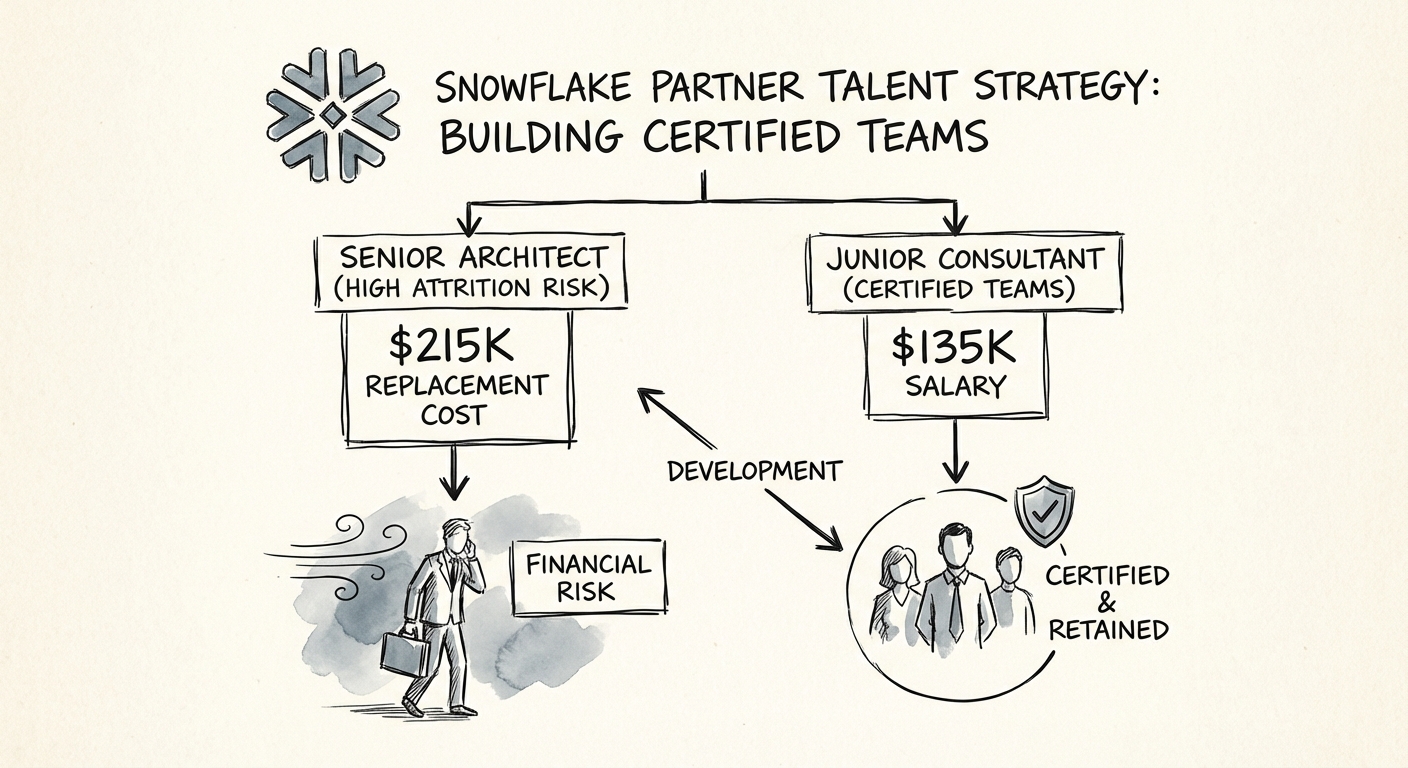
The hidden killer is Attrition Risk. In 2025, data engineering consultancies are seeing attrition rates spike above 20% for their top 10% of talent. When a Hero Architect burns out and leaves, the replacement cost is not just their salary. When factoring in recruiting fees (25%), lost billable hours (3 months ramp), and the "knowledge debt" they take with them, the true replacement cost hits $215,000 per departure. Furthermore, the remaining junior team, unable to solve complex architectural problems without their lead, introduces technical debt that typically manifests as a 30% margin erosion on fixed-bid projects due to rework.
The Pivot: From 'SQL Body Shop' to 'Data Product Team'
To fix this, PE Operating Partners must force a shift in the talent strategy: stop hiring for "Data Warehousing" and start hiring for "Data Products." The traditional Snowflake skill set—SQL, ETL, and database administration—is becoming commoditized. The premium valuation multiples in 2026 are reserved for partners building with Snowpark, Python, and Native Apps. These require a software engineering background, not just a database background.
The 2026 Talent Playbook:
- The Ratio Rule: Enforce a strict ratio of 1 SnowPro Advanced Architect for every 6 SnowPro Core consultants. If the ratio slips to 1:10, delivery risk becomes critical.
- The Snowpark Pivot: Rewrite job descriptions to prioritize Python and Containerization skills over legacy SQL experience. Your "Snowflake Developer" should look more like a Backend Engineer than a DBA.
- The Retention Ring-Fence: Identify the specific individuals holding the Advanced Architect certifications and lock them in with long-term incentives (LTIs). Do not treat them as fungible resources; they are the IP generators of the business.