
The practical answer
- Short answer
- Stop hiring 'paper tigers.' A diagnostic guide for Atlassian Partners on building teams with valid ACP-120 expertise, avoiding badge inflation, and scaling high-margin cloud practices.
- Best fit
- Industry: Professional Services. Function: Talent Management
- Operating path
- Team & Hiring → Operational Excellence → Transaction Execution Services
- Key metric
- 1:3 Ideal ratio of Business Architects to Technical Consultants for high-margin practices.
The Certification Inflation Crisis
In the race to achieve Platinum Solution Partner status, many firms have fallen into a dangerous volume trap. To meet Atlassian's tiered requirements—which now mandate $3M in cloud sales for Platinum—partners often rush to accredit their bench. The result is a workforce populated by "Paper Tigers": consultants holding entry-level badges that look impressive on a slide deck but fail under the pressure of a complex enterprise migration.
The data reveals a stark quality gap. While 83% of hiring managers prioritize certified candidates, the type of certification matters immensely. We are seeing a proliferation of ACP-620 (Managing Jira Cloud Projects) holders being billed as Solution Architects. In reality, ACP-620 is a project management credential, attainable by a power user with a few weeks of study. It is not an engineering qualification.
The 'Admin' vs. 'User' Valuation Gap
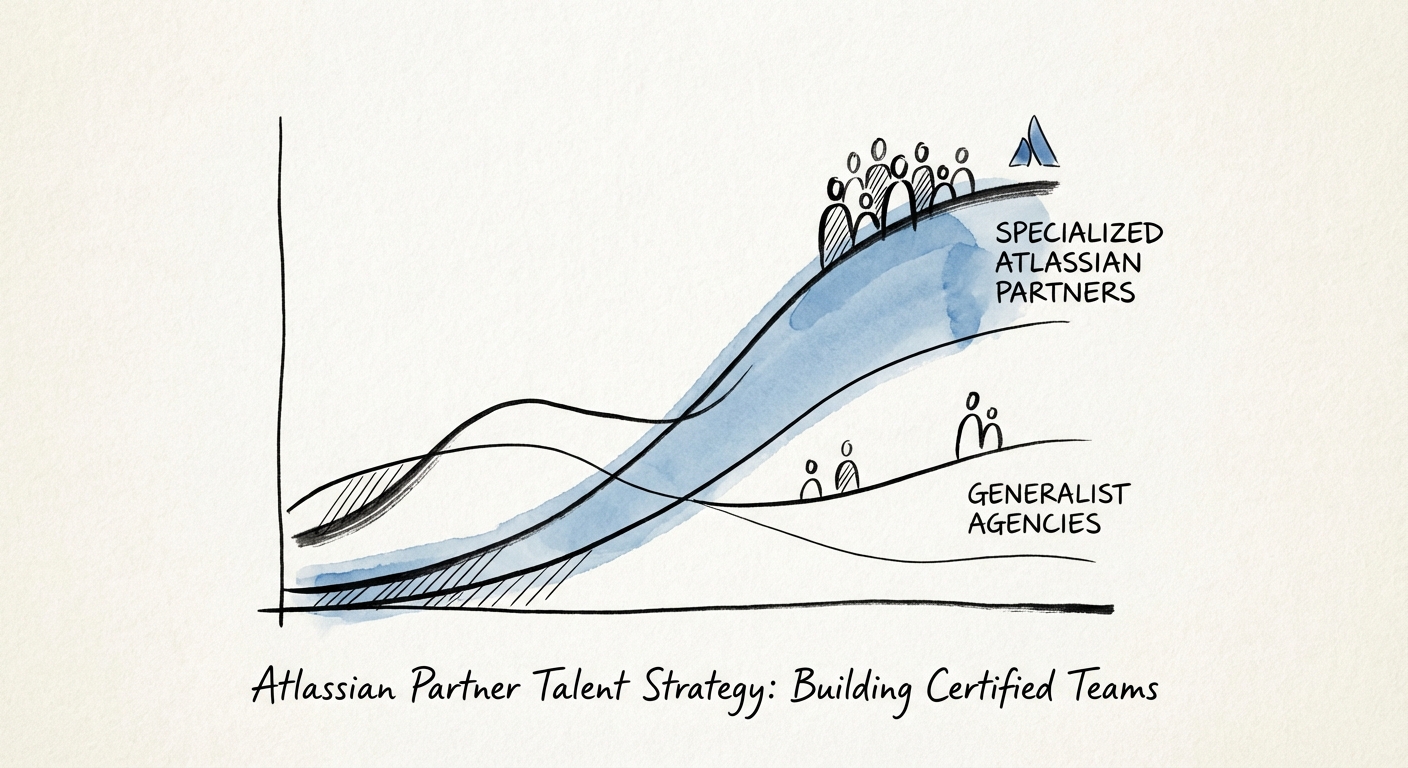
True enterprise value lies in the ACP-120 (Jira Administration for Cloud) and the new Specialist designations (ITSM, Cloud Platform). A practice built on ACP-620s is effectively a staff augmentation firm, trading at 5-6x EBITDA. A practice built on ACP-120s and Cloud Architects—who can navigate the technical debt of a Data Center to Cloud migration—commands 10-12x multiples. Acquirers in 2026 are wise to this distinction; they are no longer counting badges, they are auditing the complexity those badges represent.
We are seeing a proliferation of ACP-620 holders being billed as Solution Architects. A practice built on these 'Paper Tigers' is effectively a staff augmentation firm, trading at 5x EBITDA instead of 12x.
The New 'Business Architect' Requirement
The market has shifted. The era of selling Jira solely to IT engineering teams is closing; the new growth frontier is the "System of Work" spanning HR, Legal, and Finance—a $14B opportunity according to Atlassian's own strategic outlook. This pivot requires a fundamentally different talent profile. You cannot simply retrain a Jira Administrator to speak the language of a CHRO or CFO. You need Business Solution Architects.
Legacy partners are struggling because their talent strategies focus on features (workflows, custom fields, schemes) rather than outcomes (employee onboarding time, legal case resolution velocity). When we audit Atlassian practices, we look for a specific ratio: 1 Business Architect for every 3 Technical Consultants. Most stalling firms operate at 1:10 or worse.
The Contractor Reliance Trap
Recent benchmarks show that while only 45% of full-time employees in the ecosystem are certified, 64% of contractors hold valid certifications. This reliance on a transient workforce creates a 'knowledge leakage' risk that kills valuation. If your intellectual property and certified capability walk out the door every six months, you don't have a practice; you have a temp agency. PE buyers discount this model heavily (often by 30% or more) because the 'asset' they are buying is volatile.
A Diagnostic for Your Talent Roster
To determine if your Atlassian practice is built for scale or stuck in the 'Body Shop' trap, run this 3-step audit on your current bench:
- The Admin/User Ratio: Calculate the ratio of ACP-120 (Cloud Admin) certifications to ACP-620 (Project Manager) certifications. If it's below 1:2, you lack the technical depth for enterprise migrations.
- The 'Paper Tiger' Screen: Implement a practical lab test for all new hires. We've found that 40% of certified candidates fail a basic scenario test (e.g., 'Fix this broken permission scheme' or 'Map this complex workflow'). Stop hiring the badge; start hiring the capability.
- The Business Pivot: Assess your team's ability to deliver non-IT solutions. Do you have a dedicated 'Work Management' lead who understands Jira Work Management and Atlas, or are you forcing Software projects onto marketing teams?
Scaling a premium Atlassian practice requires moving beyond 'ticket closing' capability. It demands a talent strategy that values architectural depth over badge volume. The partners who win in 2026 will be those who can bridge the gap between technical configuration and business strategy.