
The practical answer
- Short answer
- Stop collecting 'paper tigers.' A diagnostic guide for SAP partners on balancing certification costs, consultant bill rates, and margin targets in the S/4HANA era.
- Best fit
- Industry: Professional Services. Function: Operations
- Operating path
- Team & Hiring → Operational Excellence → Transaction Execution Services
- Key metric
- 31% Average attrition rate of SAP consultants within 6 months of achieving a major certification without retention incentives.
The Certification Inflation Trap
You are likely staring at a spreadsheet of SAP certifications right now, trying to hit the new PartnerEdge requirements. By the end of 2025, SAP requires 50% of your relevant partner practitioners to hold valid certifications. For a mid-sized consultancy, that is not just a compliance headache; it is a margin-killing capital expenditure if mishandled.
The problem isn't the cost of the exam. It's the "Certification Cliff." Data shows that within six months of achieving a high-demand S/4HANA or BTP certification, consultant attrition risk spikes to 31% without intervention. You are essentially paying to train your competitors' workforce. Scaling Service Partners often fall into the trap of hiring "Badge Collectors"—consultants with 12 certifications but zero successful go-lives. These "Paper Tigers" pass the PartnerEdge audit but fail the client interview.
Your P&L cannot survive on a strategy of buying seniors. Senior SAP Architects now command $180,000+ base salaries. If your delivery pyramid is top-heavy with these resources doing functional configuration work, your gross margins will never break 45%. The only way to reach the industry gold standard of 55-65% services gross margin is to build a capability engine, not just a hiring queue.
You don't have a recruiting problem. You have a utilization problem disguised as a skills gap. Buying more badges won't fix your gross margin.
The Profitability Pyramid: Ratios That Work
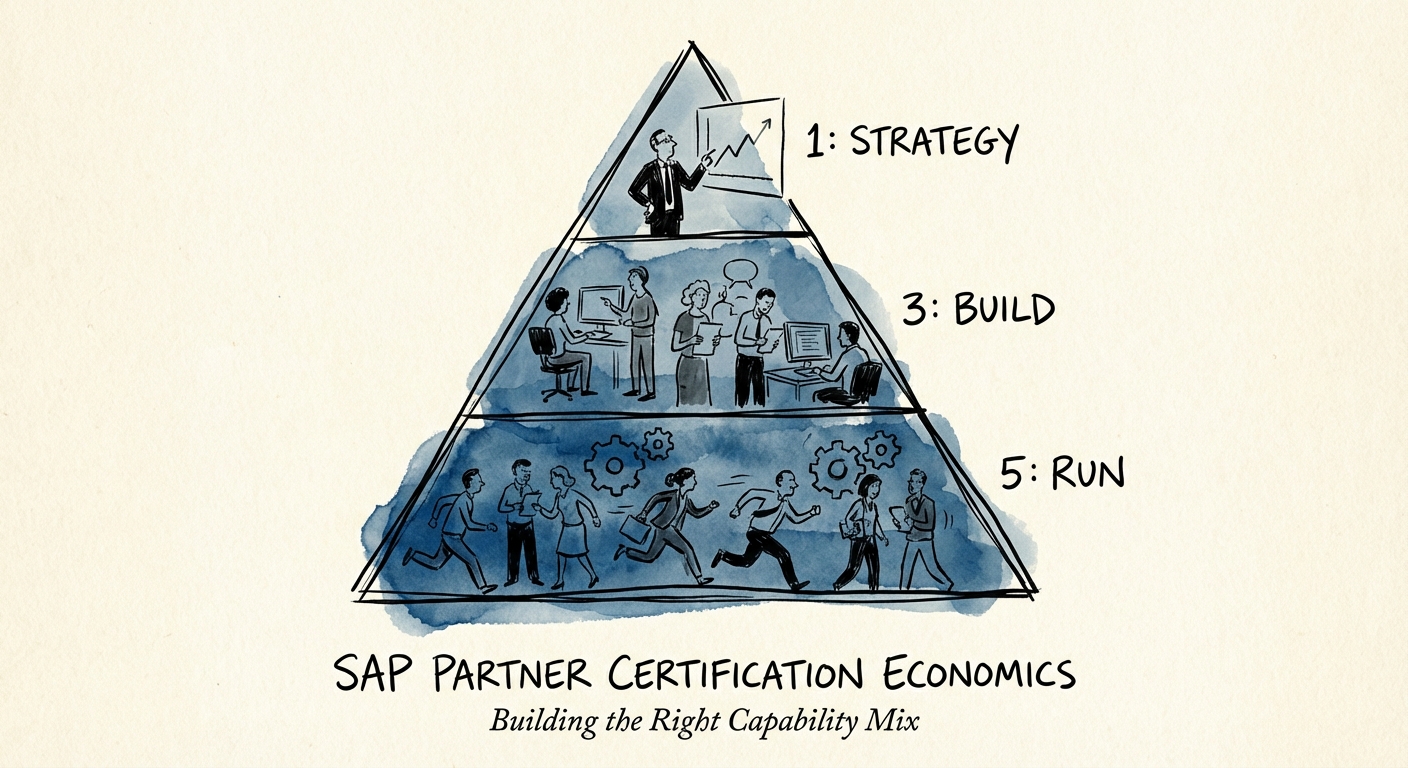
Successful SAP consultancies do not hire for coverage; they hire for leverage. You need to structure your team around a 1:3:5 Ratio to protect your unit economics while meeting the 2027 S/4HANA migration demand.
1. The Architect Layer (The 1)
These are your margin-dilutive but revenue-enabling leaders. They hold the "hard" certs (Enterprise Architect, Financial Accounting in S/4HANA). Their billable utilization should only be 50-60% because they must drive presales and QA. If you bill them at 100%, you burn them out; if you don't bill them at all, they are overhead.
2. The Functional Core (The 3)
These are your mid-level consultants (3-7 years experience). They carry the bulk of the billable load (85%+ utilization). Crucial Diagnostic: Are they certified in the latest release? SAP's shift to annual renewal requirements means a 2023 certification is effectively expired inventory. Unbillable "bench rot" here kills EBITDA faster than any other line item.
3. The Academy Layer (The 5)
This is where your margin is made. You recruit hungry juniors, put them through a 12-week intensive "Academy," and bond them for 24 months. You bill them at $125-$150/hr while paying them junior salaries. This layer must maintain 95% certification compliance because they have the time to study. This is your future margin protection against wage inflation.
The "retention packages" Strategy
If you pay for the certification, you own the capability. Stop treating certifications as a perk; treat them as a capex investment with a required return. Implement a Certification Retention Agreement (CRA) immediately.
The mechanics are simple: The firm covers training and exam costs (approx. $5,000 blended cost including non-billable study time). If the consultant leaves within 12 months, they repay 100%. Within 18 months, 50%. This does two things: it deters the "get certified and quit" mercenaries and signals to your core team that you are investing in their long-term value.
Furthermore, align your variable comp to Active Utilization, not just certification count. A consultant with 5 certs and 40% utilization is a liability. A consultant with 1 cert and 90% utilization is an asset. Your scorecard must reflect this reality. The market for S/4HANA talent is about to tighten significantly as the 2027 maintenance deadline forces laggards to migrate. If you don't lock in your capability mix now, you will be bidding $250/hr for contractors just to keep your projects staffed.