The practical answer
- Short answer
- Stop collecting vanity badges. Learn which Azure certifications actually drive bill rates, how to spot 'paper tigers,' and why specialized partners trade at 13.6x EBITDA.
- Best fit
- Industry: IT Services / MSP. Function: Operations
- Operating path
- Team & Hiring → Operational Excellence → Transaction Execution Services
- Key metric
- 13.6x Median EBITDA multiple for specialized IT consulting firms in 2025, compared to 12.0x for generalists.
The "Generalist" Trap: Why Solutions Partner Status Isn't Enough
In the early days of the Microsoft ecosystem, a Gold competency was a differentiator. By 2026, it is nothing more than the price of admission. The shift to the Microsoft AI Cloud Partner Program (MAICPP) has bifurcated the market into two distinct categories: the commoditized generalists and the specialized experts. For a Founder like you, falling into the former category is a material risk for your margins.
The data is brutal. According to 2025 benchmarks, IT consulting firms with deep, verified specializations are trading at a median of 13.6x EBITDA, while generalist development shops lag at 12.0x. That spread represents millions in enterprise value left on the table. Why? Because Private Equity buyers know that generalists compete on price, while specialists compete on value.
Furthermore, the FY26 program updates have tightened the noose. Incentives are now strictly tied to Solutions Partner designations and, crucially, the Partner Capability Score (PCS). You now need 70 points—or a targeted 25 points in a specific solution area—just to unlock rebates. If your team is composed of "jacks of all trades" who dabble in Azure, M365, and Dynamics without mastering any, you aren't just losing deal value; you're actively disqualifying yourself from Microsoft's incentive pool.
A certification proves you can pass a test. A specialization proves you can deliver an outcome. In the eyes of a PE buyer, the difference is a 2x turn on your EBITDA multiple.
The Revenue Architecture: Which Certifications Actually Bill?
Not all badges are created equal. A "Fundamentals" certification is a participation trophy; it tells your client nothing about your ability to deliver a complex migration. To build a practice that commands premium bill rates—often 25% to 40% higher than the generalist average—you must target the certifications that align with high-demand Advanced Specializations.
The "Money" Certifications for 2026
Stop sending your team to random training days. Focus your L&D budget on these three high-value tracks:
- Azure Solutions Architect Expert (AZ-305): The baseline for high-level consulting. Architects with this designation command salaries of $160,000 to $190,000, but they enable bill rates of $250+/hr because they reduce project risk.
- Azure AI Engineer Associate (AI-102): With the explosion of the "AI Platform on Azure" specialization, this is your gateway to the highest-margin projects in the ecosystem.
- Azure DevOps Engineer Expert (AZ-400): Essential for the "DevOps with GitHub" specialization. This certification proves you can deliver velocity, not just infrastructure.
The goal is to achieve Advanced Specializations like Migrate Enterprise Applications to Microsoft Azure or Analytics on Microsoft Azure. These are the credentials that unlock the "Specialist" valuation premium and get you on the short-list for enterprise deals.
The "Paper Tiger" Defense: Hiring Builders, Not Exam-Crammers
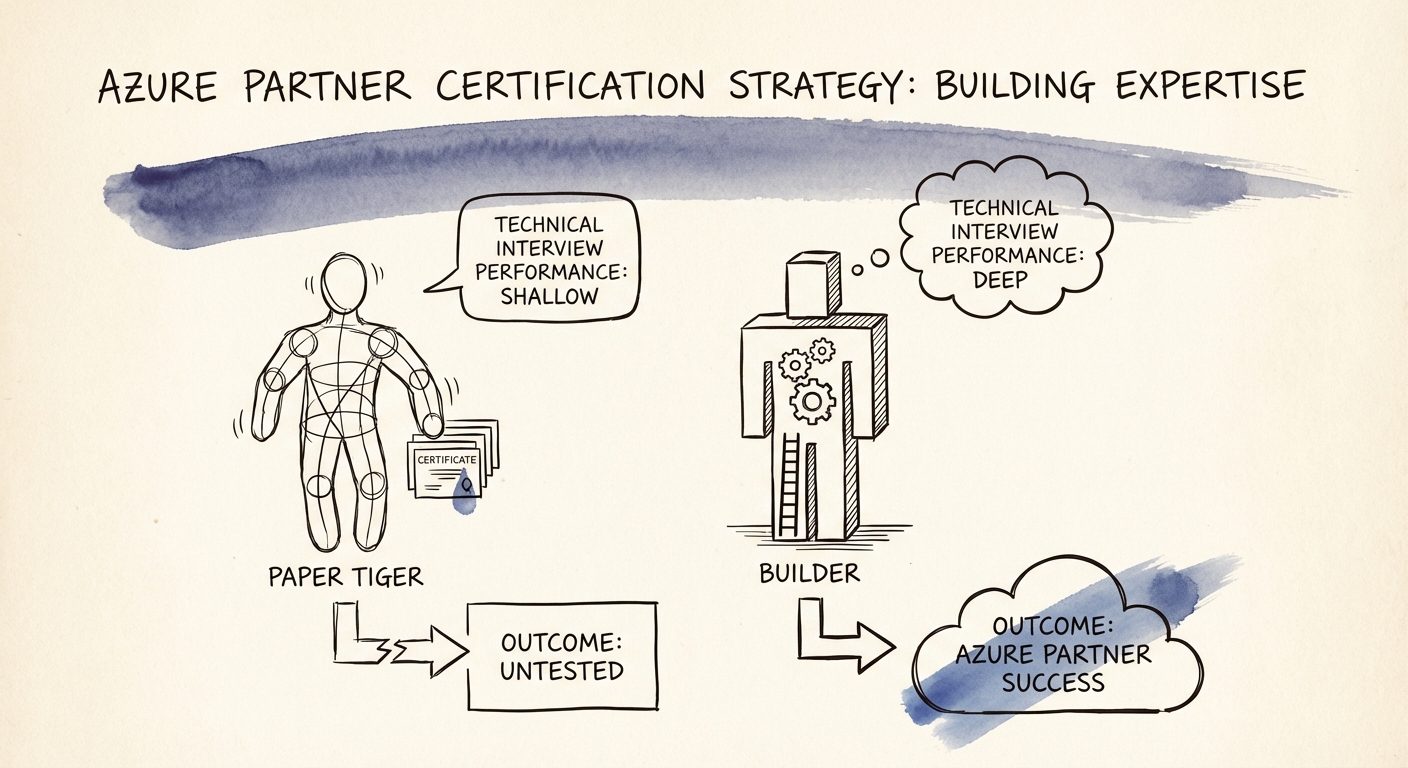
Here is the nightmare scenario for a founder: You hire a "Senior Architect" with six certifications. You pay him $180,000. Three months later, a client fires you because he architected a database migration that took down their production environment for 48 hours. You hired a Paper Tiger—someone who memorized the exam dumps but has never touched a production CLI.
The Diagnostic Interview Framework
To avoid the $240,000 mistake of a bad tech hire, you must change your interview process. Never hire based on the CV alone. Implement a "Lab-Based" technical screen:
- The "Broken Build" Test: Give the candidate a Terraform script that is intentionally broken. Ask them to debug it live. A Paper Tiger will stare at the screen; a builder will open the documentation and fix the syntax.
- The Architecture Whiteboard: Don't ask "What is a Virtual Network?" Ask, "Design a highly available architecture for a fintech app that requires zonal redundancy and strict traffic filtering." Watch how they think, not just what they know.
- The "War Story" Probe: Ask, "Tell me about the last time you broke production." If they say they never have, they are either lying or inexperienced. Real experts have scars.
Your capability building strategy must be disciplined. Incentivize your existing team to get certified, but require a "capstone project"—an internal demo or pilot—before you pay the bonus. This ensures that the knowledge has transferred from the textbook to your delivery capability.