
The practical answer
- Short answer
- The Microsoft Dynamics talent market is broken. Learn why partners are losing their best consultants to end-users and how to avoid the $240k cost of a mis-hire.
- Best fit
- Industry: Technology Services. Function: Operations
- Operating path
- Team & Hiring → Operational Excellence → Transaction Execution Services
- Key metric
- 30% Increase in Microsoft BizApps job flow in Q1 2025 vs 2024
The "End-User Drain" Is Bleeding Partners Dry
If you are running a Microsoft Dynamics partner firm with $10M-$50M in revenue, you are fighting a two-front war you are currently losing. On one front, the Global Systems Integrators (GSIs) are outbidding you for architects by 20-30%. On the other, your own customers—the "End Users"—are poaching your best functional consultants to bring their ERP knowledge in-house. This isn't just attrition; it's a structural shift in the ecosystem.
The data is clear. Job flow for Microsoft Business Applications roles surged 30% in early 2025, driven largely by end-users in manufacturing and healthcare who are tired of paying blended rates for external support. They want "ownership," and they are offering your consultants something you often can't: a life without utilization targets and travel.
For a mid-market partner, the financial impact is catastrophic. We calculate the replacement cost of a Senior Dynamics Finance & Operations (F&O) Consultant not at the standard HR benchmark of 30%, but at 150% to 200% of annual salary. When you factor in recruitment fees (20-25%), the 5.7-month ramp time where they are non-billable or low-margin, and the lost billings from the empty seat, a single senior departure costs your P&L upwards of $240,000. You cannot scale out of that hole with "more sales." You have to fix the bucket.
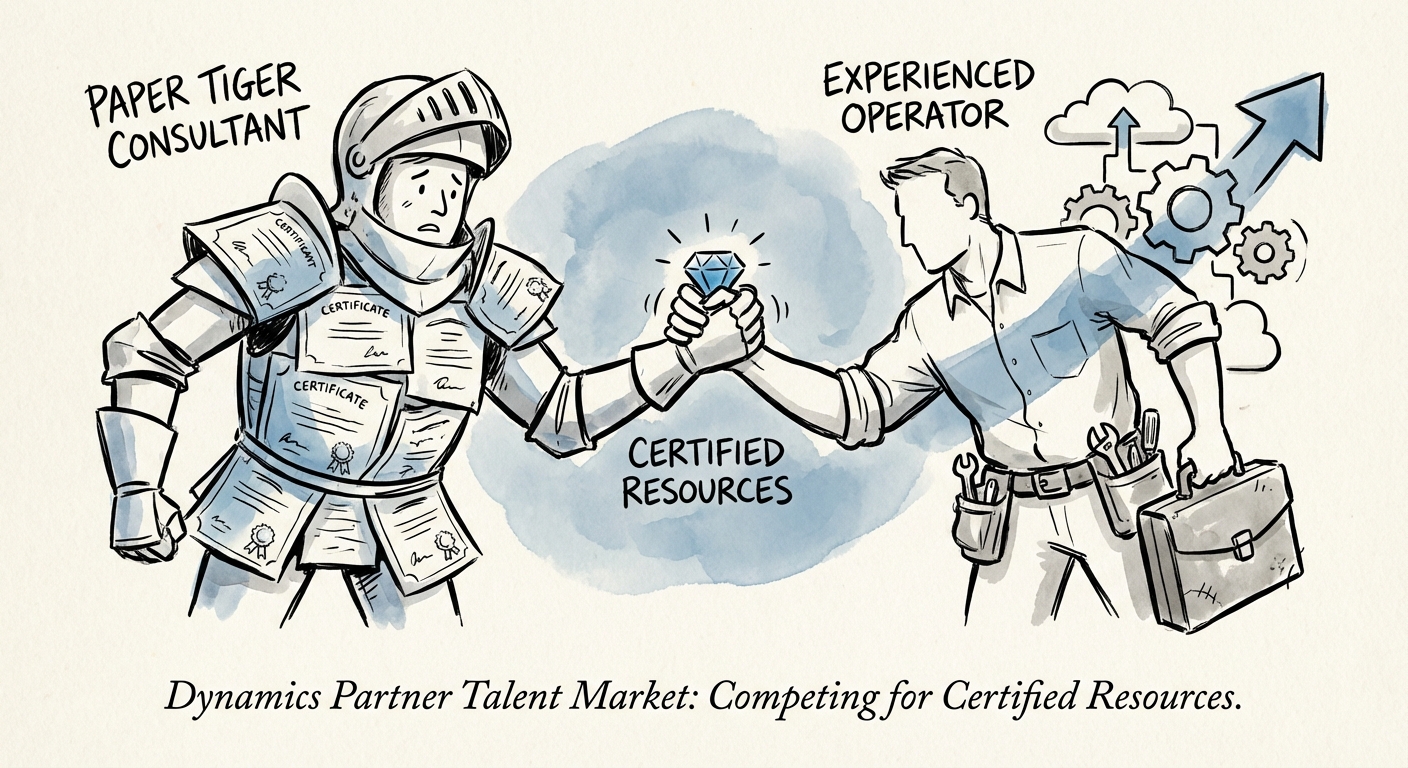
You don't have a recruiting problem; you have a 'Paper Tiger' problem. You are hiring certifications, not outcomes.
The "Paper Tiger" Epidemic: Why Certifications Are a Trap
In your desperation to fill these empty seats, you are likely falling for the "Paper Tiger" trap. Microsoft's certification ecosystem has become a volume game. There are thousands of candidates with a "MB-300" or "MB-800" badge who have never successfully navigated a complex go-live crisis. They have book knowledge, not battle scars.
Our audits of partner talent pools consistently reveal a startling gap: 48% of Dynamics customers cite "lack of appropriate skills" as their primary implementation hurdle, despite their partners claiming to be fully certified. You are hiring candidates who can pass a multiple-choice exam but cannot explain the downstream GL impact of a mismatched inventory posting profile.
Stop trusting the transcript. Your hiring process must pivot from "credential verification" to "capability interrogation." If your interview process doesn't include a live, hands-on lab where the candidate must configure a workflow or troubleshoot a broken master planning run in a sandbox environment, you are gambling with your delivery margins. We see partners paying $160k+ salaries for "Senior" consultants who effectively function as Juniors for their first 12 months. That is a margin killer that no amount of rate increases can cover.
The Retention Defense: Career Pathing vs. "Maintenance Mode"
You cannot win a salary bidding war against a Fortune 500 end-user who sees IT as a cost center. If you try to match their base pay dollar-for-dollar, you will break your unit economics. Instead, you must compete on trajectory.
The "End-User Drain" has a hidden weakness: boredom. A consultant who leaves your firm to manage a single Dynamics instance for a manufacturing plant will eventually hit a wall. They are no longer learning new modules; they are fixing printers and resetting passwords. Their market value stagnates the moment they stop seeing new implementations.
Your retention strategy must use this. Pitch your firm not as a "family" (a phrase that makes high-performers roll their eyes), but as a Tour of Duty. Show them the math: "Three years here increases your market value by 40% because you will touch AI, Copilot, and Power Platform integrations that [End User X] won't adopt for another five years."
The "Stay Interview" Protocol
Don't wait for the resignation letter. Implement quarterly "Stay Interviews" for your top 20% billable resources. Ask specifically: "What skills do you need to add to your resume this year to increase your own market value?" Then, align their project staffing to that goal. If you align their selfish interest (career growth) with your business interest (delivering complex work), you build a moat that a slightly higher salary from a boring end-user cannot cross.