The practical answer
- Short answer
- HubSpot is moving upmarket, but most partners are stuck in 'agency mode.' Here is the diagnostic to building a technical delivery team that drives 25% margins.
- Best fit
- Industry: MarTech / CRM Implementation. Function: Operations & HR
- Operating path
- Team & Hiring → Operational Excellence → Transaction Execution Services
- Key metric
- 32% of HubSpot Partner revenue is now driven by Technical Services vs. Creative (2025)
The 'Agency' Model Is Dead. Welcome to Systems Integration.
For the last decade, the HubSpot ecosystem was a gold rush for creative agencies. If you could write a blog post and set up a workflow, you could charge a retainer. That era ended in 2025.
HubSpot is no longer just a marketing tool; it is a full-stack enterprise CRM competing with Salesforce and Dynamics. Yet, most partners—specifically those in the $10M to $50M revenue band—are still hiring for the HubSpot of 2020. You are hiring 'HubSpot Specialists' when you need Solutions Architects.
The data proves the shift. According to IDC, the HubSpot ecosystem is projected to hit $17.9 billion in 2025, but the revenue mix has fundamentally changed. 32% of partner revenue is now driven by Technical Services (integrations, migrations, data schema design), outpacing Creative Services. If your team is built on 'content marketers who know a little tech,' you are bringing a knife to a gunfight.
I see this in every turnaround I lead. A partner hits $15M in revenue and stalls. Why? because they sold an enterprise migration to a FinTech client, but their delivery team consists of three former marketing managers who passed the HubSpot Academy certification videos over a weekend. The result is a $240,000 mis-hire mistake repeated across the org chart: technical debt, blown timelines, and churn.
If your delivery team consists of content marketers who 'know a little tech,' you are bringing a knife to a gunfight in the enterprise CRM market.
The 'Paper Tiger' Certification Problem
You cannot scale a technical services firm on badges alone. HubSpot’s Academy is brilliant marketing, but it creates a false sense of competency for employers. A candidate with 15 certifications might know what a feature does, but they often have no idea how to architect it for scale.
We call this the Certification Mirage. It’s a concept we see often in the Salesforce ecosystem, where partners accumulate certifications to hit tier requirements (Gold, Platinum, Elite) without adding delivery capability. The Certification Mirage: How to Spot 'Paper Tigers' applies equally here. You are paying a premium for credentials that don't convert to billable hours.
The $50,000 Competence Gap
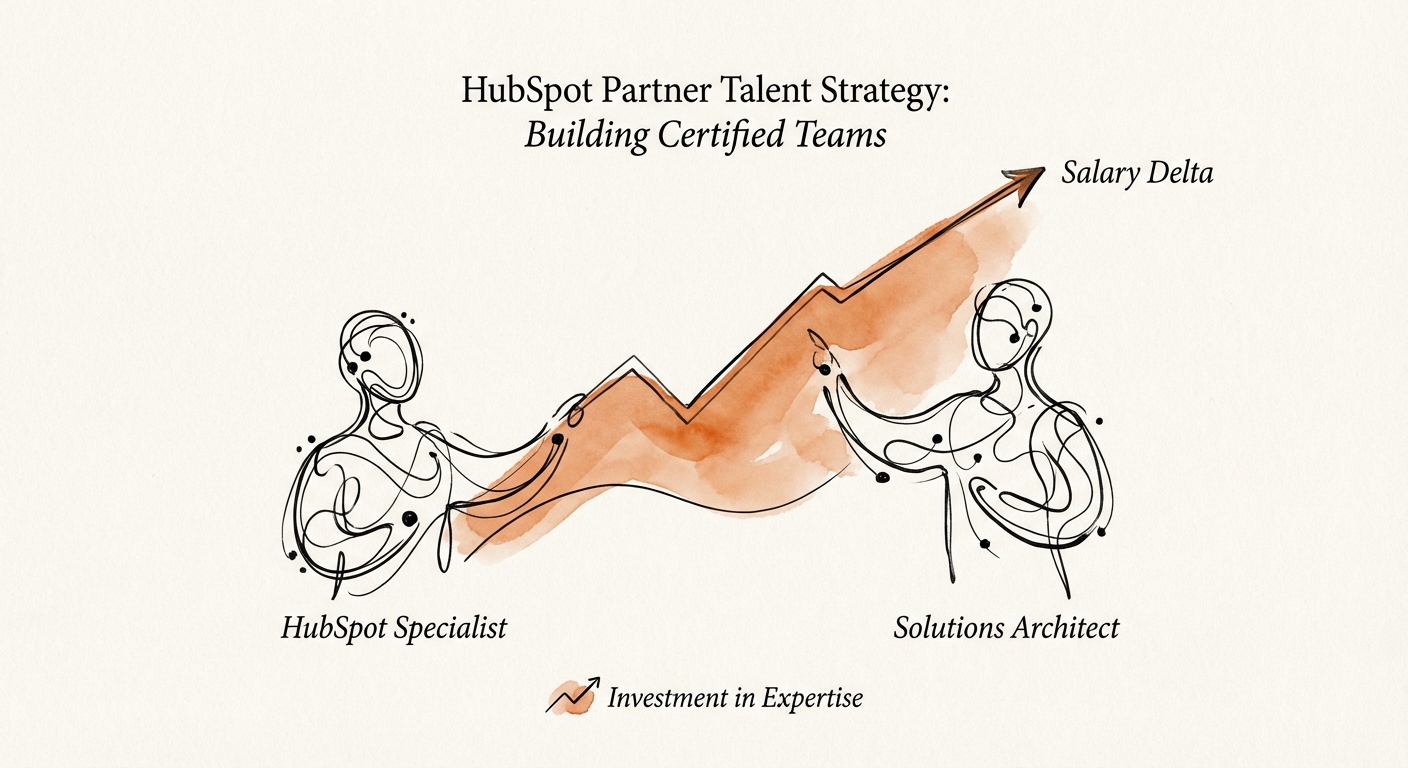
The market has bifurcated your talent pool. In 2025, the median salary for a generic 'HubSpot Specialist' hovers around $73,000. Contrast that with a true 'HubSpot Solutions Architect'—someone who understands API limits, HubL, and custom objects—who commands $125,000+. That $50,000 delta isn't just salary; it's the price of admission for enterprise deals.
If you try to save that $50k by hiring the Specialist to do the Architect's job, you will pay for it in margin erosion. We consistently see 'cheap' delivery teams running at 55% utilization because they spend half their week fixing what they broke the week before. True Architects run at 85%+ billability because they build it right the first time.
Diagnostic: Are You Hiring for Content or Code?
Look at your last three hires. Did you ask them to write a blog post, or did you ask them to diagram an ERD (Entity Relationship Diagram)? If you are selling Ops Hub and Service Hub Enterprise, your interview process must test for data logic, not just platform familiarity.
The Fix: Build a 'Tiered' Technical Bench
Stop trying to find 'unicorns' who can write copy AND code API integrations. They don't exist, and if they do, they are consulting for themselves. To break through the $10M ceiling, you must specialize your roles to protect your Revenue Per Employee.
1. The Architect (The High-Billable Brain)
Hire one senior technical lead for every $2M in ARR. This person does not write emails. They do not manage project schedules. They own the Solution Design Document. They are expensive, but they prevent the scope creep that kills fixed-fee projects.
2. The Consultant (The Client Interface)
These are your 'HubSpot Power Users.' They handle client communication, training, and standard configuration. They are the bridge. Do not let them touch the API.
3. The Implementation Specialist (The Hands)
Junior talent. Certified. They execute the tickets created by the Architect. This is where you build margin. You bill them at $175/hr, pay them $80k, and keep them 90% utilized.
The era of the 'Generalist HubSpotter' is over. If you want to capture the 15% CAGR of the technical consulting market, you need to stop hiring for badges and start hiring for engineering capacity. Your Elite status depends on retention, and retention depends on technical execution, not marketing fluff.