
The practical answer
- Short answer
- Data-backed guide for Salesforce Partners on winning the talent war. Salary benchmarks, attrition costs, and the 'Academy Model' for scaling past $10M revenue.
- Best fit
- Industry: Salesforce Partner Ecosystem. Function: Operations & HR
- Operating path
- Team & Hiring → Operational Excellence → Transaction Execution Services
- Key metric
- 27% Increase in demand for Technical Architects vs. only 4% supply growth (2025).
The Math of the Mercenary: Why You Can't Afford 'Unicorns'
If you are a Salesforce partner founder doing $10M-$50M in revenue, you are likely stuck in a losing battle. You are trying to hire Technical Architects (TAs)—the "unicorns" of the ecosystem—to lead your enterprise projects. The problem? You are fighting a war you cannot win with a budget that is too small.
The 2025 data is brutal. Technical Architects make up just 1% of the global Salesforce talent supply. Yet, demand for this specific role jumped 27% year-over-year, while supply inched up by only 4%. When you compete for this top 1%, you are not just bidding against other boutique partners; you are bidding against Accenture, Deloitte, and Salesforce itself.
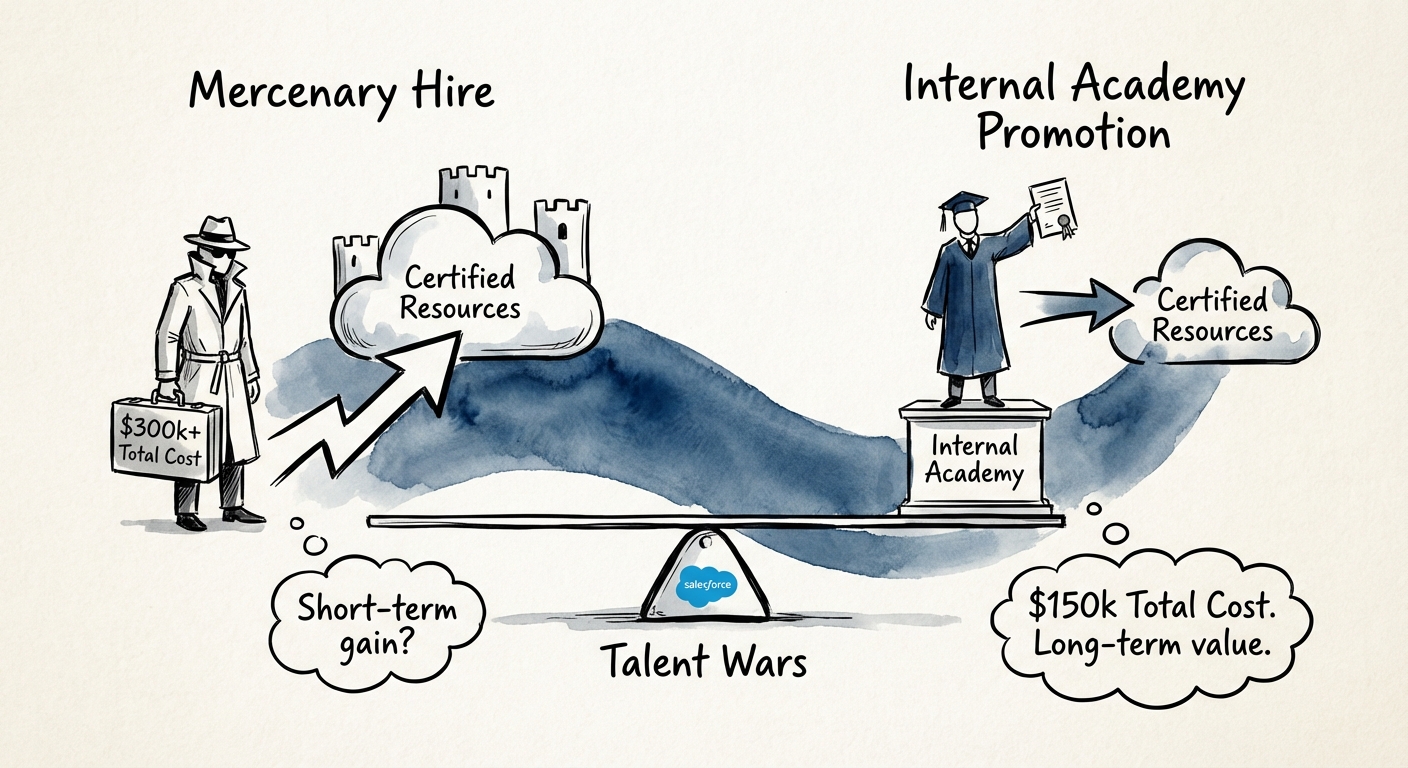
Let's look at the unit economics of a "Mercenary Hire." A senior Technical Architect in the US now commands a base salary between $175,000 and $200,000+ (with CPQ specialists pushing even higher). If you hire one, you aren't just paying that salary; you are paying a "Ransom Premium." Data shows that 72% of Salesforce professionals receive a salary increase when changing jobs, with an average bump of 20%.
But here is the number that should terrify you: The Replacement Cost. When that mercenary leaves 18 months later for another 20% bump, the cost to your business isn't just the recruitment fee. Between lost billable hours, ramp time (avg. 3-6 months), and recruitment fees, replacing a $175k Architect costs approximately $262,500 to $350,000. If you churn two architects a year, you have wiped out the net margin of a $2M project.
You are fighting for the top 1% of talent with a budget that is too small. The partners who win in 2026 won't be the ones paying the highest salaries—they will be the ones building the best academies.
The Certification Mirage: 'Paper Tigers' Are Killing Your Margins
In the absence of affordable senior talent, many founders pivot to the "High-Potential" strategy: hiring based on certifications. This is the Certification Mirage. You see a candidate with 8 certifications—Application Architect, System Architect, 4 Consultant certs—and you assume competence. You hire them at $130k, deploy them on a key account, and watch the project implode.
82% of Salesforce professionals now hold at least one certification. It is no longer a differentiator; it is a baseline. The market is flooded with "Paper Tigers"—professionals who have memorized the exam dumps but have zero "battle scars" from complex deployments. They can pass a multiple-choice test on Sharing Rules, but they cannot look a CIO in the eye and explain why a Master-Detail relationship will break their compliance model.
This disconnect creates a massive Ramp Tax. The average time-to-productivity for a new senior hire is 3 to 6 months. During this period, you are paying full salary for partial output. If you hire a "Paper Tiger," that ramp time extends indefinitely because they are learning how to consult on your dime. You are effectively running a training program that competitors benefit from.
Instead of hunting for certification badges, audit for Business Acumen. The 2025 talent data reveals a shift: while developer demand is down 12%, demand for Business Analysts has rebounded. These are the bridge-builders. It is infinitely cheaper to teach a smart Business Analyst how to configure Flow than it is to teach a "Certified Developer" how to understand a P&L.
The 'Farm Team' Playbook: Build, Don't Buy
The only sustainable way to escape the talent war is to stop fighting it. You must shift from a "Buy" strategy to a "Build" strategy. This isn't about altruism; it's about margin preservation. An internal promotion typically costs 50% less than an external hire. Here is the operational playbook for building a talent engine:
1. The 'Tour of Duty' Offer
Stop offering "jobs." Offer a career acceleration program. Recruit hungry, junior talent (1-2 years experience or strong BAs) at a salary band of $80k-$100k. Be explicit: "We will invest $15k/year in your training and certifications. In exchange, we expect a 24-month 'Tour of Duty.' If you leave before 24 months, you owe a pro-rated portion of the training costs." This scares away mercenaries and attracts builders.
2. Career Pathing Transparency
63% of developers are unsatisfied with their pay process—not just the amount. They leave because they don't know how to get the next raise. Publish a "Leveling Matrix" (e.g., L1 Consultant to L5 Architect). Define exactly what skills, billable utilization, and certifications are required for each jump. When the path is visible, they stop taking recruiter calls.
3. The 'Alumni Network' Mindset
Accept that they will leave. In the Salesforce ecosystem, average tenure is short. Plan for it and turn it into an advantage. Celebrate exits to prestigious clients. If your alum becomes the Salesforce owner at a Fortune 500 company, guess who they're going to call for their first implementation? You. Your "turnover" is actually your future business development channel.
You cannot out-pay the market. But you can out-train and out-culture it. The partners who exit for 10x multiples in 2026 will be the ones who built talent factories, not the ones who overpaid for short-term recruiting.